Section Forensic Paediatrics, Department of Forensic Medicine, Netherlands Forensic Institute, The Hague, The Netherlands.
Eur J Pediatr. 2012 Apr;171(4):617-23. doi: 10.1007/s00431-011-1611-6. Epub 2011 Nov 15.
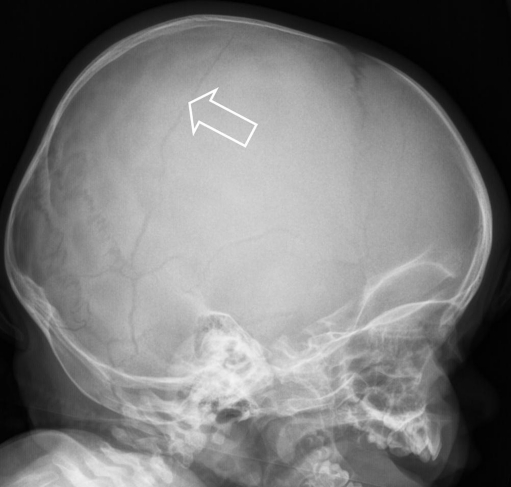
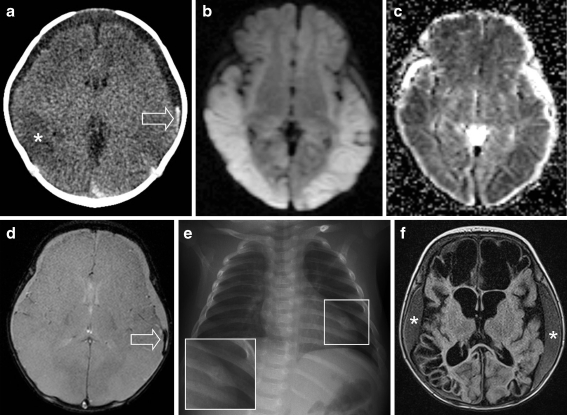
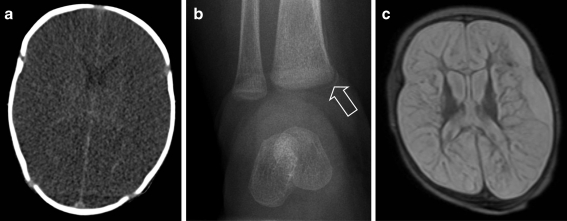
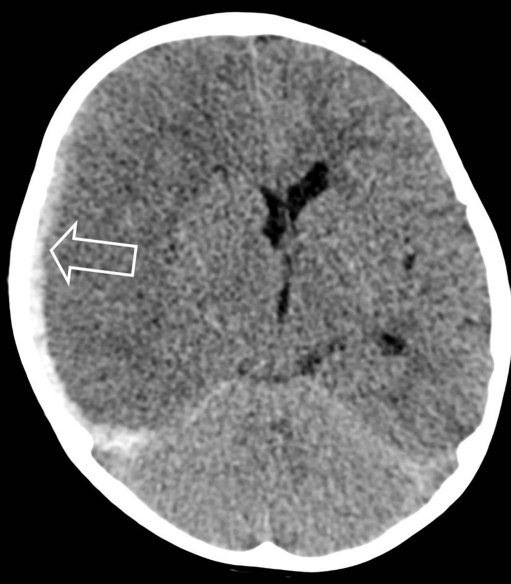
Abusive head trauma (AHT) is a relatively common cause of neurotrauma in young children. Radiology plays an important role in establishing a diagnosis and assessing a prognosis. Computed tomography (CT), followed by magnetic resonance imaging (MRI) including diffusion-weighted imaging (DWI), is the best tool for neuroimaging. There is no evidence-based approach for the follow-up of AHT; both repeat CT and MRI are currently used but literature is not conclusive. A full skeletal survey according to international guidelines should always be performed to obtain information on possible underlying bone diseases or injuries suspicious for child abuse. Cranial ultrasonography is not indicated as a diagnostic modality for the evaluation of AHT. If there is a suspicion of AHT, this should be communicated with the clinicians immediately in order to arrange protective measures as long as AHT is part of the differential diagnosis.
The final diagnosis of AHT can never be based on radiological findings only; this should always be made in a multidisciplinary team assessment where all clinical and psychosocial information is combined and judged by a group of experts in the field.
探讨虐待性头部外伤(AHT)的放射学特征、诊断和治疗策略。
通过对近年来发表的相关文献进行综合分析,对 AHT 的放射学表现、诊断和治疗进行了总结。
AHT 是儿童神经创伤的一个常见原因。放射学在诊断和评估预后方面起着重要作用。CT 后行 MRI(包括弥散加权成像[DWI])是神经影像学的最佳工具。目前尚无 AHT 随访的循证方法;重复 CT 和 MRI 均被用于随访,但文献结论并不一致。根据国际指南,应始终进行全面的骨骼检查,以获取可能存在的潜在骨疾病或疑似虐待性损伤的信息。颅超声不适用于 AHT 的评估。如果怀疑 AHT,应立即与临床医生沟通,以便在 AHT 为鉴别诊断的一部分时安排保护措施。
AHT 的最终诊断绝不能仅基于放射学发现;这应该在多学科团队评估中进行,其中所有临床和社会心理信息都结合在一起,并由该领域的一组专家进行判断。