Money Mary E, Walkowiak Jaroslaw, Virgilio Chris, Talley Nicholas J
Washington County Health Systems, Hagerstown, Maryland, USA.
Frontline Gastroenterol. 2011 Jan;2(1):48-56. doi: 10.1136/fg.2010.002253. Epub 2010 Nov 3.
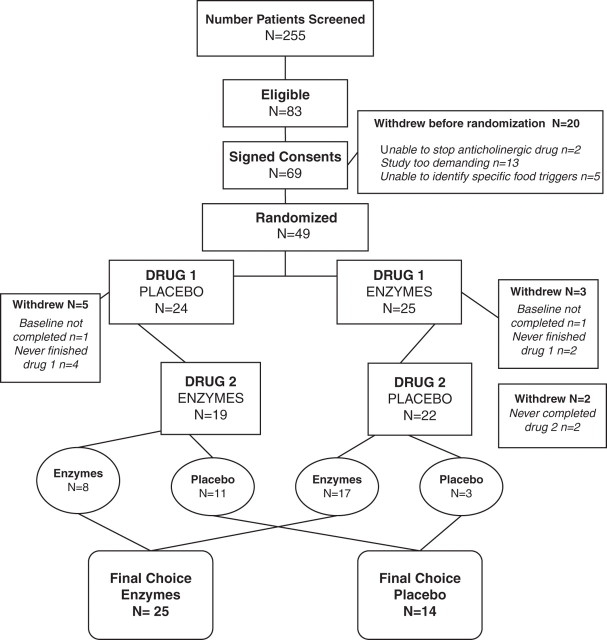
To evaluate the efficacy of pancrealipase (PEZ) compared with placebo in the reduction of postprandial irritable bowel syndrome-diarrhoea (IBS-D). DESIGN: An intention to treat, double blind, randomised, crossover trial comparing PEZ to placebo for reduction of postprandial IBS-D. Patients had to recognise at least two different triggering foods, be willing to consume six baseline 'trigger meals' and again blinded with PEZ and placebo. Patients then chose which drug they preferred for another 25 meals. SETTING: Outpatient internal medicine practice clinic. PATIENTS: 255 patients were screened; 83 met the criteria, including 5 years of symptoms, recognised 'food triggers', no other identifiable cause for the symptoms, either a normal colonoscopy or barium enema while symptomatic and able to discontinue all anticholinergic medications. 69 patients were enrolled, 20 withdrew before randomisation, leaving 49 patients: 14 men, 35 women, mean age 52 years (SD 15.3). Over 60% had experienced symptoms for 11-30 years and 16% for more than 40 years. INTERVENTIONS: After completing six baseline meals, patients were randomised in blocks of four to receive either identical PEZ or a placebo for another six meals, and after a washout period of time received the alternative drug. MAIN OUTCOME MEASURES: The primary analysis was number of patients who chose PEZ over placebo for the extended use. RESULTS: Overall, 30/49 (61%) would have chosen PEZ (p=0.078), with first drug preference for PEZ at 0.002. Among the PEZ subgroup, PEZ use compared with placebo, demonstrated improvement in all symptoms (p≤0.001) for cramping, bloating, borborygami, urge to defecate, global pain and decrease stooling with increase in stool firmness. CONCLUSIONS: PEZ was found in a small group of patients to reduce postprandial IBS-D symptoms and deserves further evaluation.
评估胰脂肪酶(PEZ)与安慰剂相比,在减轻餐后肠易激综合征腹泻型(IBS-D)方面的疗效。
一项意向性治疗、双盲、随机、交叉试验,比较PEZ与安慰剂对餐后IBS-D的减轻效果。患者必须识别至少两种不同的触发食物,愿意食用六顿基线“触发餐”,并再次对PEZ和安慰剂进行盲法处理。然后患者选择他们更喜欢的药物用于另外25餐。
门诊内科诊所。
筛选了255名患者;83名符合标准,包括有5年症状、识别出“食物触发因素”、症状无其他可识别原因、症状发作时结肠镜检查或钡剂灌肠正常且能够停用所有抗胆碱能药物。69名患者入组,20名在随机分组前退出,剩余49名患者:14名男性,35名女性,平均年龄52岁(标准差15.3)。超过60%的患者有11至30年的症状,16%的患者症状超过40年。
完成六顿基线餐后,患者按每组四人进行随机分组,接受相同的PEZ或安慰剂用于另外六餐,经过洗脱期后接受另一种药物。
主要分析是在延长使用中选择PEZ而非安慰剂的患者数量。
总体而言,49名患者中有30名(61%)会选择PEZ(p = 0.078),首次用药时对PEZ的偏好为0.002。在PEZ亚组中,与安慰剂相比,使用PEZ显示出所有症状(p≤0.001)的改善,包括绞痛、腹胀、肠鸣音、排便冲动、总体疼痛,以及随着大便硬度增加排便次数减少。
在一小部分患者中发现PEZ可减轻餐后IBS-D症状,值得进一步评估。