Department of Cell Biochemistry, University of Groningen, Groningen, The Netherlands.
PLoS One. 2011;6(11):e27532. doi: 10.1371/journal.pone.0027532. Epub 2011 Nov 9.
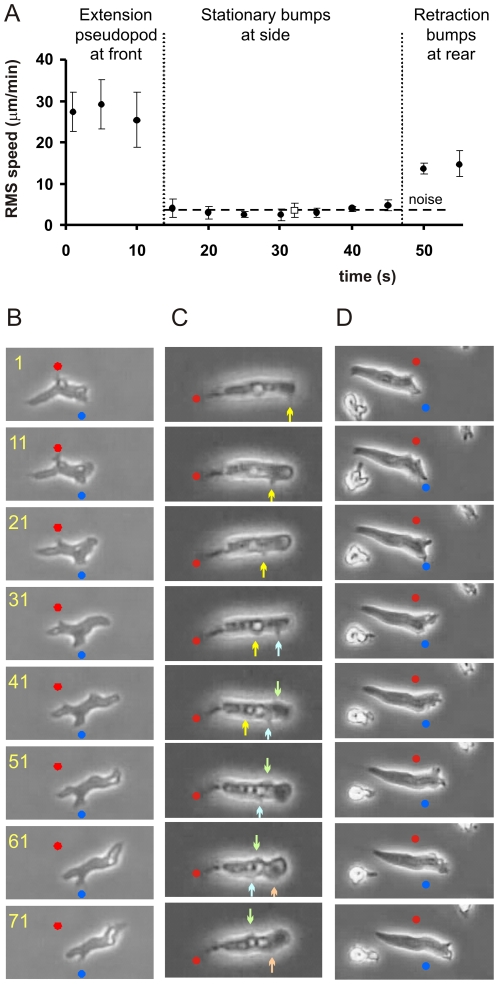
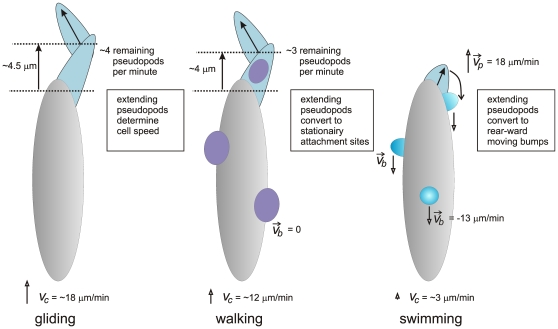
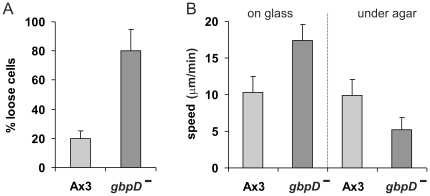
Amoeboid cells crawl using pseudopods, which are convex extensions of the cell surface. In many laboratory experiments, cells move on a smooth substrate, but in the wild cells may experience obstacles of other cells or dead material, or may even move in liquid. To understand how cells cope with heterogeneous environments we have investigated the pseudopod life cycle of wild type and mutant cells moving on a substrate and when suspended in liquid. We show that the same pseudopod cycle can provide three types of movement that we address as walking, gliding and swimming. In walking, the extending pseudopod will adhere firmly to the substrate, which allows cells to generate forces to bypass obstacles. Mutant cells with compromised adhesion can move much faster than wild type cells on a smooth substrate (gliding), but cannot move effectively against obstacles that provide resistance. In a liquid, when swimming, the extending pseudopods convert to side-bumps that move rapidly to the rear of the cells. Calculations suggest that these bumps provide sufficient drag force to mediate the observed forward swimming of the cell.
变形细胞使用伪足进行爬行,伪足是细胞表面的凸起延伸。在许多实验室实验中,细胞在光滑的基质上移动,但在自然界中,细胞可能会遇到其他细胞或死物质的障碍物,或者甚至在液体中移动。为了了解细胞如何应对异质环境,我们研究了在基质上移动和悬浮在液体中的野生型和突变型细胞的伪足生命周期。我们表明,相同的伪足循环可以提供三种运动方式,我们分别称之为行走、滑行和游泳。在行走中,延伸的伪足将牢固地附着在基质上,这使细胞能够产生力来绕过障碍物。黏附能力受损的突变细胞在光滑的基质上比野生型细胞移动得快得多(滑行),但不能有效地移动提供阻力的障碍物。在液体中,当游泳时,延伸的伪足转化为快速移动到细胞后部的侧突。计算表明,这些侧突提供了足够的阻力来介导细胞的观察到的向前游动。