University of Florida, Gainesville, Florida 32610-0009, USA.
Emerg Infect Dis. 2011 Nov;17(11):2099-104. doi: 10.3201/eid1711.111109.
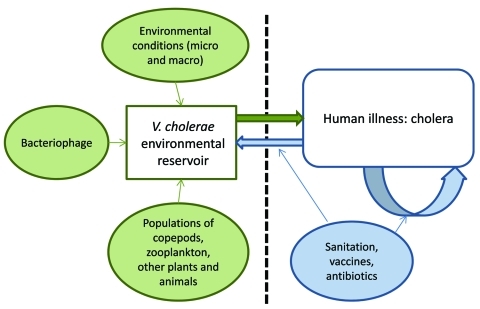
Cholera has affected humans for at least a millennium and persists as a major cause of illness and death worldwide, with recent epidemics in Zimbabwe (2008-2009) and Haiti (2010). Clinically, evidence exists of increasing severity of disease linked with emergence of atypical Vibrio cholerae organisms that have incorporated genetic material from classical biotype strains into an El Tor biotype background. A key element in transmission may be a recently recognized hyperinfectious phase, which persists for hours after passage in diarrheal feces. We propose a model of transmission in which environmental triggers (such as temperature) lead to increases in V. cholerae in environmental reservoirs, with spillover into human populations. However, once the microorganism is introduced into a human population, transmission occurs primary by "fast" transmission from person to person (taking advantage of the hyperinfectious state), without returning to the aquatic environment.
霍乱至少影响人类一千年,并且仍然是全球范围内导致疾病和死亡的主要原因,最近在津巴布韦(2008-2009 年)和海地(2010 年)爆发了霍乱疫情。临床上,有证据表明,与出现的非典型霍乱弧菌生物体相关的疾病严重程度不断增加,这些生物体将经典生物型菌株的遗传物质整合到 El Tor 生物型背景中。传播的一个关键因素可能是最近发现的超感染阶段,在腹泻粪便中排出后持续数小时。我们提出了一种传播模型,其中环境触发因素(如温度)导致环境储层中霍乱弧菌的增加,并溢出到人群中。然而,一旦微生物被引入人群,传播主要通过人与人之间的“快速”传播发生(利用超感染状态),而不会返回到水生环境。