Center for Environmental Health Sciences, Department of Basic Sciences, College of Veterinary Medicine, Mississippi State University, Mississippi State, MS 39762, USA.
Toxicol Appl Pharmacol. 2012 Jan 1;258(1):145-50. doi: 10.1016/j.taap.2011.10.017. Epub 2011 Nov 4.
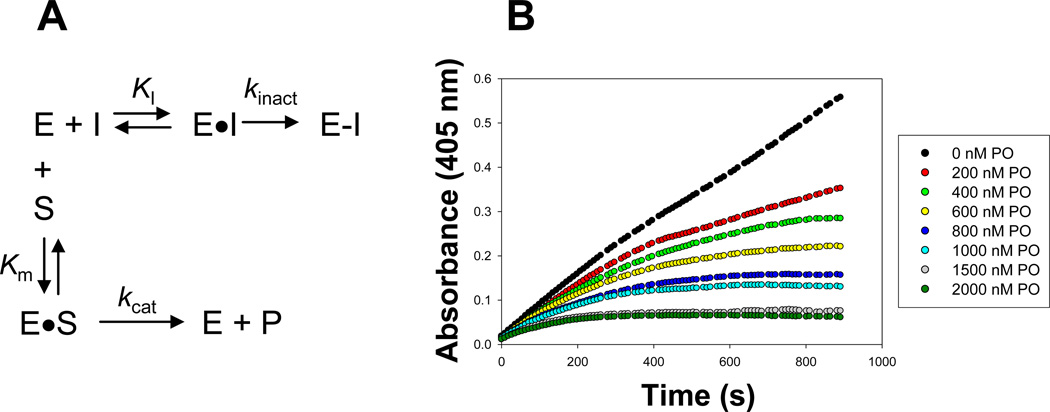
Oxons are the bioactivated metabolites of organophosphorus insecticides formed via cytochrome P450 monooxygenase-catalyzed desulfuration of the parent compound. Oxons react covalently with the active site serine residue of serine hydrolases, thereby inactivating the enzyme. A number of serine hydrolases other than acetylcholinesterase, the canonical target of oxons, have been reported to react with and be inhibited by oxons. These off-target serine hydrolases include carboxylesterase 1 (CES1), CES2, and monoacylglycerol lipase. Carboxylesterases (CES, EC 3.1.1.1) metabolize a number of xenobiotic and endobiotic compounds containing ester, amide, and thioester bonds and are important in the metabolism of many pharmaceuticals. Monoglyceride lipase (MGL, EC 3.1.1.23) hydrolyzes monoglycerides including the endocannabinoid, 2-arachidonoylglycerol (2-AG). The physiological consequences and toxicity related to the inhibition of off-target serine hydrolases by oxons due to chronic, low level environmental exposures are poorly understood. Here, we determined the potency of inhibition (IC(50) values; 15 min preincubation, enzyme and inhibitor) of recombinant CES1, CES2, and MGL by chlorpyrifos oxon, paraoxon and methyl paraoxon. The order of potency for these three oxons with CES1, CES2, and MGL was chlorpyrifos oxon>paraoxon>methyl paraoxon, although the difference in potency for chlorpyrifos oxon with CES1 and CES2 did not reach statistical significance. We also determined the bimolecular rate constants (k(inact)/K(I)) for the covalent reaction of chlorpyrifos oxon, paraoxon and methyl paraoxon with CES1 and CES2. Consistent with the results for the IC(50) values, the order of reactivity for each of the three oxons with CES1 and CES2 was chlorpyrifos oxon>paraoxon>methyl paraoxon. The bimolecular rate constant for the reaction of chlorpyrifos oxon with MGL was also determined and was less than the values determined for chlorpyrifos oxon with CES1 and CES2 respectively. Together, the results define the kinetics of inhibition of three important hydrolytic enzymes by activated metabolites of widely used agrochemicals.
氧磷是通过细胞色素 P450 单加氧酶催化的母体化合物脱硫形成的有机磷杀虫剂的生物激活代谢物。氧磷与丝氨酸水解酶的活性位点丝氨酸残基共价反应,从而使酶失活。除了氧磷的典型靶标乙酰胆碱酯酶外,许多其他丝氨酸水解酶也已被报道与氧磷反应并被其抑制。这些非靶标丝氨酸水解酶包括羧酸酯酶 1(CES1)、CES2 和单酰基甘油脂肪酶。羧酸酯酶(CES,EC 3.1.1.1)代谢许多含有酯、酰胺和硫酯键的外源性和内源性化合物,在许多药物的代谢中非常重要。单甘油酯脂肪酶(MGL,EC 3.1.1.23)水解单甘油酯,包括内源性大麻素,2-花生四烯酸甘油(2-AG)。由于慢性、低水平的环境暴露,氧磷对非靶标丝氨酸水解酶的抑制所导致的生理后果和毒性尚不清楚。在这里,我们确定了氯氧磷氧磷、对氧磷和甲基对氧磷对重组 CES1、CES2 和 MGL 的抑制效力(IC50 值;15 分钟预孵育,酶和抑制剂)。这三种氧磷对 CES1、CES2 和 MGL 的效力顺序为氯氧磷氧磷>对氧磷>甲基对氧磷,尽管氯氧磷氧磷对 CES1 和 CES2 的效力差异没有达到统计学意义。我们还确定了氯氧磷氧磷、对氧磷和甲基对氧磷与 CES1 和 CES2 的共价反应的双分子速率常数(k(inact)/K(I))。与 IC50 值的结果一致,三种氧磷与 CES1 和 CES2 的反应活性顺序均为氯氧磷氧磷>对氧磷>甲基对氧磷。氯氧磷氧磷与 MGL 的反应双分子速率常数也已确定,且小于分别与 CES1 和 CES2 反应的氯氧磷氧磷的速率常数。总之,这些结果定义了广泛使用的农用化学品的激活代谢物对三种重要水解酶的抑制动力学。