Department of Pharmacology & Chemical Biology, University of Pittsburgh School of Medicine, Pittsburgh, PA 15261, USA.
Mech Ageing Dev. 2011 Nov-Dec;132(11-12):533-42. doi: 10.1016/j.mad.2011.11.001. Epub 2011 Nov 12.
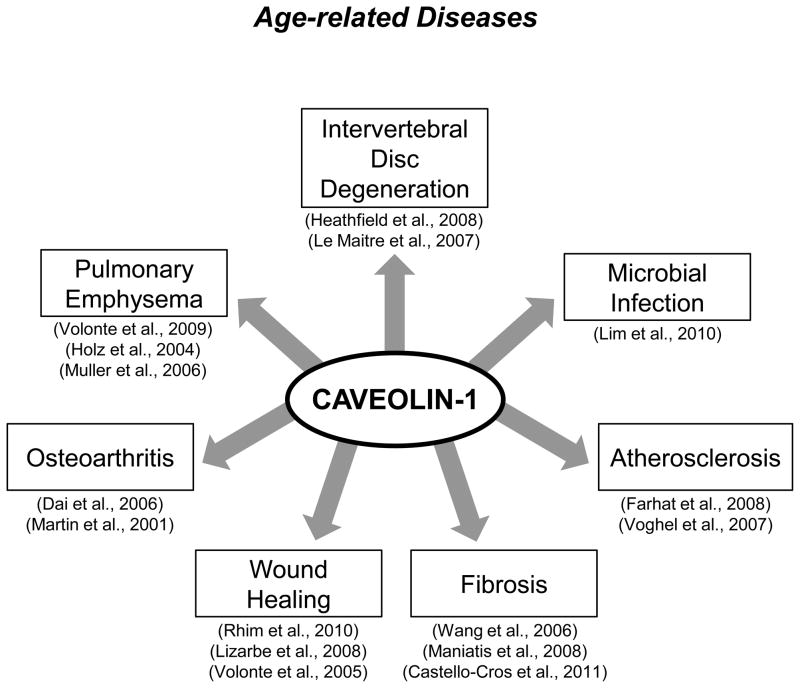
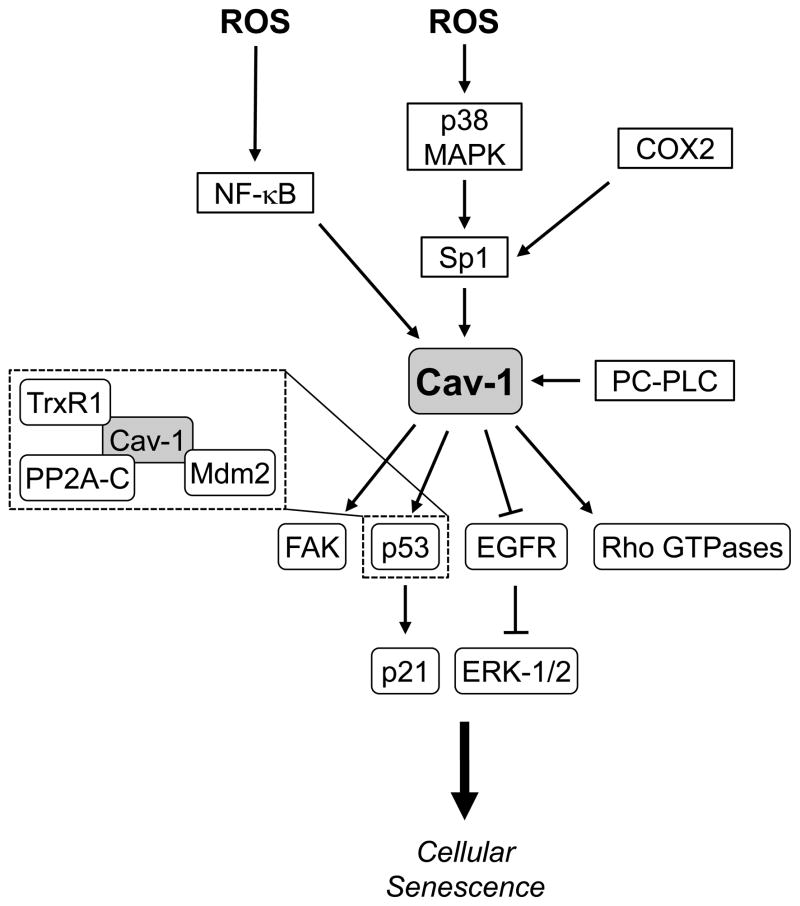
According to the "free radical theory" of aging, normal aging occurs as the result of tissue damages inflicted by reactive oxygen species (ROS) when ROS production exceeds the antioxidant capacity of the cell. ROS induce cellular dysfunctions such as stress-induced premature senescence (SIPS), which is believed to contribute to normal organismal aging and play a role in age-related diseases. Consistent with this hypothesis, increased oxidative damage of DNA, proteins, and lipids have been reported in aged animals and senescent cells accumulate in vivo with advancing age. Caveolin-1 acts as a scaffolding protein that concentrates and functionally regulates signaling molecules. Recently, great progress has been made toward understanding of the role of caveolin-1 in stress-induced premature senescence. Data show that caveolin-mediated signaling may contribute to explain, at the molecular level, how oxidative stress promotes the deleterious effects of cellular senescence such as aging and age-related diseases. In this review, we discuss the cellular mechanisms and functions of caveolin-1 in the context of SIPS and their relevance to the biology of aging.
根据衰老的“自由基理论”,当活性氧(ROS)的产生超过细胞的抗氧化能力时,ROS 会对组织造成损伤,导致正常衰老。ROS 诱导细胞功能障碍,如应激诱导的早衰(SIPS),这被认为是导致正常机体衰老的原因,并在与年龄相关的疾病中发挥作用。与这一假说一致,在衰老动物和衰老细胞中都报道了 DNA、蛋白质和脂质的氧化损伤增加,随着年龄的增长,体内衰老细胞的积累。窖蛋白-1 作为一种支架蛋白,可浓缩和功能性调节信号分子。最近,人们在理解窖蛋白-1 在应激诱导的早衰中的作用方面取得了重大进展。数据表明,窖蛋白介导的信号可能有助于从分子水平上解释氧化应激如何促进细胞衰老的有害影响,如衰老和与年龄相关的疾病。在这篇综述中,我们讨论了窖蛋白-1 在 SIPS 中的细胞机制和功能及其与衰老生物学的相关性。