Centre for Child and Adolescent Mental Health, RBUP Eastern and Southern Norway, Oslo, Norway.
Behav Genet. 2012 May;42(3):366-77. doi: 10.1007/s10519-011-9519-5. Epub 2011 Nov 19.
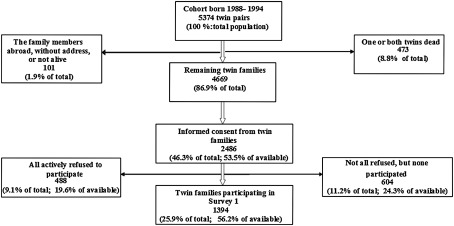
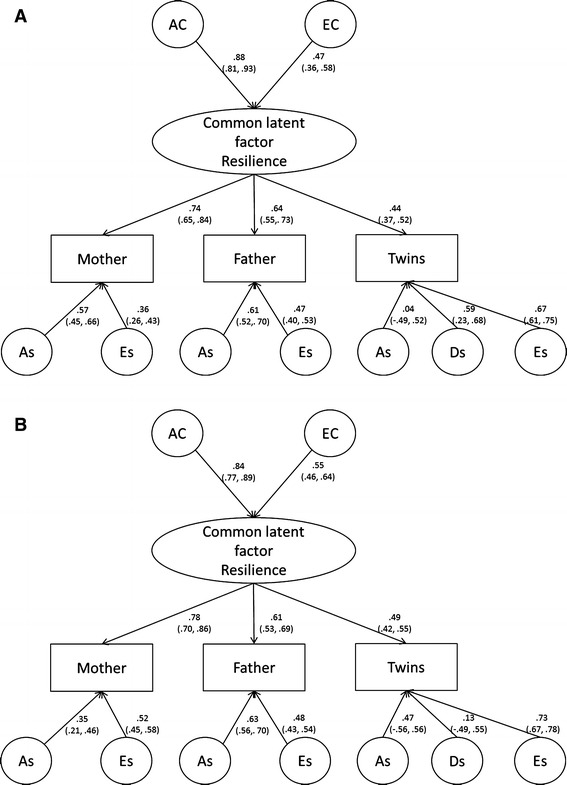
The aim of this multi-informant twin study was to determine the relative role of genetic and environmental factors in explaining variation in trait resilience in adolescents. Participants were consenting families (N = 2,638 twins in 1,394 families), from seven national cohorts (age 12-18 years, both sexes) of monozygotic and dizygotic twins reared together. Questionnaire data on the adolescents' Ego-resilience (ER89) was collected from mothers, fathers and twins, and analysed by means of multivariate genetic modelling. Variance in trait resilience was best represented in an ADE common pathways model with sex limitation. Variance in the latent psychometric resilience factor was largely explained by additive genetic factors (77% in boys, 70% in girls), with the remaining variance (23 and 30%) attributable to non-shared environmental factors. Additive genetic sources explained more than 50% of the informant specific variation in mothers and fathers scores. In twins, additive and non-additive genetic factors together explained 40% and non-shared environmental factor the remaining 60% of variation. In the mothers' scores, the additive genetic effect was larger for boys than for girls. The non-additive genetic factor found in the twins' self ratings was larger in boys than in girls. The remaining sex differences in the specific factors were small. Trait resilience is largely genetically determined. Estimates based on several informants rather than single informants approaches are recommended.
本多信息源双胞胎研究旨在确定遗传和环境因素在解释青少年特质弹性变异性方面的相对作用。参与者是来自七个国家队列(年龄 12-18 岁,男女)的同意家庭(2638 对双胞胎,1394 个家庭),这些双胞胎是同卵和异卵双胞胎,共同抚养。从母亲、父亲和双胞胎那里收集了青少年的自我弹性(ER89)问卷数据,并通过多变量遗传建模进行了分析。特质弹性的方差最好用具有性别限制的 ADE 共同途径模型来表示。潜在心理弹性因子的方差主要由加性遗传因素解释(男孩为 77%,女孩为 70%),其余方差(23%和 30%)归因于非共享环境因素。加性遗传源解释了母亲和父亲分数中超过 50%的特定信息变异。在双胞胎中,加性和非加性遗传因素共同解释了 40%的变异,非共享环境因素解释了剩余的 60%的变异。在母亲的分数中,加性遗传效应在男孩中大于女孩。在双胞胎的自我评估中发现的非加性遗传因素在男孩中大于女孩。特定因素中的剩余性别差异较小。特质弹性在很大程度上是由遗传决定的。建议使用多个信息源而不是单一信息源的方法进行估计。