Fenner School of Environment and Society, Australian National University, Canberra, ACT 0200 Australia.
Environ Sci Technol. 2012 Jan 3;46(1):132-9. doi: 10.1021/es202329f. Epub 2011 Dec 6.
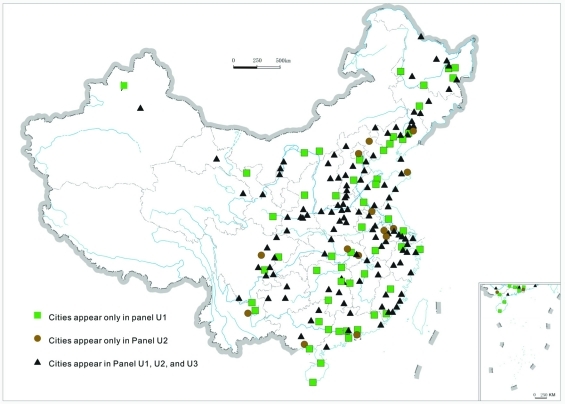
Accelerating urbanization has been viewed as an important instrument for economic development and reducing regional income disparity in some developing countries, including China. Recent studies (Bloom et al. 2008) indicate that demographic urbanization level has no causal effect on economic growth. However, due to the varying and changing definition of urban population, the use of demographic indicators as a sole representing indicator for urbanization might be misleading. Here, we re-examine the causal relationship between urbanization and economic growth in Chinese cities and provinces in recent decades, using built-up areas as a landscape urbanization indicator. Our analysis shows that (1) larger cities, both in terms of population size and built-up area, and richer cities tend to gain more income, have larger built-up area expansion, and attract more population, than poorer cities or smaller cities; and (2) that there is a long-term bidirectional causality between urban built-up area expansion and GDP per capita at both city and provincial level, and a short-term bidirectional causality at provincial level, revealing a positive feedback between landscape urbanization and urban and regional economic growth in China. Our results suggest that urbanization, if measured by a landscape indicator, does have causal effect on economic growth in China, both within the city and with spillover effect to the region, and that urban land expansion is not only the consequences of economic growth in cities, but also drivers of such growth. The results also suggest that under its current economic growth model, it might be difficult for China to control urban expansion without sacrificing economic growth, and China's policy to stop the loss of agricultural land, for food security, might be challenged by its policy to promote economic growth through urbanization.
加速城市化被视为一些发展中国家(包括中国)经济发展和缩小地区收入差距的重要手段。最近的研究(Bloom 等人,2008 年)表明,人口城市化水平对经济增长没有因果关系。然而,由于城市人口的定义不同且不断变化,因此将人口统计指标用作城市化的唯一代表性指标可能会产生误导。在这里,我们使用建成区作为景观城市化指标,重新检验了近几十年来中国城市和省份城市化与经济增长之间的因果关系。我们的分析表明:(1)在人口规模和建成区面积方面较大的城市,以及较富裕的城市,往往比较贫穷或较小的城市获得更多的收入、拥有更大的建成区扩张和吸引更多的人口;(2)城市建成区扩张和人均 GDP 之间在城市和省级层面存在长期的双向因果关系,在省级层面存在短期的双向因果关系,这表明景观城市化与中国城市和区域经济增长之间存在正反馈。我们的研究结果表明,如果以景观指标衡量,城市化对中国的经济增长具有因果关系,不仅在城市内部,而且对区域也有溢出效应,城市土地扩张不仅是城市经济增长的结果,也是推动经济增长的因素。研究结果还表明,在当前的经济增长模式下,中国可能难以在不牺牲经济增长的情况下控制城市扩张,其为了通过城市化推动经济增长而制定的政策可能会对为了粮食安全而停止农业用地流失的政策构成挑战。