Centre for Mental Health Research, The Australian National University, Canberra, Australia.
BMC Med Res Methodol. 2011 Nov 22;11:154. doi: 10.1186/1471-2288-11-154.
Screening instruments for mental disorders need to be short, engaging, and valid. Current screening instruments are usually questionnaire-based and may be opaque to the user. A prototype approach where individuals identify with a description of an individual with typical symptoms of depression, anxiety, social phobia or panic may be a shorter, faster and more acceptable method for screening. The aim of the study was to evaluate the accuracy of four new prototype screeners for predicting depression and anxiety disorders and to compare their performance with existing scales.
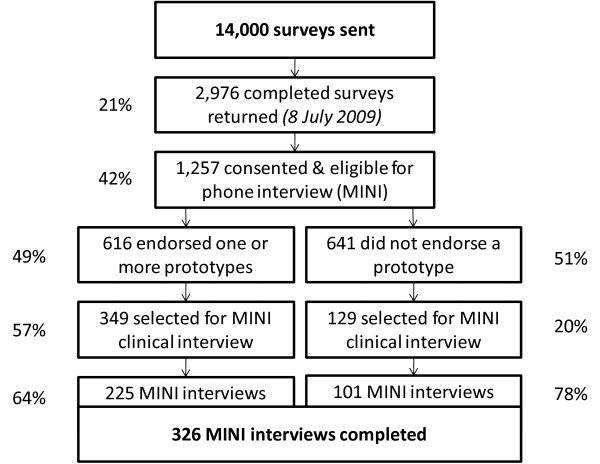
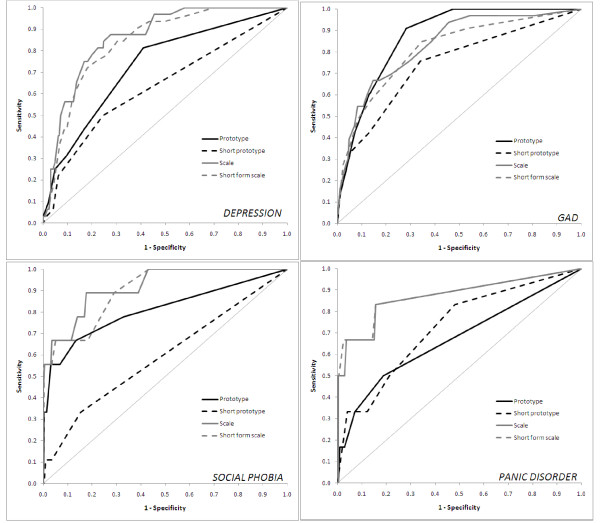
Short and ultra-short prototypes were developed for Major Depressive Disorder (MDD), Generalised Anxiety Disorder (GAD), Panic Disorder (PD) and Social Phobia (SP). Prototypes were compared to typical short and ultra-short self-report screening scales, such as the Centre for Epidemiology Scale, CES-D and the GAD-7, and their short forms. The Mini International Neuropsychiatric Interview (MINI) version 6 1 was used as the gold standard for obtaining clinical criteria through a telephone interview. From a population sample, 225 individuals who endorsed a prototype and 101 who did not were administered the MINI. Receiver operating characteristic (ROC) curves were plotted for the short and ultra short prototypes and for the short and ultra short screening scales.
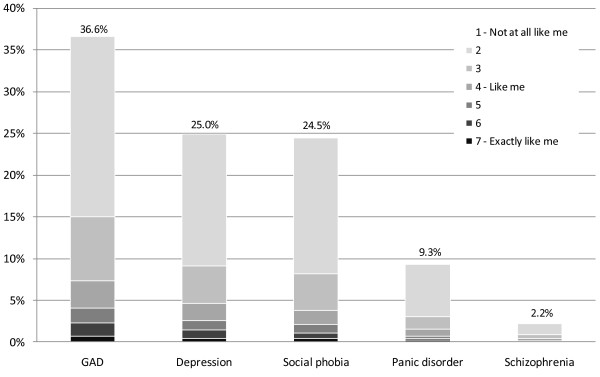
The study found that the rates of endorsement of the prototypes were commensurate with prevalence estimates. The short-form and ultra short scales outperformed the short and ultra short prototypes for every disorder except GAD, where the GAD prototype outperformed the GAD 7.
The findings suggest that people may be able to self-identify generalised anxiety more accurately than depression based on a description of a prototypical case. However, levels of identification were lower than expected. Considerable benefits from this method of screening may ensue if our prototypes can be improved for Major Depressive Disorder, Social Phobia and Panic Disorder.
精神障碍的筛查工具需要简短、引人入胜且有效。目前的筛查工具通常基于问卷,可能对用户不透明。一种原型方法是,个体通过识别一个具有典型抑郁、焦虑、社交恐惧症或惊恐障碍症状的个体的描述来进行筛查,这可能是一种更简短、更快且更易被接受的方法。本研究旨在评估四种新的原型筛查器预测抑郁和焦虑障碍的准确性,并比较它们与现有量表的性能。
为重度抑郁症(MDD)、广泛性焦虑症(GAD)、惊恐障碍(PD)和社交恐惧症(SP)开发了简短和超短原型。原型与典型的简短和超短自我报告筛查量表(如流行病学中心量表、CES-D 和 GAD-7 及其简短形式)进行了比较。使用迷你国际神经精神访谈(MINI)第 6 版 1 作为通过电话访谈获得临床标准的金标准。从人群样本中,对 225 名认可原型的个体和 101 名不认可原型的个体进行了 MINI 测试。绘制了简短和超短原型以及简短和超短筛查量表的受试者工作特征(ROC)曲线。
研究发现,原型的认可率与患病率估计相符。对于每种疾病,短型和超短型量表的表现均优于短型和超短型原型,除 GAD 外,GAD 原型的表现优于 GAD 7。
研究结果表明,人们可能能够根据典型病例的描述更准确地自我识别广泛性焦虑,而不是抑郁。然而,识别水平低于预期。如果我们的原型可以针对重度抑郁症、社交恐惧症和惊恐障碍进行改进,那么这种筛查方法可能会带来巨大的益处。