Product Research Department, Chugai Pharmaceutical Co., Ltd., Gotemba, Shizuoka 412-8513 Japan.
Cardiovasc Diabetol. 2011 Nov 23;10:105. doi: 10.1186/1475-2840-10-105.
Nicorandil, an anti-angina agent, reportedly improves outcomes even in angina patients with diabetes. However, the precise mechanism underlying the beneficial effect of nicorandil on diabetic patients has not been examined. We investigated the protective effect of nicorandil on endothelial function in diabetic rats because endothelial dysfunction is a major risk factor for cardiovascular disease in diabetes.
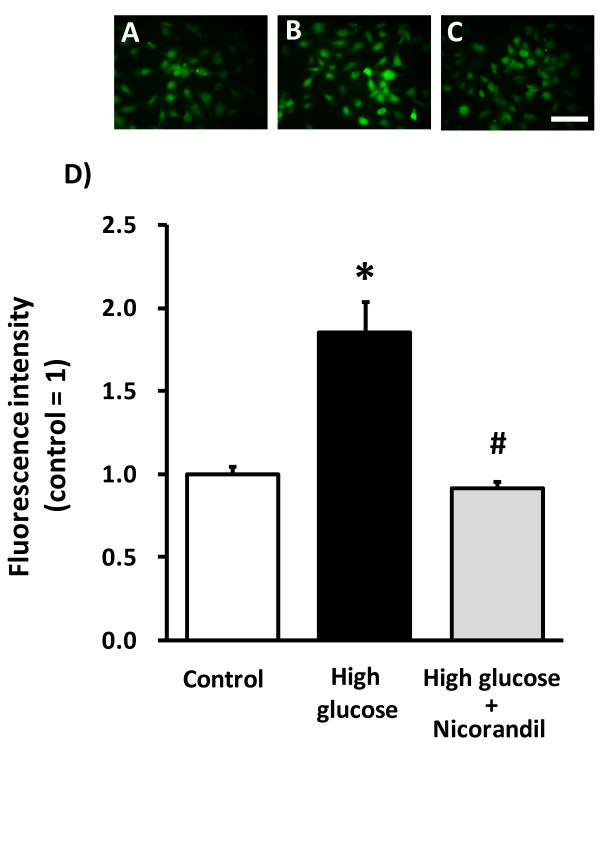
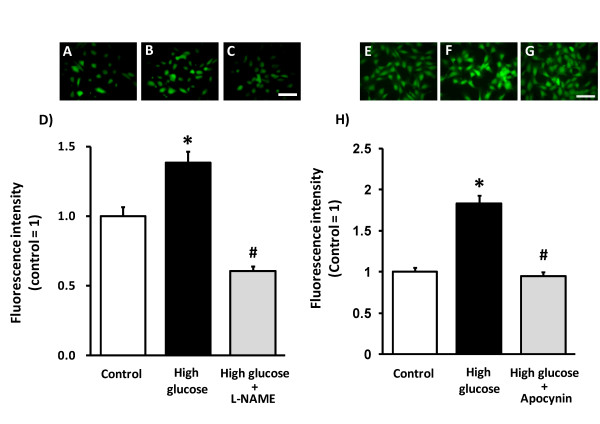
Male Sprague-Dawley rats (6 weeks old) were intraperitoneally injected with streptozotocin (STZ, 40 mg/kg, once a day for 3 days) to induce diabetes. Nicorandil (15 mg/kg/day) and tempol (20 mg/kg/day, superoxide dismutase mimetic) were administered in drinking water for one week, starting 3 weeks after STZ injection. Endothelial function was evaluated by measuring flow-mediated dilation (FMD) in the femoral arteries of anaesthetised rats. Cultured human coronary artery endothelial cells (HCAECs) were treated with high glucose (35.6 mM, 24 h) and reactive oxygen species (ROS) production with or without L-NAME (300 μM), apocynin (100 μM) or nicorandil (100 μM) was measured using fluorescent probes.
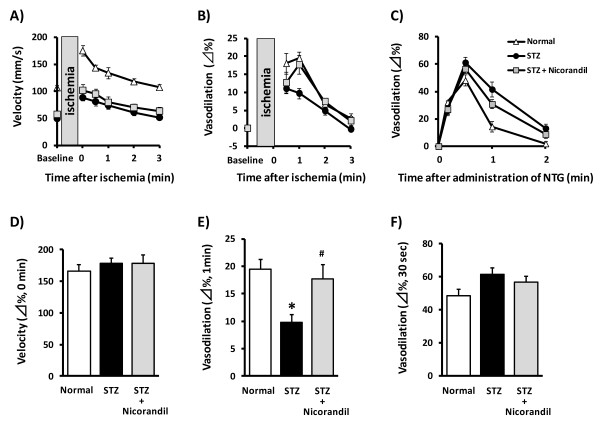
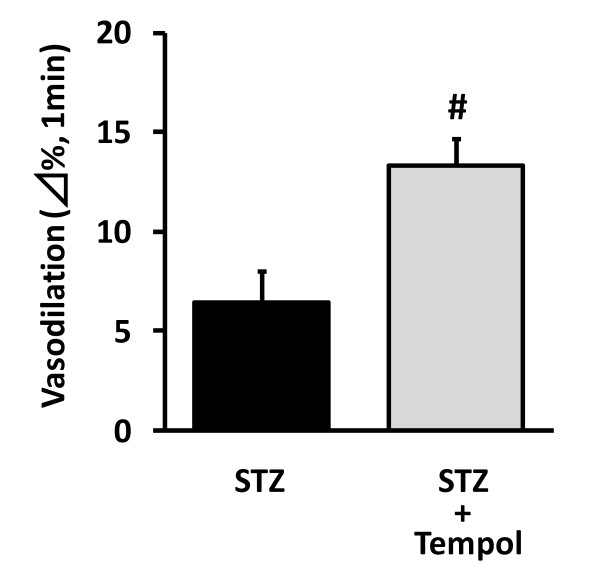
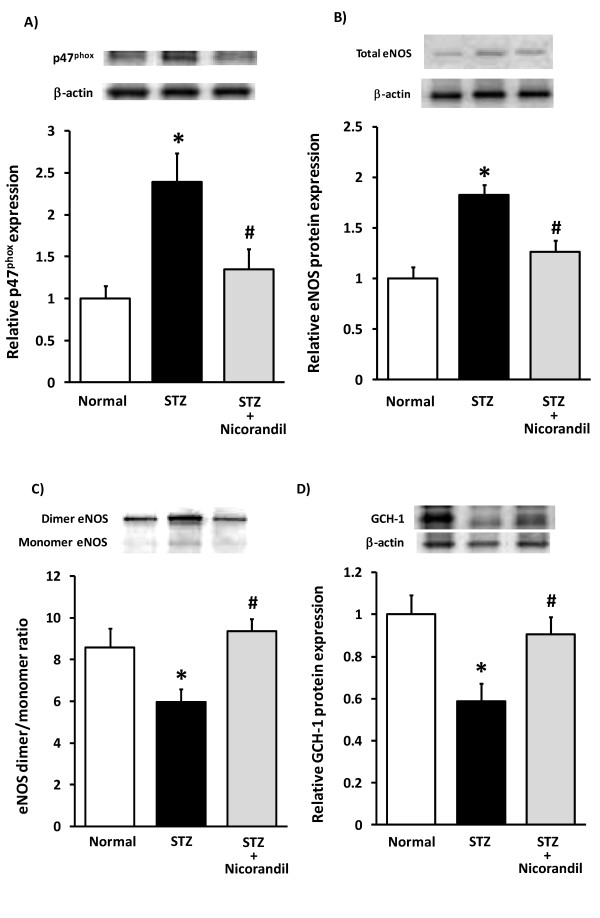
Endothelial function as evaluated by FMD was significantly reduced in diabetic as compared with normal rats (diabetes, 9.7 ± 1.4%; normal, 19.5 ± 1.7%; n = 6-7). There was a 2.4-fold increase in p47phox expression, a subunit of NADPH oxidase, and a 1.8-fold increase in total eNOS expression in diabetic rat femoral arteries. Nicorandil and tempol significantly improved FMD in diabetic rats (nicorandil, 17.7 ± 2.6%; tempol, 13.3 ± 1.4%; n = 6). Nicorandil significantly inhibited the increased expressions of p47phox and total eNOS in diabetic rat femoral arteries. Furthermore, nicorandil significantly inhibited the decreased expression of GTP cyclohydrolase I and the decreased dimer/monomer ratio of eNOS. ROS production in HCAECs was increased by high-glucose treatment, which was prevented by L-NAME and nicorandil suggesting that eNOS itself might serve as a superoxide source under high-glucose conditions and that nicorandil might prevent ROS production from eNOS.
These results suggest that nicorandil improved diabetes-induced endothelial dysfunction through antioxidative effects by inhibiting NADPH oxidase and eNOS uncoupling.
作为一种抗心绞痛药物,尼可地尔据称可改善糖尿病患者的预后。然而,尼可地尔对糖尿病患者有益作用的确切机制尚未得到研究。我们研究了尼可地尔对糖尿病大鼠内皮功能的保护作用,因为内皮功能障碍是糖尿病患者发生心血管疾病的主要危险因素。
雄性 Sprague-Dawley 大鼠(6 周龄)经腹腔注射链脲佐菌素(STZ,40mg/kg,每天 1 次,连续 3 天)诱导糖尿病。在 STZ 注射后 3 周开始,尼可地尔(15mg/kg/天)和替米沙坦(20mg/kg/天,超氧化物歧化酶模拟物)通过饮用水给药 1 周。通过测量麻醉大鼠股动脉血流介导的扩张(FMD)来评估内皮功能。用 35.6mM 高葡萄糖处理培养的人冠状动脉内皮细胞(HCAEC)24 小时,并使用荧光探针测量活性氧(ROS)产生,同时加入 L-NAME(300μM)、apocynin(100μM)或尼可地尔(100μM)。
与正常大鼠相比,FMD 评估的内皮功能明显降低(糖尿病大鼠 9.7 ± 1.4%,正常大鼠 19.5 ± 1.7%;n=6-7)。糖尿病大鼠股动脉中 NADPH 氧化酶亚基 p47phox 的表达增加了 2.4 倍,内皮型一氧化氮合酶(eNOS)的总表达增加了 1.8 倍。尼可地尔和替米沙坦显著改善了糖尿病大鼠的 FMD(尼可地尔 17.7 ± 2.6%;替米沙坦 13.3 ± 1.4%;n=6)。尼可地尔显著抑制了糖尿病大鼠股动脉中 p47phox 和 eNOS 总表达的增加。此外,尼可地尔显著抑制了 GTP 环水解酶 I 的表达降低和 eNOS 二聚体/单体比例的降低。高葡萄糖处理增加了 HCAEC 中的 ROS 产生,L-NAME 和尼可地尔可阻止这种增加,表明 eNOS 本身在高葡萄糖条件下可能作为超氧化物的来源,尼可地尔可能防止来自 eNOS 的 ROS 产生。
这些结果表明,尼可地尔通过抑制 NADPH 氧化酶和 eNOS 解偶联来改善糖尿病引起的内皮功能障碍,从而发挥抗氧化作用。