Translational Research Laboratory, Catalan Institute of Oncology, Bellvitge Biomedical Research Institute-IDIBELL, L'Hospitalet, Catalonia, Spain.
PLoS Biol. 2011 Nov;9(11):e1001199. doi: 10.1371/journal.pbio.1001199. Epub 2011 Nov 15.
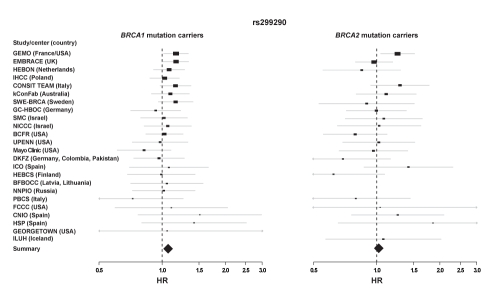
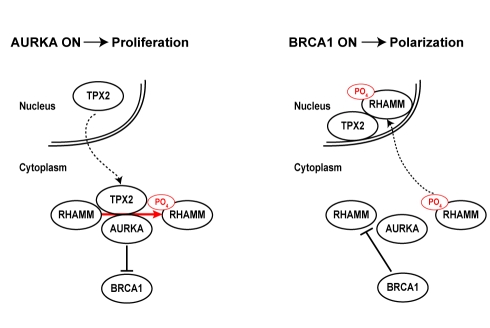
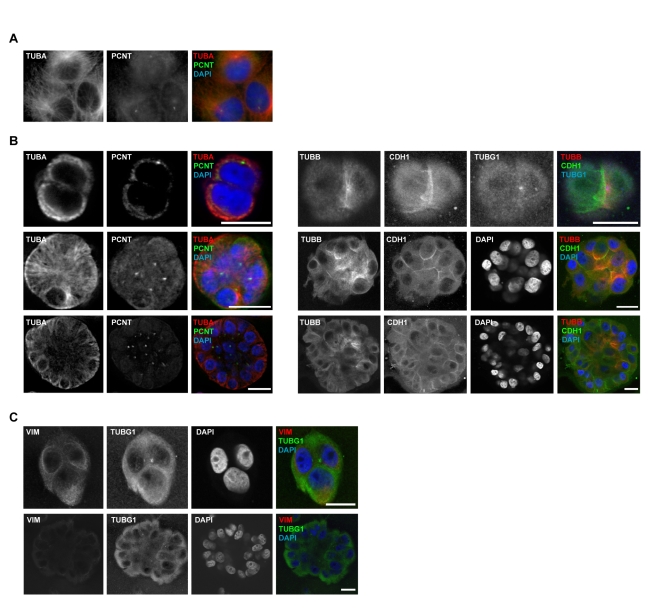
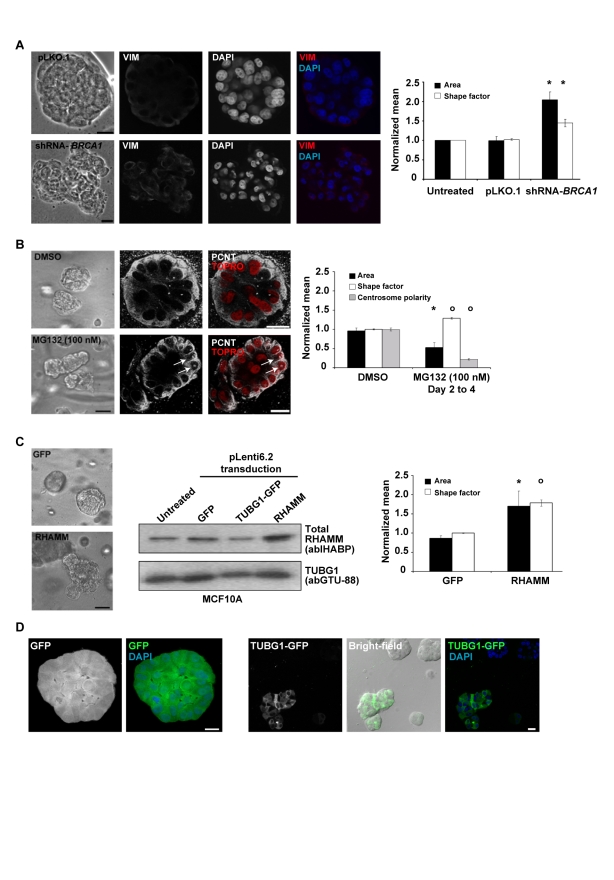
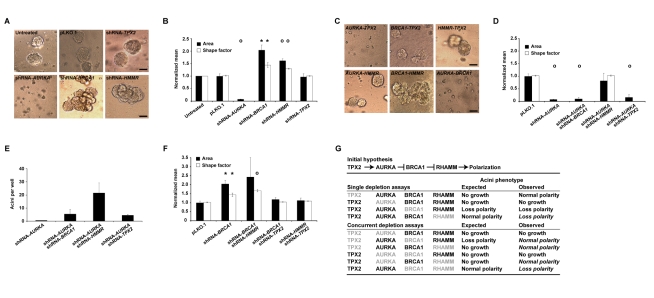
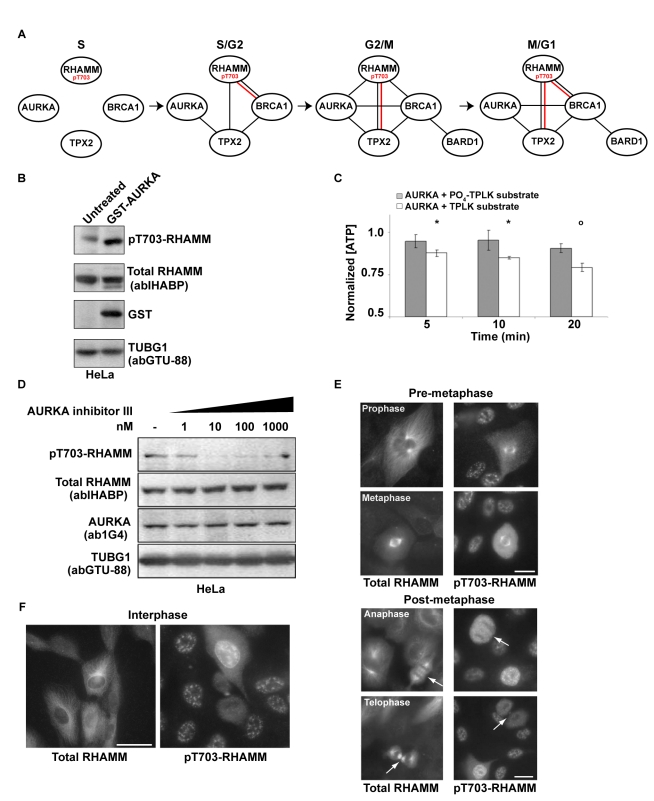
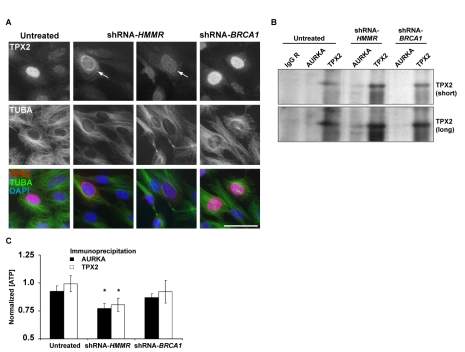
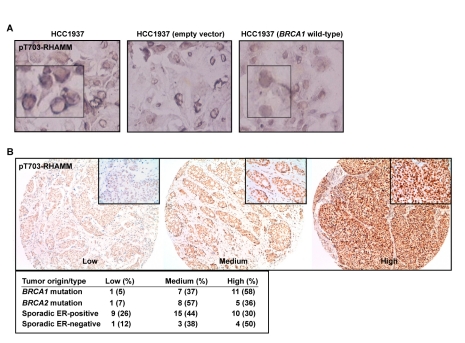
Differentiated mammary epithelium shows apicobasal polarity, and loss of tissue organization is an early hallmark of breast carcinogenesis. In BRCA1 mutation carriers, accumulation of stem and progenitor cells in normal breast tissue and increased risk of developing tumors of basal-like type suggest that BRCA1 regulates stem/progenitor cell proliferation and differentiation. However, the function of BRCA1 in this process and its link to carcinogenesis remain unknown. Here we depict a molecular mechanism involving BRCA1 and RHAMM that regulates apicobasal polarity and, when perturbed, may increase risk of breast cancer. Starting from complementary genetic analyses across families and populations, we identified common genetic variation at the low-penetrance susceptibility HMMR locus (encoding for RHAMM) that modifies breast cancer risk among BRCA1, but probably not BRCA2, mutation carriers: n = 7,584, weighted hazard ratio ((w)HR) = 1.09 (95% CI 1.02-1.16), p(trend) = 0.017; and n = 3,965, (w)HR = 1.04 (95% CI 0.94-1.16), p(trend) = 0.43; respectively. Subsequently, studies of MCF10A apicobasal polarization revealed a central role for BRCA1 and RHAMM, together with AURKA and TPX2, in essential reorganization of microtubules. Mechanistically, reorganization is facilitated by BRCA1 and impaired by AURKA, which is regulated by negative feedback involving RHAMM and TPX2. Taken together, our data provide fundamental insight into apicobasal polarization through BRCA1 function, which may explain the expanded cell subsets and characteristic tumor type accompanying BRCA1 mutation, while also linking this process to sporadic breast cancer through perturbation of HMMR/RHAMM.
分化的乳腺上皮细胞表现出顶底极性,组织丧失是乳腺癌发生的早期标志。在 BRCA1 突变携带者中,正常乳腺组织中干细胞和祖细胞的积累以及基底样型肿瘤发生风险的增加表明 BRCA1 调节干细胞/祖细胞的增殖和分化。然而,BRCA1 在这一过程中的功能及其与癌症发生的关系仍不清楚。在这里,我们描述了一个涉及 BRCA1 和 RHAMM 的分子机制,该机制调节顶底极性,当受到干扰时,可能会增加乳腺癌的风险。从跨家庭和人群的互补遗传分析开始,我们在低外显率易感 HMMR 基因座(编码 RHAMM)发现了常见的遗传变异,该变异可改变 BRCA1 但可能不是 BRCA2 突变携带者的乳腺癌风险:n = 7584,加权风险比(wHR)= 1.09(95%CI 1.02-1.16),p(趋势)= 0.017;n = 3965,(wHR)= 1.04(95%CI 0.94-1.16),p(趋势)= 0.43。随后,对 MCF10A 顶底极化的研究揭示了 BRCA1 和 RHAMM 与 AURKA 和 TPX2 一起在微管的基本重排中起核心作用。从机制上讲,BRCA1 促进了重排,而 AURKA 则阻碍了重排,AURKA 受 RHAMM 和 TPX2 负反馈调节。综上所述,我们的数据通过 BRCA1 功能提供了对顶底极化的基本认识,这可以解释伴随 BRCA1 突变的扩展细胞亚群和特征性肿瘤类型,同时通过 HMMR/RHAMM 的干扰将这一过程与散发性乳腺癌联系起来。