Chang Shiao-Ying, Chen Yun-Wen, Chenier Isabelle, Tran Stella Le Minh, Zhang Shao-Ling
Research Centre, Centre Hospitalier de l'Université de Montréal, Hôtel-Dieu, Pavillon Masson, 8-227, 3850 Saint Urbain Street, Montréal, QC, Canada.
Exp Diabetes Res. 2011;2011:521076. doi: 10.1155/2011/521076. Epub 2011 Oct 27.
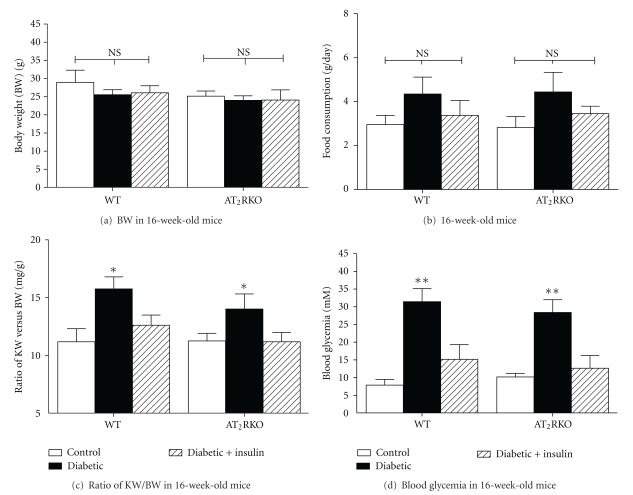
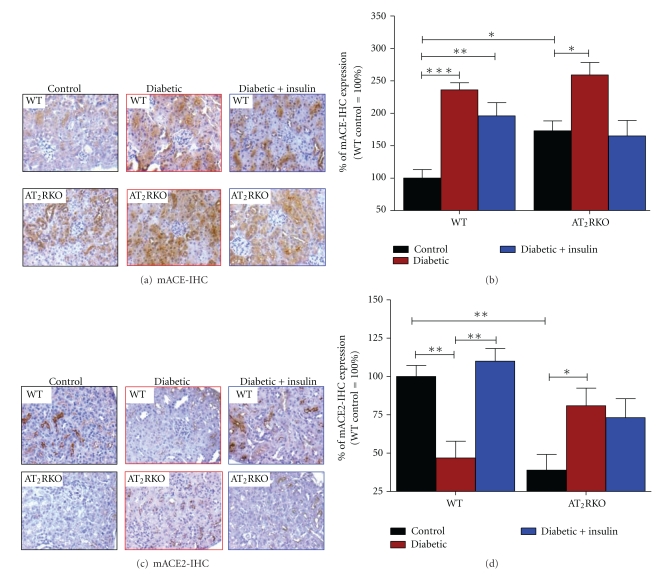
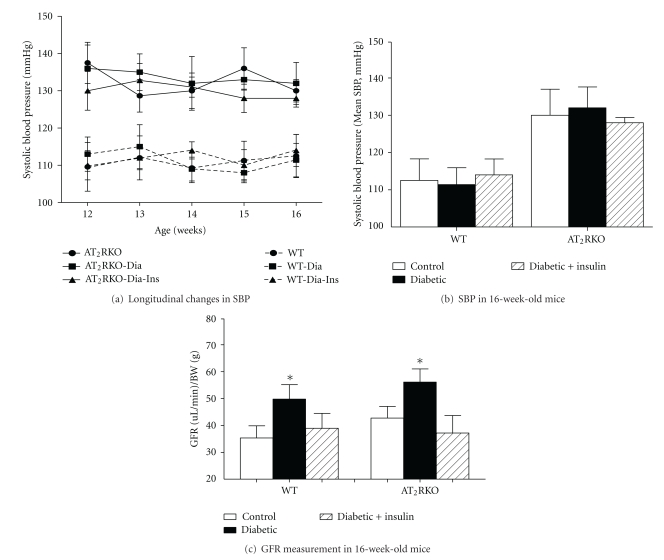
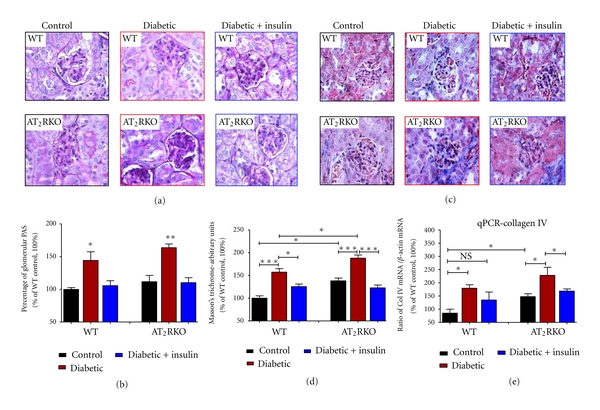
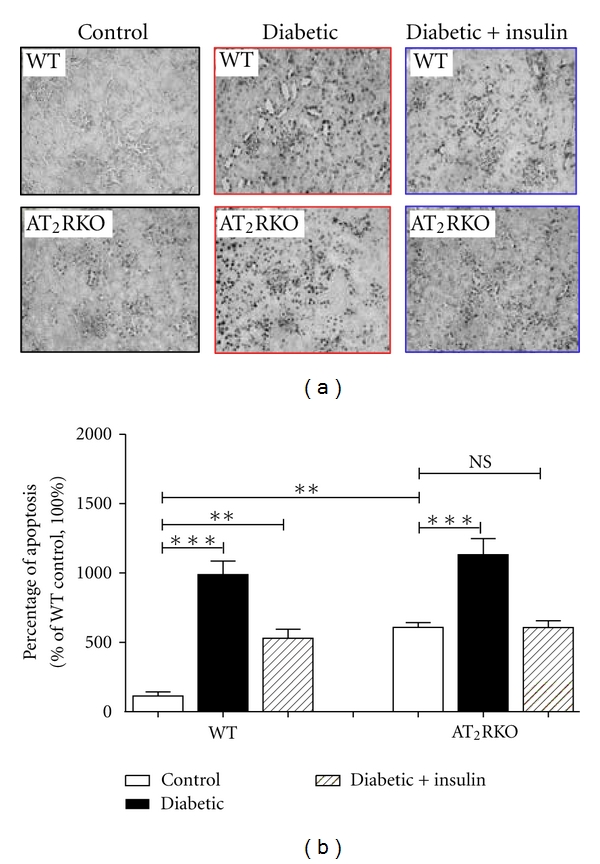
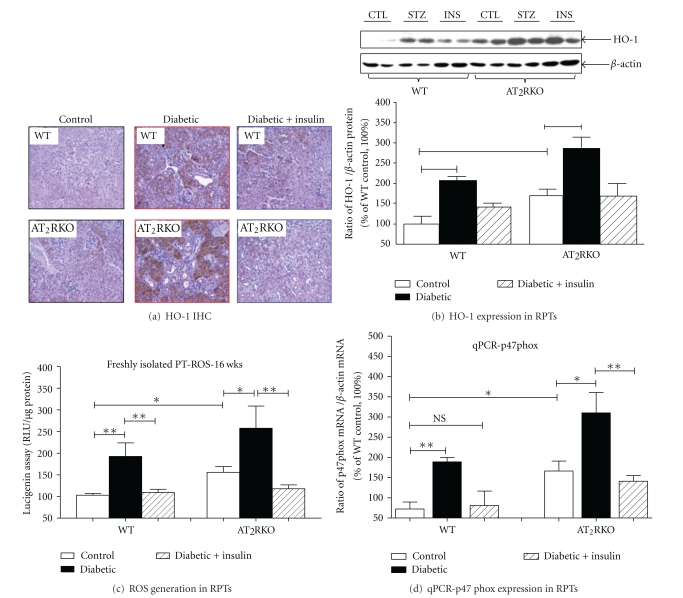
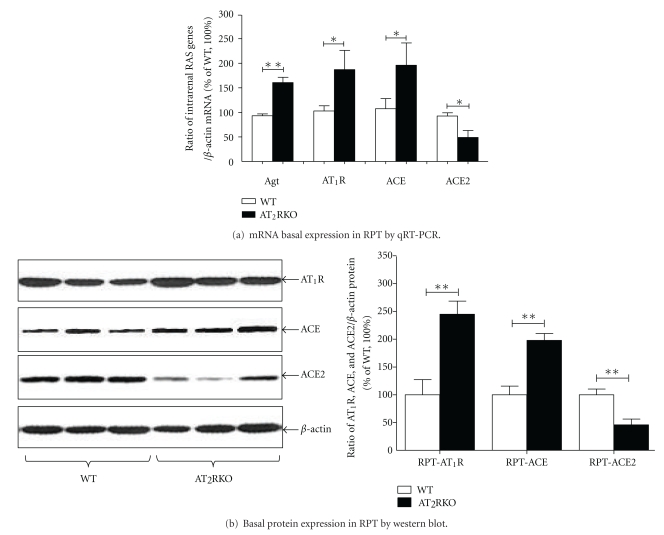
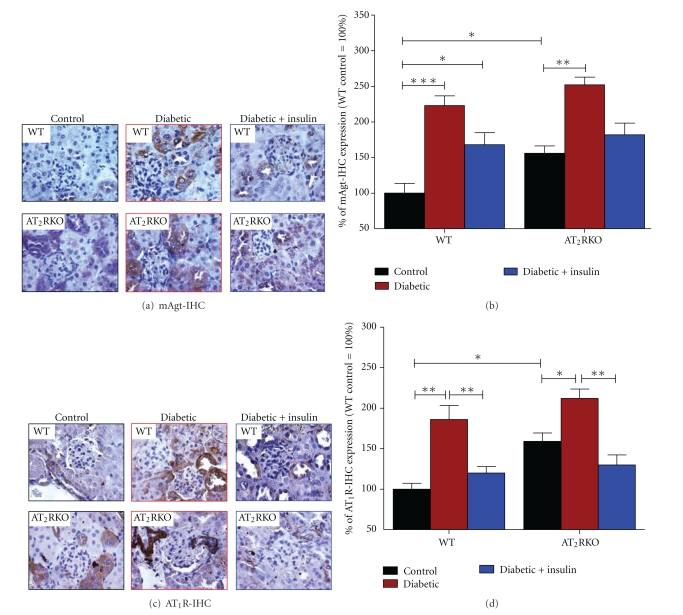
Since the functional role(s) of angiotensin II (Ang II) type II receptor (AT(2)R) in type I diabetes is unknown, we hypothesized that AT(2)R is involved in decreasing the effects of type I diabetes on the kidneys. We induced diabetes with low-dose streptozotocin (STZ) in both AT(2)R knockout (AT(2)RKO) and wild-type (WT) male mice aged 12 weeks and followed them for 4 weeks. Three subgroups nondiabetic, diabetic, and insulin-treated diabetic (Rx insulin implant) were studied. Systolic blood pressure (SBP), physiological parameters, glomerular filtration rate (GFR), renal morphology, gene expression, and apoptosis were assessed. After 4 weeks of diabetes, compared to WT controls, AT(2)RKO mice clearly developed features of early diabetic nephropathy (DN), such as renal hypertrophy, tubular apoptosis, and progressive extracellular matrix (ECM) protein accumulation as well as increased GFR. AT(2)RKO mice presented hypertension unaffected by diabetes. Renal oxidative stress (measured as heme oxygenase 1 (HO-1) gene expression and reactive oxygen species (ROS) generation) and intrarenal renin angiotensin system components, such as angiotensinogen (Agt), AT(1)R, and angiotensin-converting enzyme (ACE) gene expression, were augmented whereas angiotensin-converting enzyme2 (ACE2) gene expression was decreased in renal proximal tubules (RPTs) of AT(2)RKO mice. The renal changes noted above were significantly enhanced in diabetic AT(2)RKO mice but partially attenuated in insulin-treated diabetic WT and AT(2)RKO mice. In conclusion, AT(2)R deficiency accelerates the development of DN, which appears to be mediated, at least in part, via heightened oxidative stress and ACE/ACE2 ratio in RPTs.
由于血管紧张素II(Ang II)2型受体(AT(2)R)在1型糖尿病中的功能作用尚不清楚,我们推测AT(2)R参与减轻1型糖尿病对肾脏的影响。我们用低剂量链脲佐菌素(STZ)诱导12周龄的AT(2)R基因敲除(AT(2)RKO)和野生型(WT)雄性小鼠患糖尿病,并对它们进行了4周的跟踪观察。研究了三个亚组:非糖尿病组、糖尿病组和胰岛素治疗糖尿病组(皮下植入胰岛素)。评估了收缩压(SBP)、生理参数、肾小球滤过率(GFR)、肾脏形态、基因表达和细胞凋亡情况。糖尿病4周后,与WT对照组相比,AT(2)RKO小鼠明显出现了早期糖尿病肾病(DN)的特征,如肾脏肥大、肾小管凋亡、细胞外基质(ECM)蛋白逐渐积累以及GFR增加。AT(2)RKO小鼠出现不受糖尿病影响的高血压。肾脏氧化应激(以血红素加氧酶1(HO-1)基因表达和活性氧(ROS)生成来衡量)以及肾内肾素血管紧张素系统成分,如血管紧张素原(Agt)、AT(1)R和血管紧张素转换酶(ACE)基因表达在AT(2)RKO小鼠的肾近端小管(RPTs)中增加,而血管紧张素转换酶2(ACE2)基因表达则降低。上述肾脏变化在糖尿病AT(2)RKO小鼠中显著增强,但在胰岛素治疗的糖尿病WT和AT(2)RKO小鼠中部分减轻。总之,AT(2)R缺乏会加速DN的发展,这似乎至少部分是通过RPTs中氧化应激增强和ACE/ACE2比值升高介导的。