Department of Veterinary Microbiology and Pathology, College of Veterinary Medicine, Washington State University, Pullman, WA 99164-7040, USA.
BMC Vet Res. 2011 Nov 23;7:75. doi: 10.1186/1746-6148-7-75.
Classical scrapie is a naturally occurring transmissible spongiform encephalopathy of sheep and goats characterized by cellular accumulation of abnormal isoforms of prion protein (PrPSc) in the central nervous system and the follicles of peripheral lymphoid tissues. Previous studies have shown that the whole blood and buffy coat blood fraction of scrapie infected sheep harbor prion infectivity. Although PrPSc has been detected in peripheral blood mononuclear cells (PBMCs), plasma, and more recently within a subpopulation of B lymphocytes, the infectivity status of these cells and plasma in sheep remains unknown. Therefore, the objective of this study was to determine whether circulating PBMCs, B lymphocytes and platelets from classical scrapie infected sheep harbor prion infectivity using a sheep bioassay.
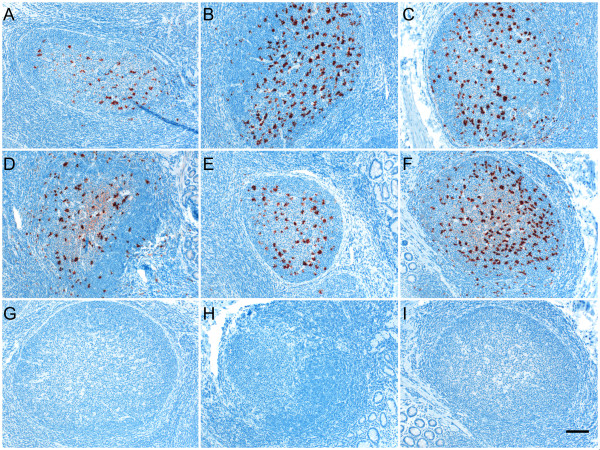
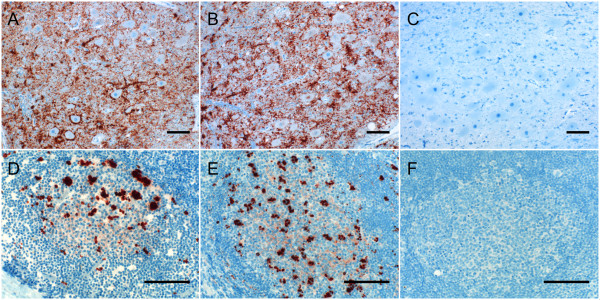
Serial rectal mucosal biopsy and immunohistochemistry were used to detect preclinical infection in lambs transfused with whole blood or blood cell fractions from preclinical or clinical scrapie infected sheep. PrPSc immunolabeling was detected in antemortem rectal and postmortem lymphoid tissues from recipient lambs receiving PBMCs (15/15), CD72+ B lymphocytes (3/3), CD21+ B lymphocytes (3/3) or platelet-rich plasma (2/3) fractions. As expected, whole blood (11/13) and buffy coat (5/5) recipients showed positive PrPSc labeling in lymphoid follicles. However, at 549 days post-transfusion, PrPSc was not detected in rectal or other lymphoid tissues in three sheep receiving platelet-poor plasma fraction.
Prion infectivity was detected in circulating PBMCs, CD72+ pan B lymphocytes, the CD21+ subpopulation of B lymphocytes and platelet-rich plasma of classical scrapie infected sheep using a sheep bioassay. Combining platelets with B lymphocytes might enhance PrPSc detection levels in blood samples.
经典绵羊痒病是一种天然发生的传染性海绵状脑病,其特征是中枢神经系统和周围淋巴组织滤泡中异常朊病毒蛋白(PrPSc)的细胞积累。先前的研究表明,感染绵羊的全血和白细胞层血液部分具有朊病毒感染性。尽管已在绵羊的外周血单核细胞(PBMC)、血浆中,以及最近在亚群 B 淋巴细胞中检测到 PrPSc,但这些细胞和血浆的感染状态仍不清楚。因此,本研究的目的是使用绵羊生物测定法确定是否从经典绵羊痒病感染的绵羊循环中 PBMC、B 淋巴细胞和血小板中携带朊病毒感染性。
通过直肠粘膜活检和免疫组织化学,检测用来自临床前或临床感染绵羊的全血或血细胞部分输注的羔羊的临床前感染。从接受 PBMC(15/15)、CD72+B 淋巴细胞(3/3)、CD21+B 淋巴细胞(3/3)或富含血小板血浆(2/3)部分的受体羔羊的直肠和死后淋巴组织中检测到 PrPSc 免疫标记。如预期的那样,全血(11/13)和白细胞层(5/5)受者在淋巴滤泡中显示出阳性 PrPSc 标记。然而,在输注后 549 天,在接受富含血小板血浆部分的三只绵羊的直肠或其他淋巴组织中未检测到 PrPSc。
使用绵羊生物测定法,在经典绵羊痒病感染的绵羊的循环 PBMC、CD72+泛 B 淋巴细胞、CD21+B 淋巴细胞亚群和富含血小板的血浆中检测到朊病毒感染性。将血小板与 B 淋巴细胞结合可能会提高血液样本中 PrPSc 的检测水平。