Department of Biological and Biomedical Sciences, Glasgow Caledonian University, Cowcaddens Road, Glasgow, G4 0BA, UK.
Mol Pain. 2011 Nov 23;7:91. doi: 10.1186/1744-8069-7-91.
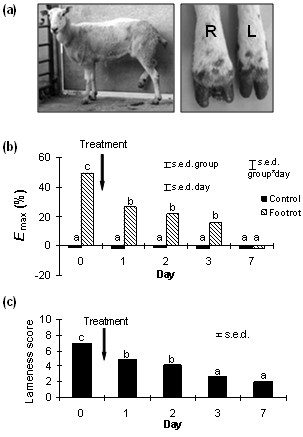
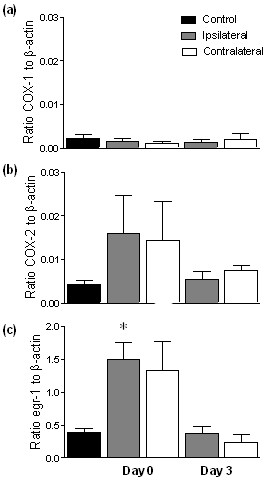
This study characterised the effects of persistent peripheral inflammation of the foot on pain and spinal cord expression of cyclooxygenase-1 and -2 (COX-1 and COX-2) and early growth response gene 1 (Egr-1), known markers of neuronal plasticity, in a clinical model of naturally-occurring inflammatory disease and hyperalgesia in sheep ('footrot'), before and after routine treatment (parenteral treatment with antibiotics and antiseptic footbathing). The temporal pattern of expression of COX-1, COX-2 and Egr-1 mRNA and protein were analysed using real-time PCR and Western blotting.
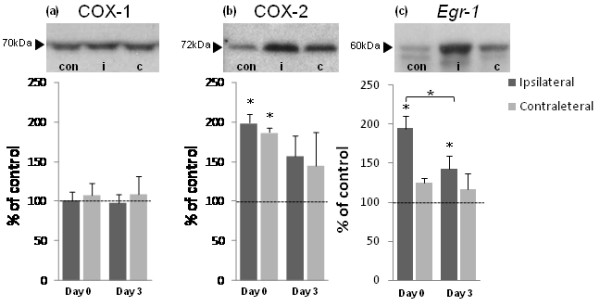
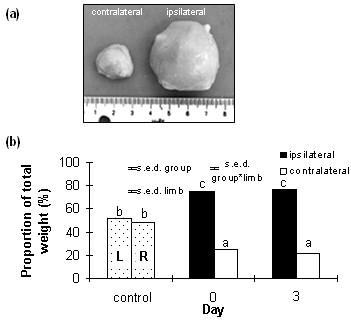
Animals affected with persistent peripheral inflammation displayed significant hyperalgesia and lameness (a proxy indicator of spontaneous pain) restricted to the inflamed limb. Hyperalgesia and lameness were significantly attenuated 1 day after treatment, and resolved further by day 7 and day 3, respectively. COX-2 but not COX-1, protein expression was up-regulated in spinal cord from lame animals on day 0, before treatment. Following treatment and attenuation of pain behaviours, levels of COX-2 returned to control levels. Significant induction of Egr-1 mRNA and protein were observed in spinal cord from lame animals. Three days after treatment, levels of Egr-1 mRNA returned to control levels, however, Egr-1 protein remained elevated.
Elevated levels of spinal COX-2 and Egr-1 protein correlate with the presence of pain and hyperalgesia, and may underlie persistent pain, although a direct causal link has still to be established. Understanding the temporal pattern of expression of key mediators in clinical pain states may lead to better strategies to manage pain.
本研究在绵羊自然发生炎症性疾病和痛觉过敏的临床模型中(“腐蹄病”),在常规治疗(全身给予抗生素和防腐洗脚浴)前后,研究了足部持续性外周炎症对疼痛和脊髓中环氧化酶-1 和 -2(COX-1 和 COX-2)以及早期生长反应基因 1(Egr-1)表达的影响,这些是神经元可塑性的已知标志物。使用实时 PCR 和 Western blot 分析 COX-1、COX-2 和 Egr-1 mRNA 和蛋白的表达模式。
患有持续性外周炎症的动物表现出明显的痛觉过敏和跛行(自发疼痛的替代指标),仅限于受影响的肢体。跛行和疼痛在治疗后 1 天显著减轻,并分别在第 7 天和第 3 天进一步缓解。COX-2 但不是 COX-1,在治疗前,跛行动物的脊髓中蛋白表达上调。治疗后疼痛行为减轻后,COX-2 水平恢复至对照水平。在跛行动物的脊髓中观察到 Egr-1 mRNA 和蛋白的显著诱导。治疗 3 天后,Egr-1 mRNA 水平恢复至对照水平,但 Egr-1 蛋白仍升高。
脊髓 COX-2 和 Egr-1 蛋白水平升高与疼痛和痛觉过敏的存在相关,可能是持续性疼痛的基础,尽管仍需要建立直接的因果关系。了解临床疼痛状态中关键介质的表达时间模式可能会导致更好的疼痛管理策略。