Department of Pharmaceutical Biosciences, Uppsala University, Uppsala, Sweden, 751 24.
Department of Molecular Medicine, University of Southern Denmark, Odense, Denmark, 5230.
eNeuro. 2021 May 25;8(3). doi: 10.1523/ENEURO.0548-20.2021. Print 2021 May-Jun.
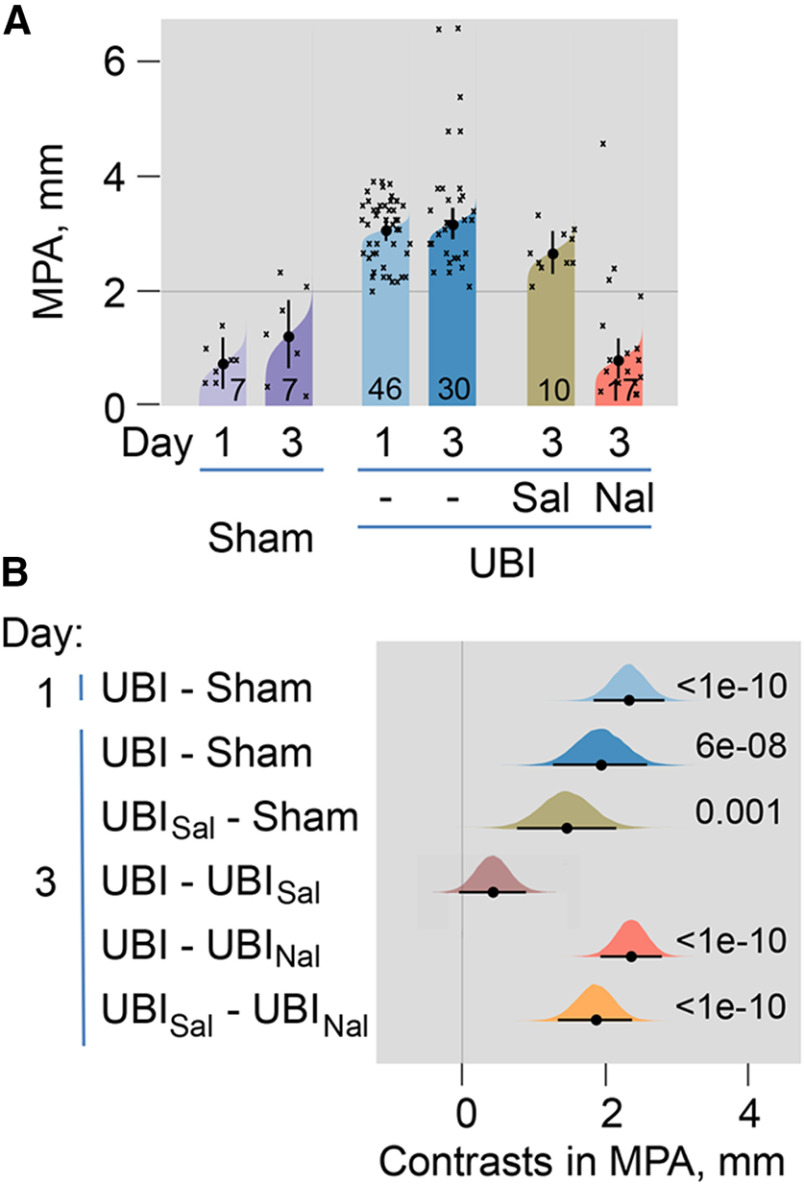
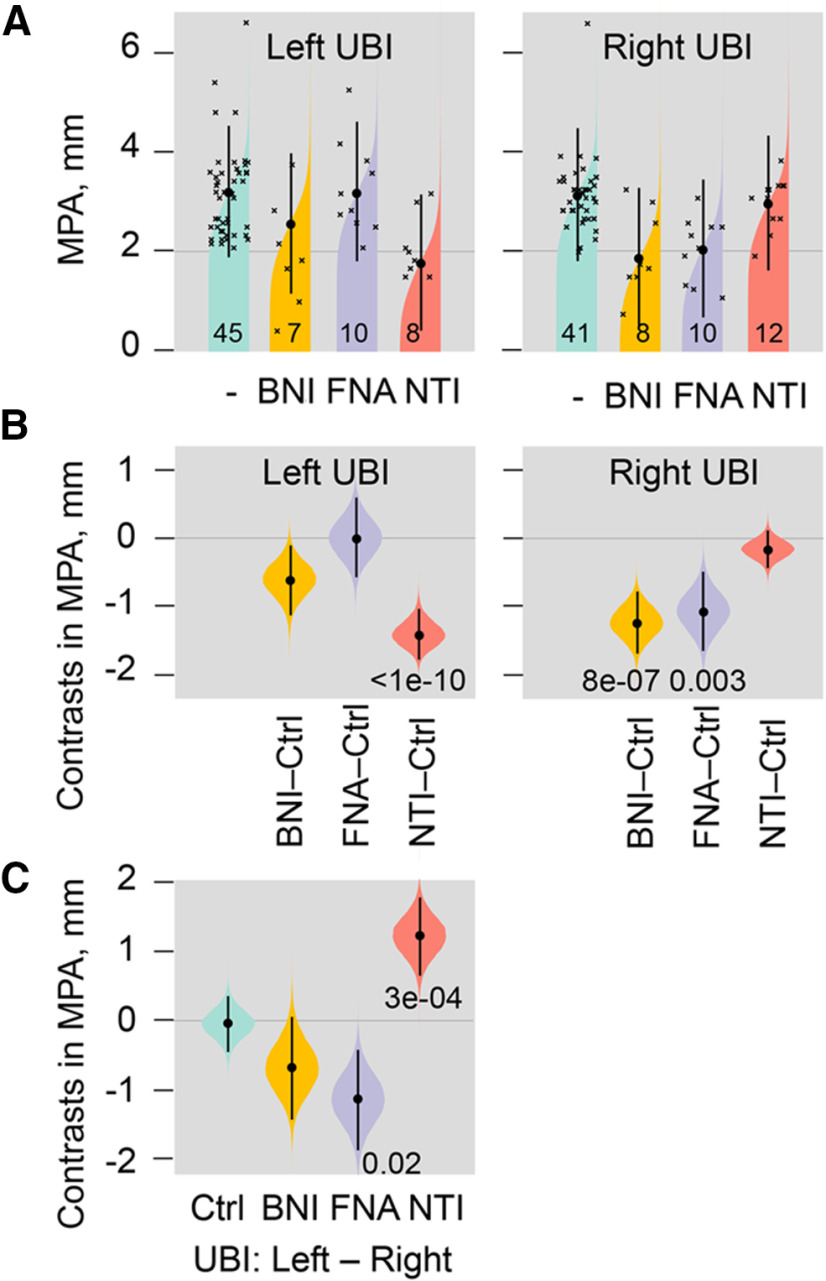
Neuropeptides are implicated in control of lateralized processes in the brain. A unilateral brain injury (UBI) causes the contralesional sensorimotor deficits. To examine whether opioid neuropeptides mediate UBI induced asymmetric processes we compared effects of opioid antagonists on the contralesional and ipsilesional hindlimb responses to the left-sided and right-sided injury in rats. UBI induced hindlimb postural asymmetry (HL-PA) with the contralesional hindlimb flexion, and activated contralesional withdrawal reflex of extensor digitorum longus (EDL) evoked by electrical stimulation and recorded with EMG technique. No effects on the interossei (Int) and peroneaus longus (PL) were evident. The general opioid antagonist naloxone blocked postural effects, did not change EDL asymmetry while uncovered cryptic asymmetry in the PL and Int reflexes induced by UBI. Thus, the spinal opioid system may either mediate or counteract the injury effects. Strikingly, effects of selective opioid antagonists were the injury side-specific. The μ-antagonist β-funaltrexamine (FNA) and κ-antagonist nor-binaltorphimine (BNI) reduced postural asymmetry after the right but not left UBI. In contrast, the δ-antagonist naltrindole (NTI) inhibited HL-PA after the left but not right-side brain injury. The opioid gene expression and opioid peptides were lateralized in the lumbar spinal cord, and coordination between expression of the opioid and neuroplasticity-related genes was impaired by UBI that together may underlie the side-specific effects of the antagonists. We suggest that mirror-symmetric neural circuits that mediate effects of left and right brain injury on the contralesional hindlimbs are differentially controlled by the lateralized opioid system.
神经肽参与了大脑中侧化过程的控制。单侧脑损伤(UBI)导致对侧感觉运动缺陷。为了研究阿片类神经肽是否介导 UBI 诱导的不对称过程,我们比较了阿片类拮抗剂对大鼠左、右侧损伤后对侧和同侧后肢反应的影响。UBI 诱导后肢姿势不对称(HL-PA),表现为对侧后肢弯曲,电刺激引起的伸趾长肌(EDL)对侧退缩反射被 EMG 技术记录。对间骨肌(Int)和腓骨长肌(PL)没有明显影响。通用阿片拮抗剂纳洛酮阻断姿势效应,不改变 EDL 不对称性,但揭示了 UBI 诱导的 PL 和 Int 反射的隐性不对称性。因此,脊髓阿片系统可能介导或拮抗损伤效应。引人注目的是,选择性阿片拮抗剂的作用具有损伤侧特异性。μ-拮抗剂β-氟纳曲胺(FNA)和 κ-拮抗剂诺比那肽(BNI)减少了右侧 UBI 后而不是左侧 UBI 后的姿势不对称性。相反,δ-拮抗剂纳曲吲哚(NTI)抑制了左侧 UBI 后而不是右侧 UBI 后的 HL-PA。阿片类基因表达和阿片肽在腰髓中呈侧化,UBI 破坏了阿片类和神经可塑性相关基因表达之间的协调,这可能是拮抗剂产生侧特异性作用的基础。我们认为,介导左、右脑损伤对对侧后肢影响的镜像对称神经回路受到侧化阿片系统的不同控制。