Department of Pharmacy, Banasthali Vidhyapith, Banasthali, India.
Int J Nanomedicine. 2011;6:2097-111. doi: 10.2147/IJN.S23985. Epub 2011 Sep 23.
Particulate systems have received increasing attention for oral delivery of biomolecules. The objective of the present study was to prepare submicron particulate formulations of papain for pH-dependent site-specific release using pH-sensitive polymers.
Enteric submicron particle formulations of papain were prepared by w/o/w emulsion solvent evaporation using hydroxypropyl methylcellulose phthalate (HPMCP), Eudragit L100, and Eudragit S100, to avoid gastric inactivation of papain.
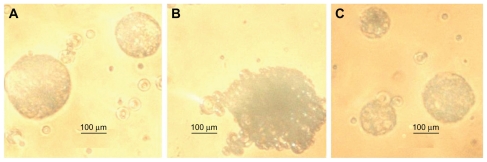
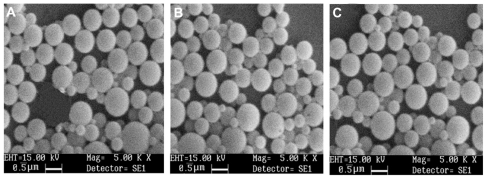
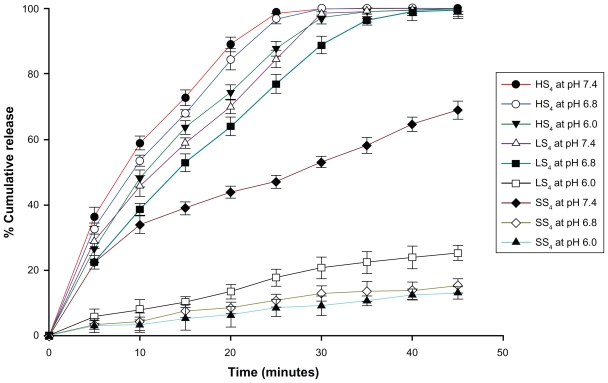
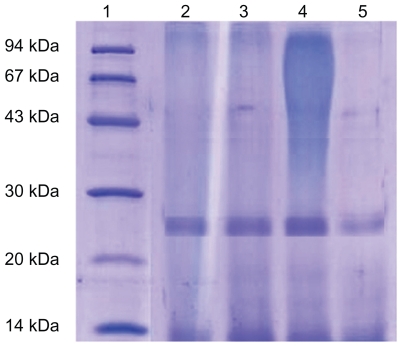
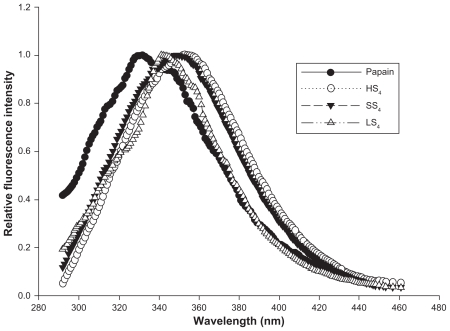
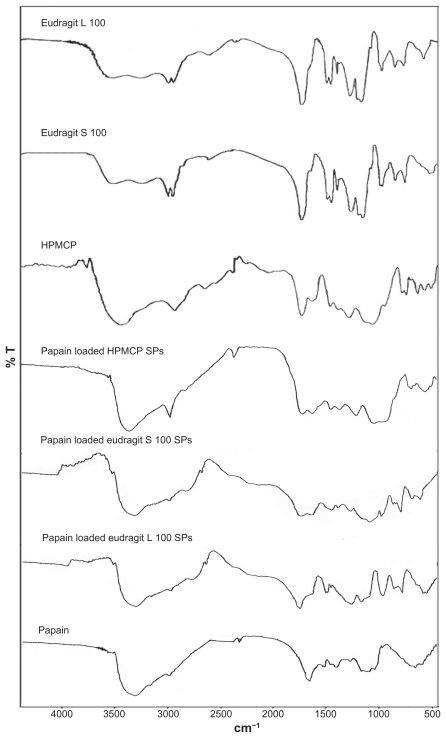
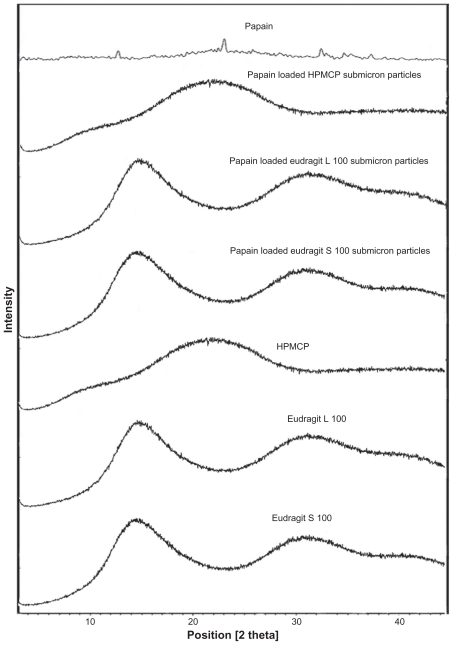
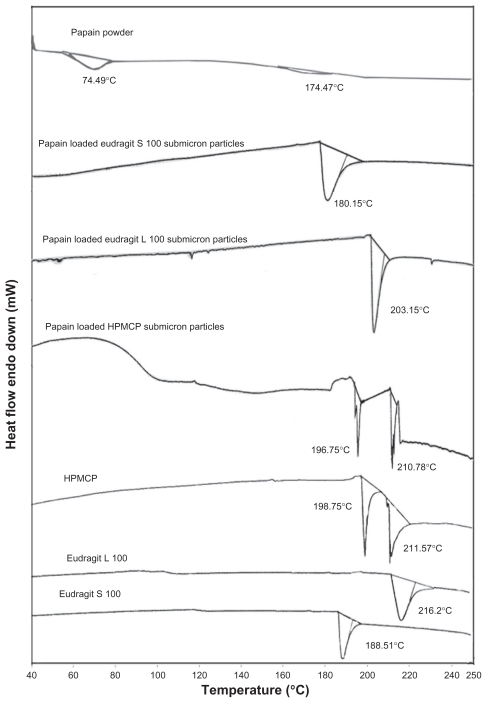
Smaller internal and external aqueous phase volumes provided maximum encapsulation efficiency (75.58%-82.35%), the smallest particle size (665.6-692.4 nm), and 25%-30% loss of enzyme activity. Release studies in 0.1 N HCl confirmed the gastroresistance of the formulations. The anionic submicron particles aggregated in 0.1 N HCl (ie, gastric pH 1.2) due to protonation of carboxylic groups in the enteric polymer. Aggregates < 500 μm size would not impede gastric emptying. However, at pH > 5.0 (duodenal pH), the submicron particles showed deaggregation due to restoration of surface charge. HPMCP submicron particles facilitated almost complete release of papain within 30 minutes at pH 6.0, while Eudragit L100 and Eudragit S100 particles released 88.82% and 53.00% of papain at pH 6.8 and pH 7.4, respectively, according to the Korsmeyer-Peppas equation. Sodium dodecyl sulfate polyacrylamide gel electrophoresis and fluorescence spectroscopy confirmed that the structural integrity of the enzyme was maintained during encapsulation. Fourier transform infrared spectroscopy revealed entrapment of the enzyme, with powder x-ray diffraction and differential scanning calorimetry indicating an amorphous character, and scanning electron microscopy showing that the submicron particles had a spherical shape.
In simulated gastrointestinal pH conditions, the HPMCP, Eudragit L100, and Eudragit S100 submicron particles showed good digestion of paneer and milk protein, and could serve as potential carriers for oral enzyme delivery. Stability studies indicated that formulations with approximately 6% overage would ensure a two-year shelf-life at room temperature.
颗粒系统因其在生物分子的口服传递方面的应用而受到越来越多的关注。本研究的目的是使用 pH 敏感聚合物制备木瓜蛋白酶的亚微米颗粒制剂,以实现 pH 依赖性的定位释放。
通过 w/o/w 乳液溶剂蒸发法,使用羟丙基甲基纤维素邻苯二甲酸酯(HPMCP)、Eudragit L100 和 Eudragit S100 制备肠溶亚微米颗粒制剂,以避免胃蛋白酶的失活。
较小的内相和外相体积提供了最大的包封效率(75.58%-82.35%)、最小的粒径(665.6-692.4nm)和 25%-30%的酶活损失。在 0.1N HCl 中的释放研究证实了配方的胃耐受力。在 0.1N HCl(即胃 pH 1.2)中,阴离子亚微米颗粒由于肠溶性聚合物中羧酸基团的质子化而聚集。<500μm 大小的团聚物不会阻碍胃排空。然而,在 pH>5.0(十二指肠 pH)时,由于表面电荷的恢复,亚微米颗粒发生解聚。HPMCP 亚微米颗粒在 pH 6.0 下几乎能在 30 分钟内完全释放木瓜蛋白酶,而 Eudragit L100 和 Eudragit S100 颗粒在 pH 6.8 和 pH 7.4 下分别释放了 88.82%和 53.00%的木瓜蛋白酶,符合 Korsmeyer-Peppas 方程。十二烷基硫酸钠聚丙烯酰胺凝胶电泳和荧光光谱证实,在包封过程中,酶的结构完整性得以保持。傅立叶变换红外光谱显示酶被包封,粉末 X 射线衍射和差示扫描量热法表明其具有无定形特征,扫描电子显微镜显示亚微米颗粒呈球形。
在模拟胃肠道 pH 条件下,HPMCP、Eudragit L100 和 Eudragit S100 亚微米颗粒对印度奶酪和牛奶蛋白具有良好的消化能力,可作为口服酶传递的潜在载体。稳定性研究表明,约 6%的过量配方可确保在室温下两年的保质期。