Institute of Carbon Science and Technology, Shinshu University, Matsumoto, Nagano, Japan.
Int J Nanomedicine. 2011;6:2689-95. doi: 10.2147/IJN.S25471. Epub 2011 Nov 4.
In the present study, we investigated whether DJ-1 could serve as a biomarker for assessing the biocompatibility of multiwalled carbon nanotubes (MWCNTs), using the highly purified carbon nanotube, HTT2800.
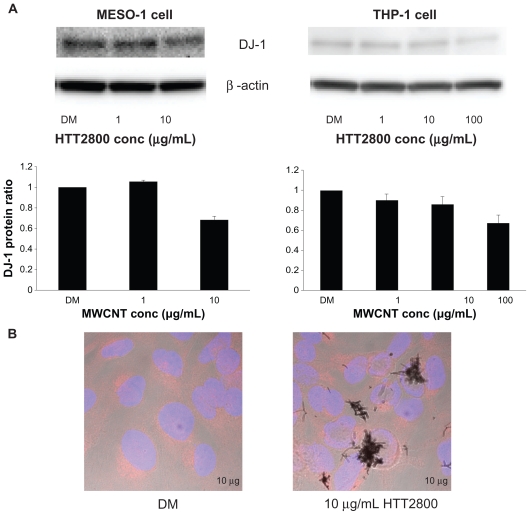
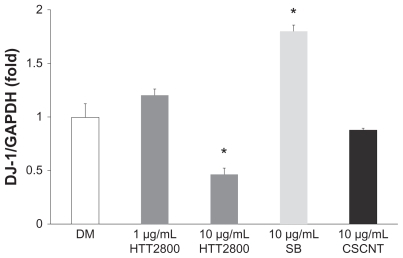
Using Western blot analysis, we determined DJ-1 protein levels in two different types of cells (one capable and the other incapable of HTT2800 endocytosis). Using quantitative real-time polymerase chain reaction, we also investigated the ability of purified nanotubes to alter DJ-1 mRNA levels.
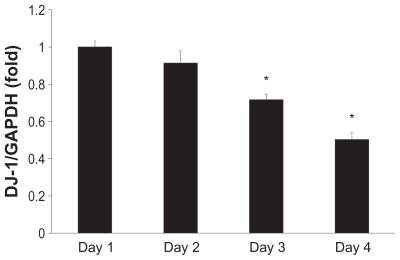
We demonstrated that the DJ-1 protein concentration was reduced, regardless of the cytotoxic activity of intracellular HTT2800. Furthermore, HTT2800 decreased the DJ-1 mRNA levels in a dose-dependent manner. This decrease in DJ-1 mRNA levels was not observed in the case of Sumi black or cup-stacked carbon nanotubes.
These data indicate that modification of DJ-1 expression is caused by the cell response to MWCNTs. We conclude that DJ-1 is a promising candidate biomarker for the development of biocompatible MWCNTs.
在本研究中,我们使用高度纯化的碳纳米管 HTT2800 研究了 DJ-1 是否可以作为评估多壁碳纳米管 (MWCNT) 生物相容性的生物标志物。
使用 Western blot 分析,我们测定了两种不同类型细胞(一种能够内化 HTT2800,另一种不能)中 DJ-1 蛋白水平。使用实时定量聚合酶链反应,我们还研究了纯化纳米管改变 DJ-1 mRNA 水平的能力。
我们证明,无论 HTT2800 的细胞毒性活性如何,DJ-1 蛋白浓度均降低。此外,HTT2800 以剂量依赖性方式降低 DJ-1 mRNA 水平。在 Sumi 黑或杯堆叠碳纳米管的情况下,未观察到 DJ-1 mRNA 水平降低。
这些数据表明 DJ-1 表达的修饰是由细胞对 MWCNT 的反应引起的。我们得出结论,DJ-1 是开发生物相容 MWCNT 的有前途的候选生物标志物。