Laboratory of Allergic Diseases, National Institute of Allergy and Infectious Diseases, National Institutes of Health, Bethesda, MD 20892, USA.
Immunity. 2011 Nov 23;35(5):806-18. doi: 10.1016/j.immuni.2011.09.016.
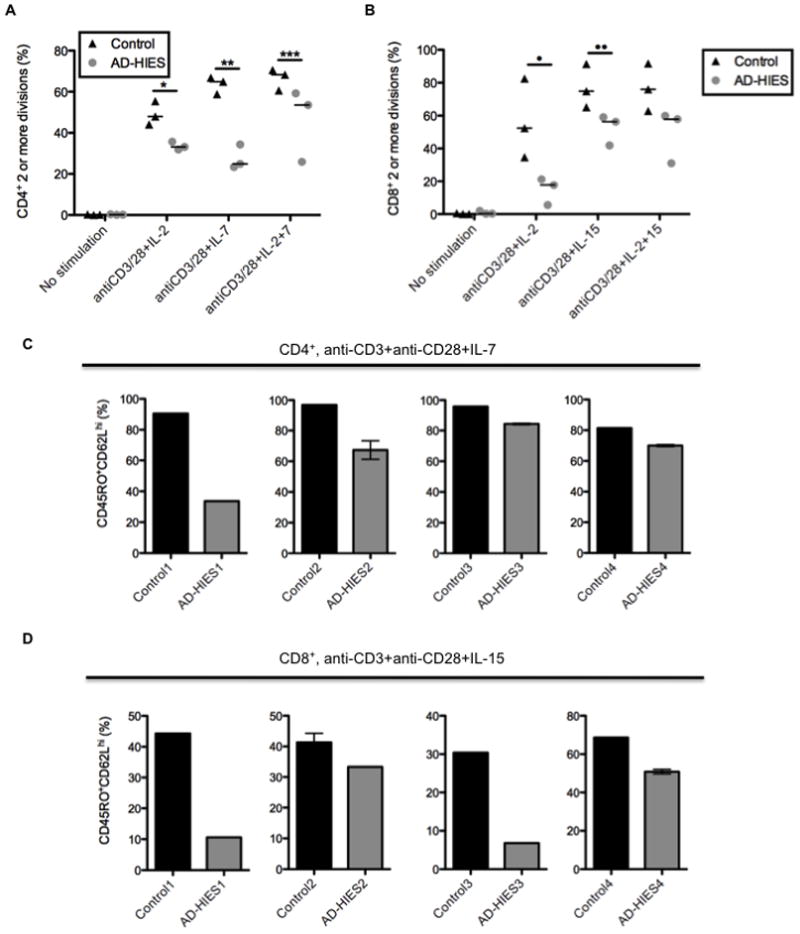
STAT3 transcription factor signaling in specific T helper cell differentiation has been well described, although the broader roles for STAT3 in lymphocyte memory are less clear. Patients with autosomal-dominant hyper-IgE syndrome (AD-HIES) carry dominant-negative STAT3 mutations and are susceptible to a variety of bacterial and fungal infections. We found that AD-HIES patients have a cell-intrinsic defect in the number of central memory CD4(+) and CD8(+) T cells compared to healthy controls. Naive T cells from AD-HIES patients had lower expression of memory-related transcription factors BCL6 and SOCS3, a primary proliferation defect, and they failed to acquire central memory-like surface phenotypes in vitro. AD-HIES patients showed a decreased ability to control varicella zoster virus (VZV) and Epstein-Barr virus (EBV) latency, and T cell memory to both of these viruses was compromised. These data point to a specific role for STAT3 in human central memory T cell formation and in control of certain chronic viruses.
STAT3 转录因子信号在特定的辅助性 T 细胞分化中已有很好的描述,尽管 STAT3 在淋巴细胞记忆中的更广泛作用尚不清楚。常染色体显性遗传高免疫球蛋白 E 综合征(AD-HIES)患者携带显性负 STAT3 突变,易发生各种细菌和真菌感染。我们发现,与健康对照组相比,AD-HIES 患者的中央记忆 CD4(+)和 CD8(+)T 细胞数量存在细胞内缺陷。与健康对照组相比,AD-HIES 患者的幼稚 T 细胞中记忆相关转录因子 BCL6 和 SOCS3 的表达水平较低,存在原发性增殖缺陷,并且它们无法在体外获得类似于中央记忆的表面表型。AD-HIES 患者控制水痘带状疱疹病毒(VZV)和 Epstein-Barr 病毒(EBV)潜伏感染的能力下降,并且这两种病毒的 T 细胞记忆均受到损害。这些数据表明 STAT3 在人类中央记忆 T 细胞形成和控制某些慢性病毒方面具有特定作用。