Department of Neurology, Xiangya Hospital, Central South University, Changsha, Hunan Province, 410008, China.
Brain. 2011 Dec;134(Pt 12):3493-3501. doi: 10.1093/brain/awr289. Epub 2011 Nov 26.
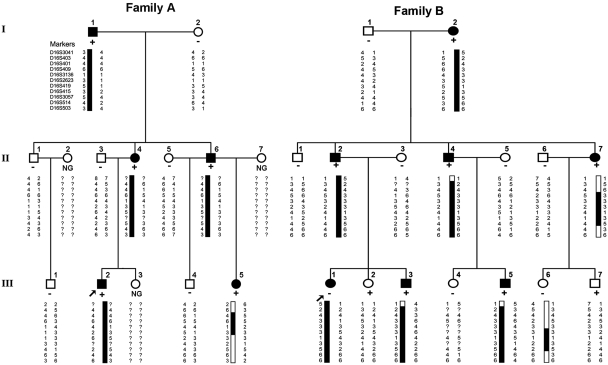
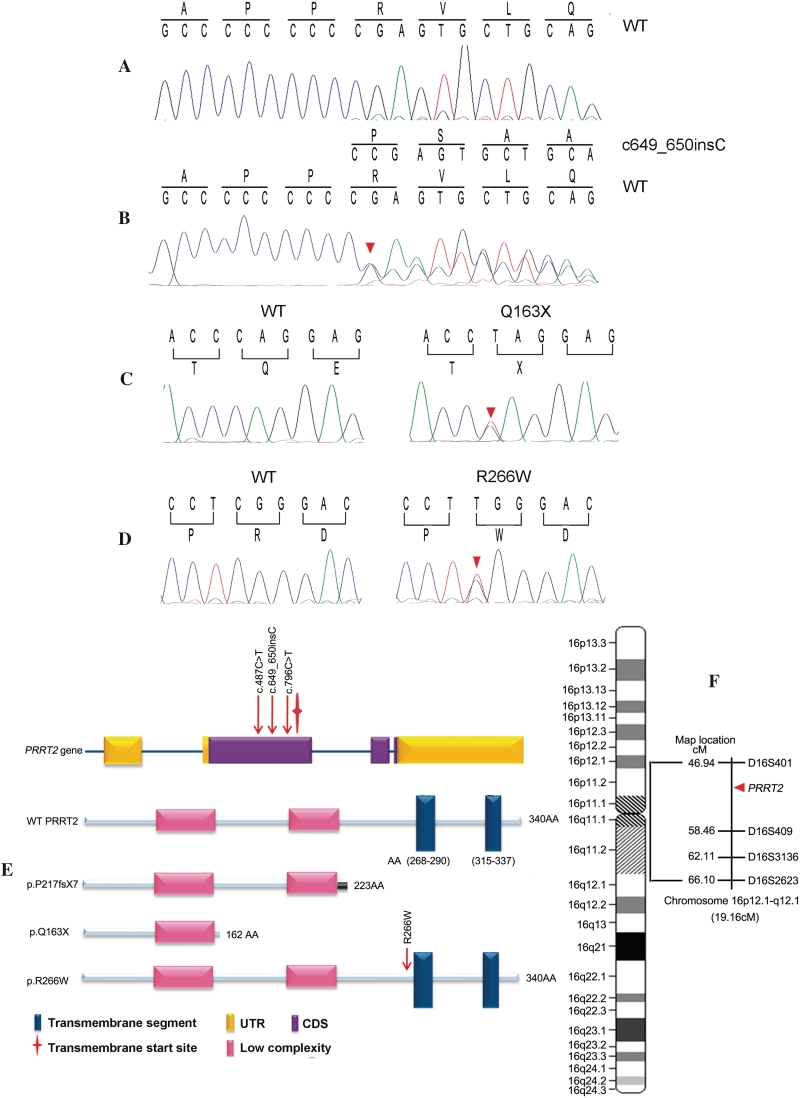
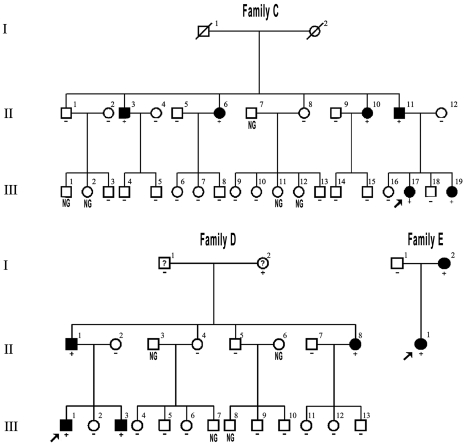
Paroxysmal kinesigenic dyskinesias is a paroxysmal movement disorder characterized by recurrent, brief attacks of abnormal involuntary movements induced by sudden voluntary movements. Although several loci, including the pericentromeric region of chromosome 16, have been linked to paroxysmal kinesigenic dyskinesias, the causative gene has not yet been identified. Here, we identified proline-rich transmembrane protein 2 (PRRT2) as a causative gene of paroxysmal kinesigenic dyskinesias by using a combination of exome sequencing and linkage analysis. Genetic linkage mapping with 11 markers that encompassed the pericentromeric of chromosome 16 was performed in 27 members of two families with autosomal dominant paroxysmal kinesigenic dyskinesias. Then, the whole-exome sequencing was performed in three patients from these two families. By combining the defined linkage region (16p12.1-q12.1) and the results of exome sequencing, we identified an insertion mutation c.649_650InsC (p.P217fsX7) in one family and a nonsense mutation c.487C>T (p.Q163X) in another family. To confirm our findings, we sequenced the exons and flanking introns of PRRT2 in another three families with paroxysmal kinesigenic dyskinesias. The c.649_650InsC (p.P217fsX7) mutation was identified in two of these families, whereas a missense mutation, c.796C>T (R266W), was identified in another family with paroxysmal kinesigenic dyskinesias. All of these mutations completely co-segregated with the phenotype in each family. None of these mutations was identified in 500 normal unaffected individuals of matched geographical ancestry. Thus, we have identified PRRT2 as the first causative gene of paroxysmal kinesigenic dyskinesias, warranting further investigations to understand the pathogenesis of this disorder.
发作性运动诱发性运动障碍是一种阵发性运动障碍,其特征是反复出现短暂的异常不自主运动发作,这些发作由突然的随意运动诱发。虽然已经确定了几个与发作性运动诱发性运动障碍相关的基因座,包括 16 号染色体着丝粒周围区域,但致病基因尚未确定。在这里,我们通过外显子组测序和连锁分析相结合,确定富含脯氨酸的跨膜蛋白 2(PRRT2)是发作性运动诱发性运动障碍的致病基因。在两个常染色体显性遗传发作性运动诱发性运动障碍家族的 27 名成员中,使用 11 个标记物进行了包含 16 号染色体着丝粒周围区域的遗传连锁作图。然后,对来自这两个家族的 3 名患者进行了全外显子组测序。通过结合定义的连锁区域(16p12.1-q12.1)和外显子组测序结果,我们在一个家族中发现了一个插入突变 c.649_650InsC(p.P217fsX7),在另一个家族中发现了一个无义突变 c.487C>T(p.Q163X)。为了确认我们的发现,我们对另外三个发作性运动诱发性运动障碍家族的 PRRT2 外显子和侧翼内含子进行了测序。在其中两个家族中发现了 c.649_650InsC(p.P217fsX7)突变,而在另一个家族中发现了一个错义突变 c.796C>T(R266W)。这些突变在每个家族中与表型完全共分离。在具有匹配地理起源的 500 名正常未受影响个体中未发现这些突变。因此,我们已经确定 PRRT2 是发作性运动诱发性运动障碍的第一个致病基因,需要进一步研究以了解这种疾病的发病机制。