Department of Dermatology, University of California San Francisco, San Francisco, California 94115, USA.
Nature. 2011 Nov 27;480(7378):538-42. doi: 10.1038/nature10664.
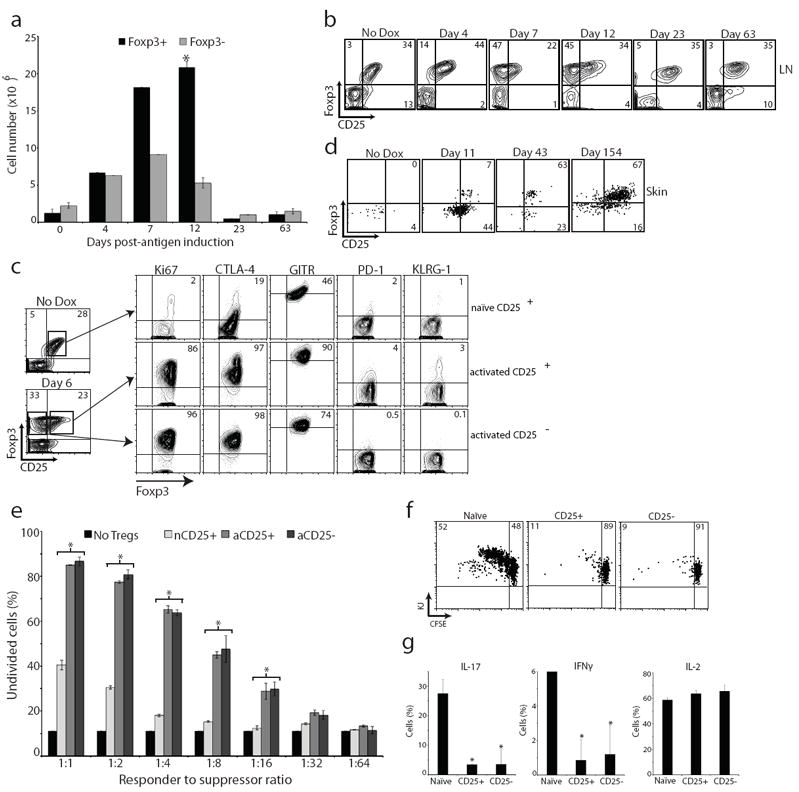
Immune homeostasis in tissues is achieved through a delicate balance between pathogenic T-cell responses directed at tissue-specific antigens and the ability of the tissue to inhibit these responses. The mechanisms by which tissues and the immune system communicate to establish and maintain immune homeostasis are currently unknown. Clinical evidence suggests that chronic or repeated exposure to self antigen within tissues leads to an attenuation of pathological autoimmune responses, possibly as a means to mitigate inflammatory damage and preserve function. Many human organ-specific autoimmune diseases are characterized by the initial presentation of the disease being the most severe, with subsequent flares being of lesser severity and duration. In fact, these diseases often spontaneously resolve, despite persistent tissue autoantigen expression. In the practice of antigen-specific immunotherapy, allergens or self antigens are repeatedly injected in the skin, with a diminution of the inflammatory response occurring after each successive exposure. Although these findings indicate that tissues acquire the ability to attenuate autoimmune reactions upon repeated responses to antigens, the mechanism by which this occurs is unknown. Here we show that upon expression of self antigen in a peripheral tissue, thymus-derived regulatory T cells (T(reg) cells) become activated, proliferate and differentiate into more potent suppressors, which mediate resolution of organ-specific autoimmunity in mice. After resolution of the inflammatory response, activated T(reg) cells are maintained in the target tissue and are primed to attenuate subsequent autoimmune reactions when antigen is re-expressed. Thus, T(reg) cells function to confer 'regulatory memory' to the target tissue. These findings provide a framework for understanding how T(reg) cells respond when exposed to self antigen in peripheral tissues and offer mechanistic insight into how tissues regulate autoimmunity.
组织中的免疫稳态是通过针对组织特异性抗原的致病性 T 细胞反应与组织抑制这些反应的能力之间的微妙平衡来实现的。组织和免疫系统用来建立和维持免疫稳态的机制目前尚不清楚。临床证据表明,慢性或反复暴露于组织内的自身抗原会导致病理性自身免疫反应减弱,这可能是减轻炎症损伤和保护功能的一种手段。许多人类器官特异性自身免疫性疾病的特点是疾病的初始表现最为严重,随后的发作则较为轻微且持续时间较短。事实上,尽管持续存在组织自身抗原表达,这些疾病往往会自行缓解。在抗原特异性免疫治疗的实践中,过敏原或自身抗原会反复注射到皮肤中,每次连续暴露后炎症反应都会减弱。尽管这些发现表明,组织在反复接触抗原后获得了减弱自身免疫反应的能力,但这种情况发生的机制尚不清楚。在这里,我们表明,在外周组织中表达自身抗原后,胸腺来源的调节性 T 细胞(Treg 细胞)被激活、增殖并分化为更有效的抑制物,从而介导小鼠的器官特异性自身免疫的消退。在炎症反应消退后,活化的 Treg 细胞在靶组织中得以维持,并在抗原再次表达时被预先致敏以减弱随后的自身免疫反应。因此,Treg 细胞为靶组织赋予“调节性记忆”。这些发现为理解 Treg 细胞在暴露于外周组织中的自身抗原时的反应提供了一个框架,并为组织如何调节自身免疫提供了机制上的见解。