Hematology Department, 12 De Octubre University Hospital, Madrid, Spain.
BMC Gastroenterol. 2011 Nov 28;11:130. doi: 10.1186/1471-230X-11-130.
Vascular complications, such as HAT, are an important cause of graft loss and recipient mortality. We aimed to characterize post-transplant thrombotic events in a cohort of liver transplant recipients, and identify independent risk factors for these complications.
We conducted a thrombophilic study of 293 orthotopic liver transplants performed in the Digestive Surgery Department of the 12 de Octubre Hospital (Madrid, Spain) between January 2001 and December 2006.
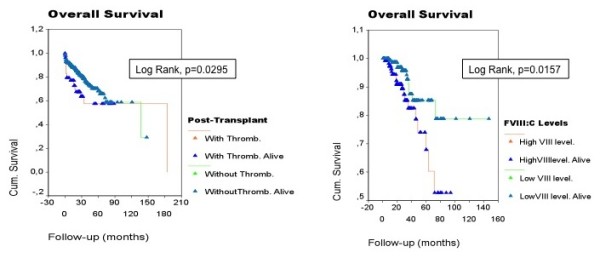
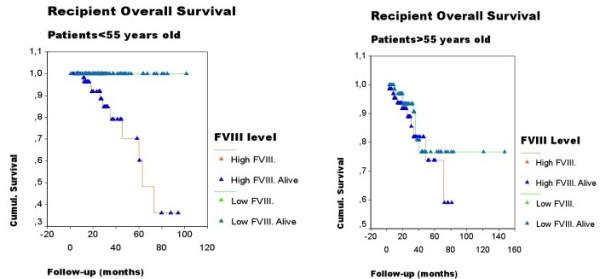
The most frequent post-transplant thrombotic events were HAT (9%) and PVT (1.7%). The one variable associated with post-transplant thrombotic event was a high fibrinogen level in the global cohort of liver transplantation. But toxicity as event post-OLT has been associated with post-transplant thrombotic event in the retrospective group and high fibrinogen level and low protein C levels were associated post-transplant thrombotic event in the prospective group. Liver disease relapse (HR 6.609, p < 0.001), high levels of FVIII (HR 1.008, p = 0.019)) and low levels of antithrombin (HR 0.946, p < 0.001) were associated with poor overall survival (OS).In conclusion, high fibrinogen and decreased protein C levels were associated with allograft thrombosis. Further studies are required in order to assess the clinical relevance of these parameters in prospective studies and to study the effect of anticoagulation prophylaxis in this group of risk.
血管并发症,如 HAT,是移植物丢失和受者死亡的重要原因。我们旨在描述一组肝移植受者移植后血栓形成事件,并确定这些并发症的独立危险因素。
我们对 2001 年 1 月至 2006 年 12 月在西班牙马德里 12 月 12 日医院消化外科进行的 293 例原位肝移植进行了血栓形成研究。
最常见的移植后血栓形成事件是 HAT(9%)和 PVT(1.7%)。在肝移植的全球队列中,与移植后血栓形成事件相关的唯一变量是纤维蛋白原水平升高。但在回顾性组中,OLT 后毒性与移植后血栓形成事件相关,而在前瞻性组中,纤维蛋白原水平升高和蛋白 C 水平降低与移植后血栓形成事件相关。肝疾病复发(HR 6.609,p < 0.001)、VIII 因子水平升高(HR 1.008,p = 0.019)和抗凝血酶水平降低(HR 0.946,p < 0.001)与总生存(OS)不良相关。总之,高纤维蛋白原和蛋白 C 水平降低与同种异体移植血栓形成相关。需要进一步研究以评估这些参数在前瞻性研究中的临床相关性,并研究抗凝预防在这组风险中的作用。