Department of Neuroscience and Pharmacology, Rudolf Magnus Institute of Neuroscience, UMC Utrecht, Universiteitsweg 100, 3584 CG, Utrecht, The Netherlands.
Psychopharmacology (Berl). 2012 Jan;219(2):313-26. doi: 10.1007/s00213-011-2576-x. Epub 2011 Dec 3.
High levels of impulsivity are a core symptom of psychiatric disorders such as ADHD, mania, personality disorders and drug addiction. The effectiveness of drugs targeting dopamine (DA), noradrenaline (NA) and/or serotonin (5-HT) in the treatment of impulse control disorders emphasizes the role of monoaminergic neurotransmission in impulsivity. However, impulsive behavior is behaviorally and neurally heterogeneous, and several caveats remain in our understanding of the role of monoamines in impulse control.
This study aims to investigate the role of DA, NA and 5-HT in two main behavioral dimensions of impulsivity.
The effects of selective DA (GBR12909; 2.5-10 mg/kg), NA (atomoxetine; 0.3-3.0 mg/kg) and 5-HT (citalopram; 0.3-3.0 mg/kg) reuptake inhibitors as well as amphetamine (0.25-1.0 mg/kg) were evaluated on impulsive action in the five-choice serial reaction time task (5-CSRTT) and impulsive choice in the delayed reward task (DRT). In the 5-CSRTT, neuropharmacological challenges were performed under baseline and long intertrial interval (ITI) conditions to enhance impulsive behavior in the task.
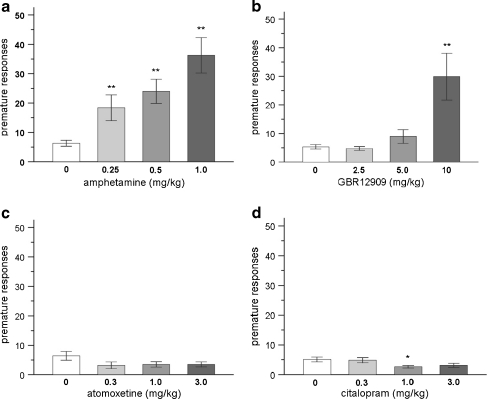
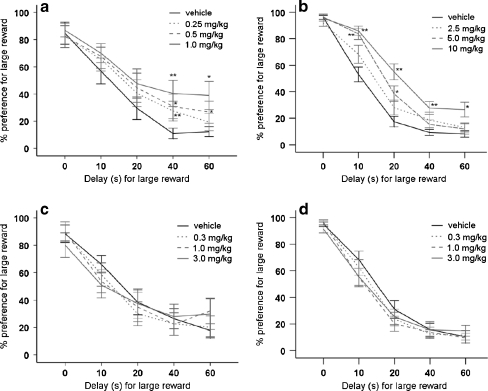
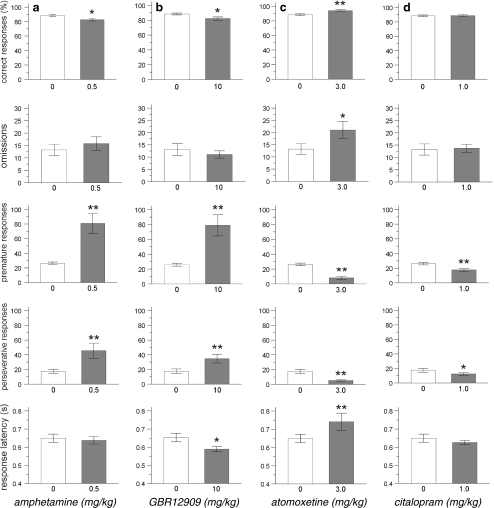
Amphetamine and GBR12909 increased impulsive action and perseverative responding and decreased accuracy and response latency in the 5-CSRTT. Atomoxetine increased errors of omission and response latency under baseline conditions in the 5-CSRTT. Under a long ITI, atomoxetine also reduced premature and perseverative responding and increased accuracy. Citalopram improved impulse control in the 5-CSRTT. Amphetamine and GBR12909, but not citalopram or atomoxetine, reduced impulsive choice in the DRT.
Elevation of DA neurotransmission increases impulsive action and reduces impulsive choice. Increasing NA or 5-HT neurotransmission reduces impulsive action.
冲动水平高是 ADHD、躁狂症、人格障碍和药物成瘾等精神疾病的核心症状。靶向多巴胺(DA)、去甲肾上腺素(NA)和/或 5-羟色胺(5-HT)的药物在冲动控制障碍治疗中的有效性强调了单胺能神经传递在冲动性中的作用。然而,冲动行为在行为和神经上是异质的,我们对单胺在冲动控制中的作用的理解仍然存在一些注意事项。
本研究旨在探讨 DA、NA 和 5-HT 在冲动性的两个主要行为维度中的作用。
评估选择性 DA(GBR12909;2.5-10mg/kg)、NA(阿托西汀;0.3-3.0mg/kg)和 5-HT(西酞普兰;0.3-3.0mg/kg)再摄取抑制剂以及安非他命(0.25-1.0mg/kg)对 5 选择连续反应时间任务(5-CSRTT)中的冲动动作和延迟奖励任务(DRT)中的冲动选择的影响。在 5-CSRTT 中,在基线和长试验间隔(ITI)条件下进行神经药理学挑战,以增强任务中的冲动行为。
安非他命和 GBR12909 增加了 5-CSRTT 中的冲动动作和持续反应,并降低了准确性和反应时。阿托西汀在 5-CSRTT 的基线条件下增加了遗漏错误和反应时。在长 ITI 下,阿托西汀还减少了过早和持续反应,并提高了准确性。西酞普兰改善了 5-CSRTT 中的冲动控制。安非他命和 GBR12909,但不是西酞普兰或阿托西汀,减少了 DRT 中的冲动选择。
升高 DA 神经传递增加冲动动作并减少冲动选择。增加 NA 或 5-HT 神经传递减少冲动动作。