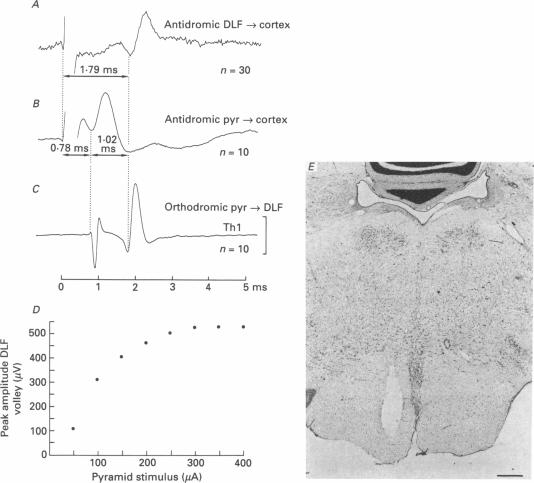
The responses evoked by non-invasive electromagnetic and surface anodal electrical stimulation of the scalp (scalp stimulation) have been studied in the monkey. Conventional recording and stimulating electrodes, placed in the corticospinal pathway in the hand area of the left motor cortex, left medullary pyramid and the right spinal dorsolateral funiculus (DLF), allowed comparison of the actions of non-invasive stimuli and conventional electrical stimulation. 2. Responses to electromagnetic stimulation (with the coil tangential to the skull) were studied in four anaesthetized monkeys. In each case short-latency descending volleys were recorded in the contralateral DLF at threshold. In two animals later responses were also seen at higher stimulus intensities. Both early and late responses were of corticospinal origin since they could be completely collided by appropriately timed stimulation of the pyramidal tract. The latency of the early response in the DLF indicated that it resulted from direct activation of corticospinal neurones: its latency was the same as the latency of the antidromic action potentials evoked in the motor cortex from the recording site in the DLF. 3. Scalp stimulation, which was also investigated in three of the monkeys, evoked short-latency volleys at threshold and at higher stimulus intensities these were followed by later waves. The short-latency volleys could be collided from the pyramid and, at threshold, had latencies compatible with direct activation of corticospinal neurones. The longer latency volleys were also identified as corticospinal in origin. 4. The latency of the early volley evoked by electromagnetic stimulation remained constant with increasing stimulus intensities. In contrast, with scalp stimulation above threshold the latency of the early volleys decreased considerably, indicating remote activation of the corticospinal pathway below the level of the motor cortex. In two monkeys both collision and latency data suggest activation of the corticospinal pathway as far caudal as the medulla. 5. The majority of fast corticospinal fibres could be excited by scalp stimulation with intensities of 20% of maximum stimulator output. Electromagnetic stimulation at maximum stimulator output elicited a volley of between 70 and 90% of the size of the maximal volley evoked from the pyramidal electrodes. 6. Electromagnetic stimulation was also investigated in one awake monkey during the performance of a precision grip task. Short-latency EMG responses were evoked in hand and forearm muscles. The onsets of these responses were approximately 0.8 ms longer than the responses evoked by electrical stimulation of the pyramid.(ABSTRACT TRUNCATED AT 400 WORDS)