National Institute of Floricultural Science (NIFS), National Agriculture and Food Research Organization (NARO), 2-1 Fujimoto, Tsukuba, Ibaraki 305-8519, Japan.
J Exp Bot. 2012 Feb;63(3):1461-77. doi: 10.1093/jxb/err387. Epub 2011 Dec 3.
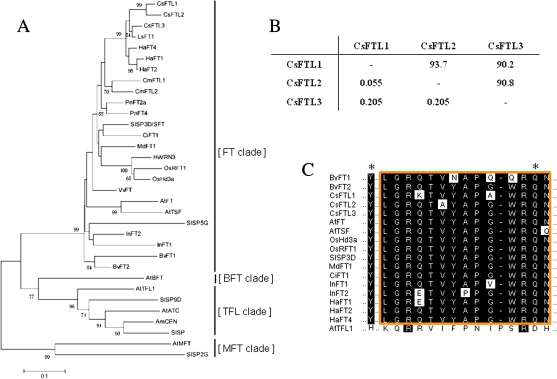
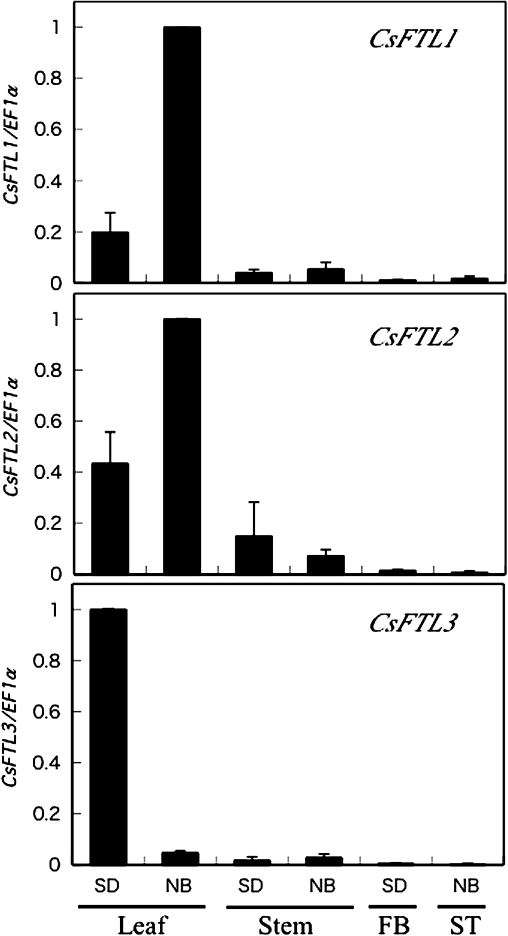
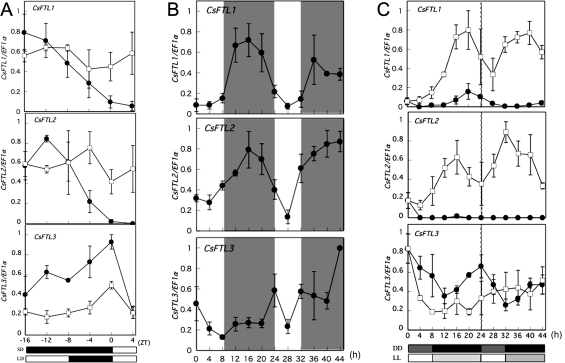
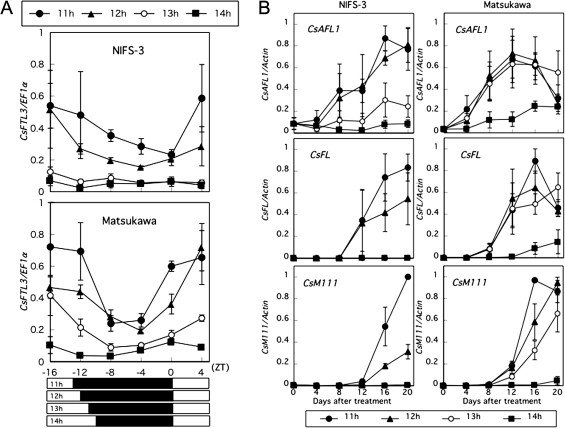
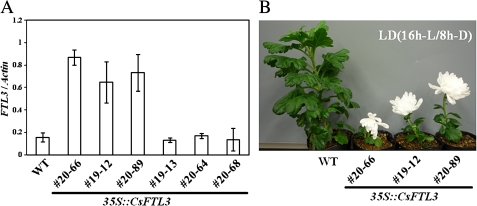
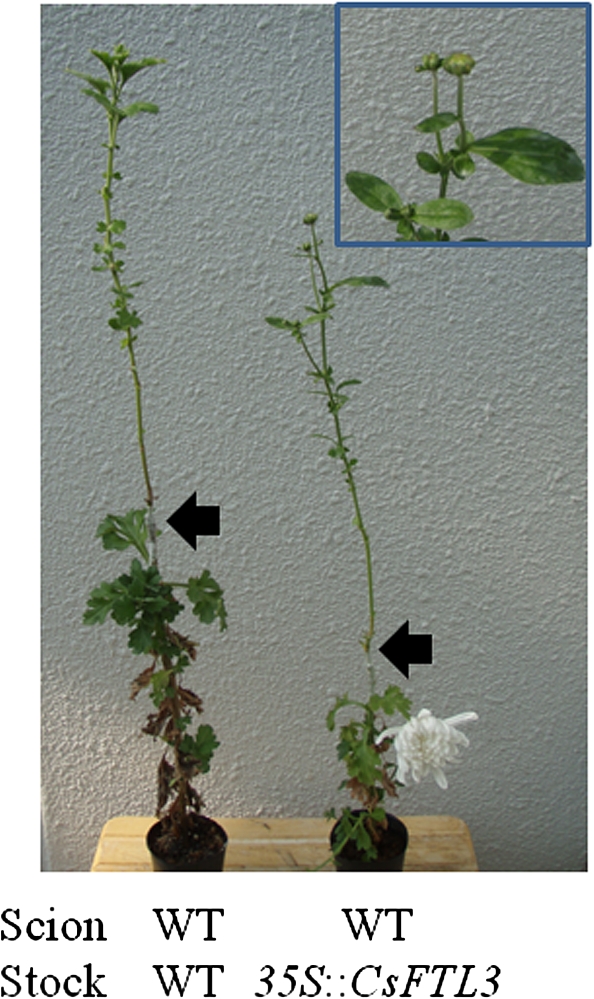
Chrysanthemum is a typical short-day (SD) plant that responds to shortening daylength during the transition from the vegetative to the reproductive phase. FLOWERING LOCUS T (FT)/Heading date 3a (Hd3a) plays a pivotal role in the induction of phase transition and is proposed to encode a florigen. Three FT-like genes were isolated from Chrysanthemum seticuspe (Maxim.) Hand.-Mazz. f. boreale (Makino) H. Ohashi & Yonek, a wild diploid chrysanthemum: CsFTL1, CsFTL2, and CsFTL3. The organ-specific expression patterns of the three genes were similar: they were all expressed mainly in the leaves. However, their response to daylength differed in that under SD (floral-inductive) conditions, the expression of CsFTL1 and CsFTL2 was down-regulated, whereas that of CsFTL3 was up-regulated. CsFTL3 had the potential to induce early flowering since its overexpression in chrysanthemum could induce flowering under non-inductive conditions. CsFTL3-dependent graft-transmissible signals partially substituted for SD stimuli in chrysanthemum. The CsFTL3 expression levels in the two C. seticuspe accessions that differed in their critical daylengths for flowering closely coincided with the flowering response. The CsFTL3 expression levels in the leaves were higher under floral-inductive photoperiods than under non-inductive conditions in both the accessions, with the induction of floral integrator and/or floral meristem identity genes occurring in the shoot apexes. Taken together, these results indicate that the gene product of CsFTL3 is a key regulator of photoperiodic flowering in chrysanthemums.
菊花是一种典型的短日照(SD)植物,在从营养生长向生殖生长的转变过程中,对日照时间缩短做出响应。FT/Heading date 3a(Hd3a)在诱导阶段转变中起着关键作用,并被提议编码成成花素。从野菊 Chrysanthemum seticuspe(Maxim.)Hand.-Mazz. f. boreale(Makino)H. Ohashi & Yonek 中分离出三个 FT 样基因:CsFTL1、CsFTL2 和 CsFTL3。这三个基因的器官特异性表达模式相似:它们主要在叶片中表达。然而,它们对日照长度的反应不同,在 SD(诱导开花)条件下,CsFTL1 和 CsFTL2 的表达下调,而 CsFTL3 的表达上调。CsFTL3 具有诱导早花的潜力,因为它在菊花中的过表达可以在非诱导条件下诱导开花。CsFTL3 依赖的嫁接可传递信号部分替代了菊花中的 SD 刺激。在开花关键日长不同的两个野菊品系中,CsFTL3 的表达水平与开花反应密切吻合。在两个品系中,在诱导开花的光周期下,CsFTL3 在叶片中的表达水平高于非诱导条件下,并且在茎顶端发生了花整合素和/或花分生组织身份基因的诱导。总之,这些结果表明,CsFTL3 的基因产物是菊花光周期开花的关键调节剂。