Department of Orthopedic Surgery, Keio University School of Medicine, Shinjuku-ku, Tokyo, Japan.
PLoS One. 2011;6(11):e27706. doi: 10.1371/journal.pone.0027706. Epub 2011 Nov 29.
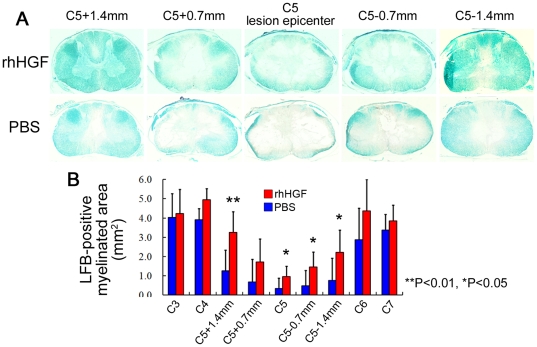
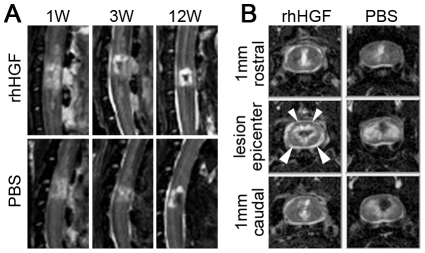
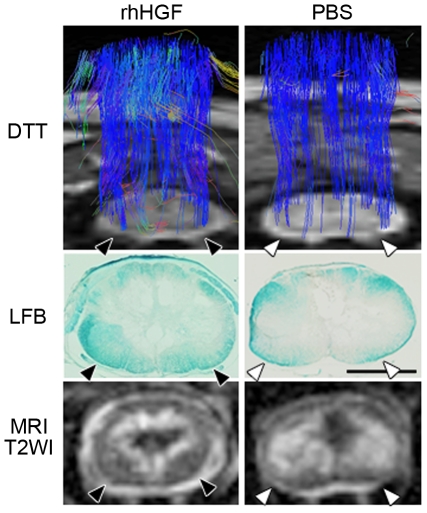
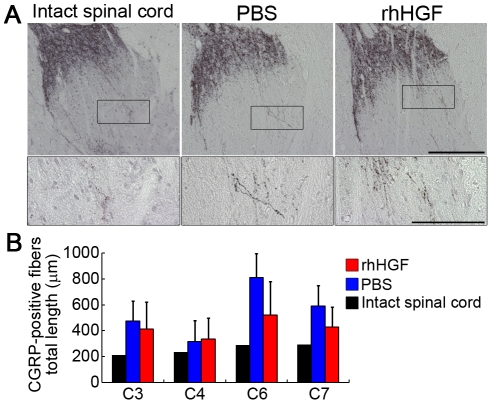
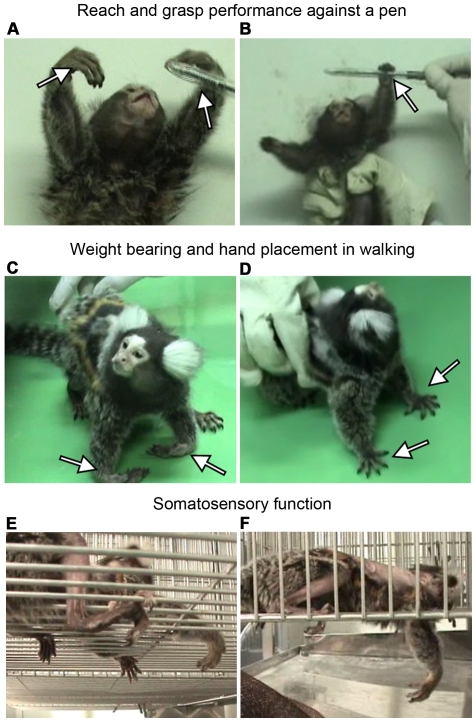
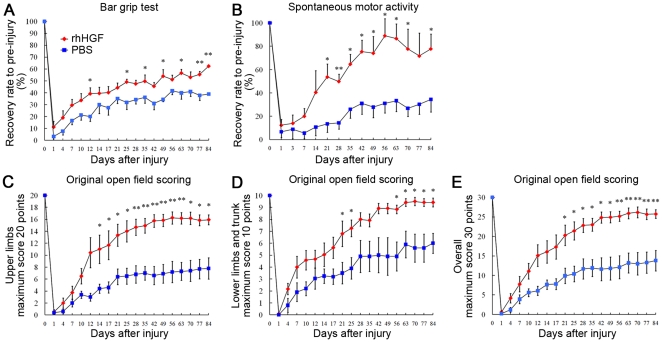
Many therapeutic interventions for spinal cord injury (SCI) using neurotrophic factors have focused on reducing the area damaged by secondary, post-injury degeneration, to promote functional recovery. Hepatocyte growth factor (HGF), which is a potent mitogen for mature hepatocytes and a mediator of the inflammatory responses to tissue injury, was recently highlighted as a potent neurotrophic factor in the central nervous system. We previously reported that introducing exogenous HGF into the injured rodent spinal cord using a herpes simplex virus-1 vector significantly reduces the area of damaged tissue and promotes functional recovery. However, that study did not examine the therapeutic effects of administering HGF after injury, which is the most critical issue for clinical application. To translate this strategy to human treatment, we induced a contusive cervical SCI in the common marmoset, a primate, and then administered recombinant human HGF (rhHGF) intrathecally. Motor function was assessed using an original open field scoring system focusing on manual function, including reach-and-grasp performance and hand placement in walking. The intrathecal rhHGF preserved the corticospinal fibers and myelinated areas, thereby promoting functional recovery. In vivo magnetic resonance imaging showed significant preservation of the intact spinal cord parenchyma. rhHGF-treatment did not give rise to an abnormal outgrowth of calcitonin gene related peptide positive fibers compared to the control group, indicating that this treatment did not induce or exacerbate allodynia. This is the first study to report the efficacy of rhHGF for treating SCI in non-human primates. In addition, this is the first presentation of a novel scale for assessing neurological motor performance in non-human primates after contusive cervical SCI.
许多使用神经营养因子的脊髓损伤 (SCI) 治疗干预措施都集中在减少继发性损伤后的损伤区域,以促进功能恢复。肝细胞生长因子 (HGF) 是一种成熟肝细胞的有效有丝分裂原,也是组织损伤炎症反应的介质,最近被认为是中枢神经系统中的一种有效神经营养因子。我们之前报道过,使用单纯疱疹病毒 1 载体将外源性 HGF 引入受损的啮齿动物脊髓中,可以显著减少受损组织的面积并促进功能恢复。然而,该研究并未检查损伤后给予 HGF 的治疗效果,这是临床应用的最关键问题。为了将该策略转化为人类治疗,我们在原猴中诱导了颈脊髓的挫伤性 SCI,然后鞘内给予重组人 HGF (rhHGF)。使用着重于手动功能的原始开放式评分系统评估运动功能,包括伸手抓握性能和行走时的手放置。鞘内 rhHGF 保留了皮质脊髓纤维和有髓鞘区域,从而促进了功能恢复。体内磁共振成像显示完整脊髓实质得到了显著保留。与对照组相比,rhHGF 治疗不会导致降钙素基因相关肽阳性纤维的异常过度生长,表明该治疗不会引起或加剧痛觉过敏。这是第一项报道 rhHGF 治疗非人类灵长类动物 SCI 的功效的研究。此外,这是首次在非人类灵长类动物颈脊髓挫伤后评估神经运动表现的新型量表。