Helmholtz-University Group Oncolytic Adenoviruses, German Cancer Research Center (Deutsches Krebsforschungszentrum-DKFZ), Department of Dermatology, Heidelberg University Hospital, Heidelberg, Germany.
PLoS One. 2011;6(11):e27934. doi: 10.1371/journal.pone.0027934. Epub 2011 Nov 30.
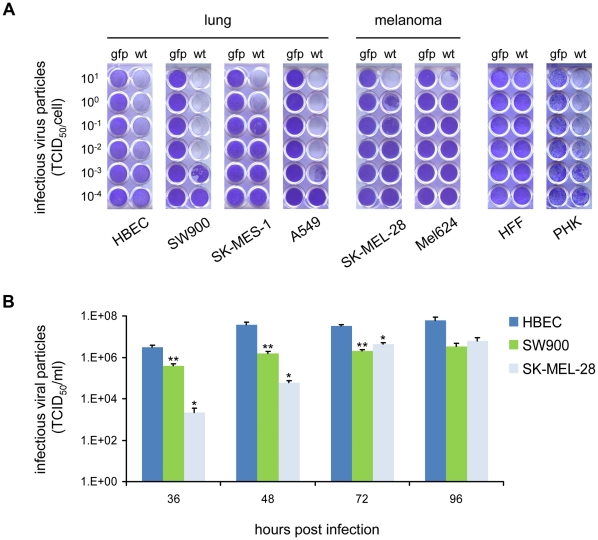
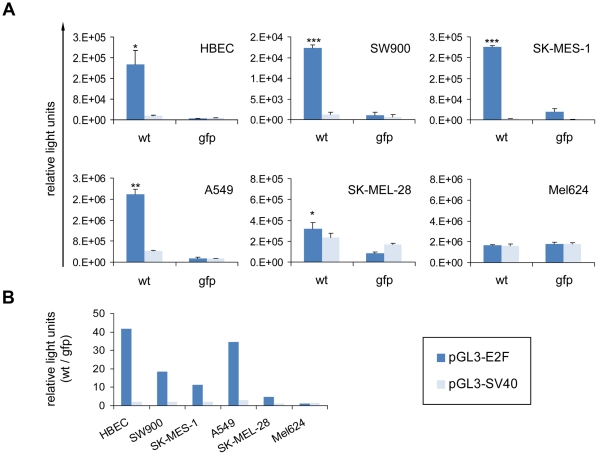
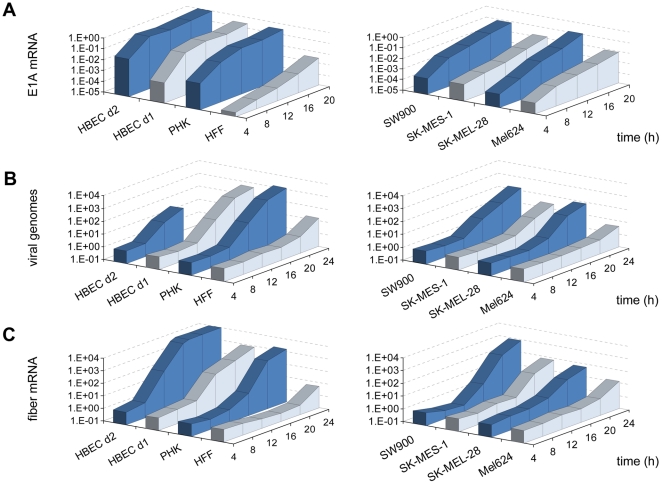
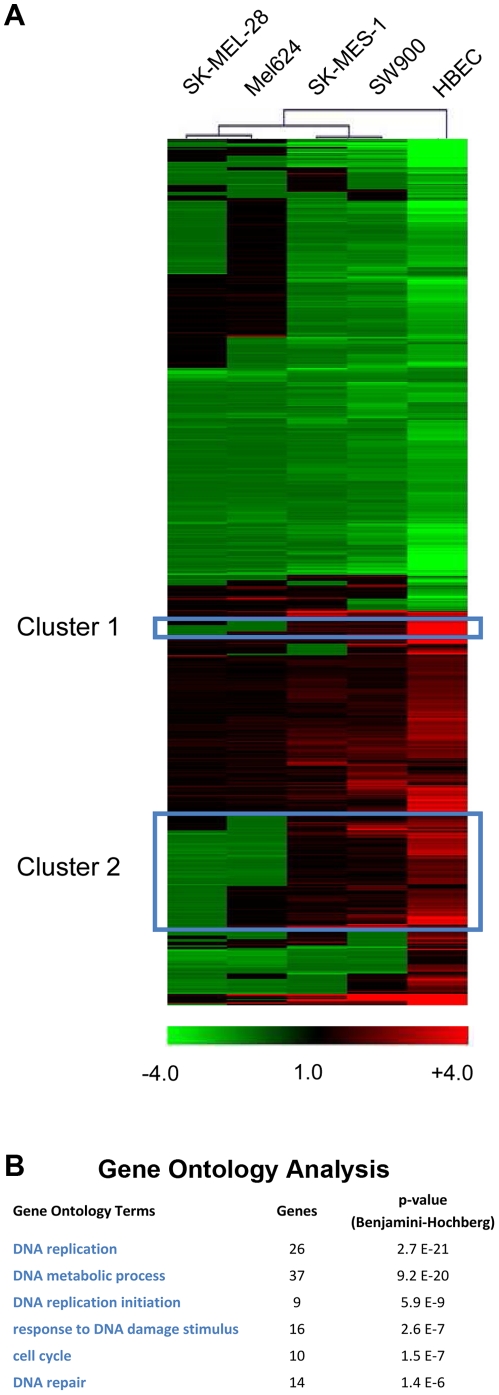
Adenoviruses (Ads), especially HAdV-5, have been genetically equipped with tumor-restricted replication potential to enable applications in oncolytic cancer therapy. Such oncolytic adenoviruses have been well tolerated in cancer patients, but their anti-tumor efficacy needs to be enhanced. In this regard, it should be considered that cancer cells, dependent on their tissue of origin, can differ substantially from the normal host cells to which Ads are adapted by complex virus-host interactions. Consequently, viral replication efficiency, a key determinant of oncolytic activity, might be suboptimal in cancer cells. Therefore, we have analyzed both the replication kinetics of HAdV-5 and the virus-induced transcriptome in human bronchial epithelial cells (HBEC) in comparison to cancer cells. This is the first report on genome-wide expression profiling of Ads in their native host cells. We found that E1A expression and onset of viral genome replication are most rapid in HBEC and considerably delayed in melanoma cells. In squamous cell lung carcinoma cells, we observed intermediate HAdV-5 replication kinetics. Infectious particle production, viral spread and lytic activity of HAdV-5 were attenuated in melanoma cells versus HBEC. Expression profiling at the onset of viral genome replication revealed that HAdV-5 induced the strongest changes in the cellular transcriptome in HBEC, followed by lung cancer and melanoma cells. We identified prominent regulation of genes involved in cell cycle and DNA metabolism, replication and packaging in HBEC, which is in accord with the necessity to induce S phase for viral replication. Strikingly, in melanoma cells HAdV-5 triggered opposing regulation of said genes and, in contrast to lung cancer cells, no weak S phase induction was detected when using the E2F promoter as reporter. Our results provide a rationale for improving oncolytic adenoviruses either by adaptation of viral infection to target tumor cells or by modulating tumor cell functions to better support viral replication.
腺病毒(Ads),特别是 HAdV-5,在遗传上具有肿瘤限制复制潜力,可用于溶瘤癌症治疗。在癌症患者中,此类溶瘤腺病毒的耐受性良好,但它们的抗肿瘤疗效需要增强。在这方面,应该考虑到癌细胞,取决于其起源组织,可以与 Ads 通过复杂的病毒-宿主相互作用适应的正常宿主细胞有很大的不同。因此,病毒复制效率,即溶瘤活性的关键决定因素,在癌细胞中可能不理想。因此,我们分析了 HAdV-5 的复制动力学以及病毒诱导的人类支气管上皮细胞(HBEC)与癌细胞中的转录组。这是 Ads 在其天然宿主细胞中进行全基因组表达谱分析的首次报道。我们发现,E1A 表达和病毒基因组复制的开始在 HBEC 中最快,在黑色素瘤细胞中则明显延迟。在鳞状细胞肺癌细胞中,我们观察到中间的 HAdV-5 复制动力学。与 HBEC 相比,感染性颗粒产生、病毒传播和 HAdV-5 的溶细胞活性在黑色素瘤细胞中减弱。在病毒基因组复制开始时的表达谱分析显示,HAdV-5 在 HBEC 中诱导细胞转录组发生最强变化,其次是肺癌细胞和黑色素瘤细胞。我们确定了与病毒复制所需的 S 期诱导相关的细胞周期和 DNA 代谢、复制和包装基因的显著调节。引人注目的是,在黑色素瘤细胞中,HAdV-5 触发了这些基因的相反调节,与肺癌细胞不同,当使用 E2F 启动子作为报告基因时,未检测到 S 期的弱诱导。我们的结果为改进溶瘤腺病毒提供了依据,既可以通过适应病毒感染靶肿瘤细胞,也可以通过调节肿瘤细胞功能来更好地支持病毒复制。