Bioinformatics and Biostatistics Core, Center of Genomic Medicine, National Taiwan University, Taipei, Taiwan.
PLoS One. 2011;6(11):e28222. doi: 10.1371/journal.pone.0028222. Epub 2011 Nov 29.
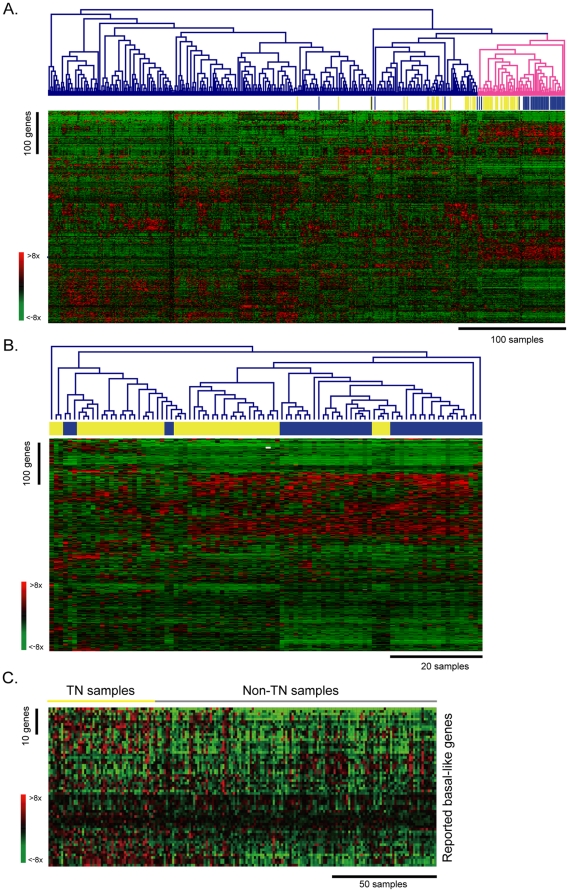
Discrepancies in the prognosis of triple negative breast cancer exist between Caucasian and Asian populations. Yet, the gene signature of triple negative breast cancer specifically for Asians has not become available. Therefore, the purpose of this study is to construct a prediction model for recurrence of triple negative breast cancer in Taiwanese patients. Whole genome expression profiling of breast cancers from 185 patients in Taiwan from 1995 to 2008 was performed, and the results were compared to the previously published literature to detect differences between Asian and Western patients. Pathway analysis and Cox proportional hazard models were applied to construct a prediction model for the recurrence of triple negative breast cancer. Hierarchical cluster analysis showed that triple negative breast cancers from different races were in separate sub-clusters but grouped in a bigger cluster. Two pathways, cAMP-mediated signaling and ephrin receptor signaling, were significantly associated with the recurrence of triple negative breast cancer. After using stepwise model selection from the combination of the initial filtered genes, we developed a prediction model based on the genes SLC22A23, PRKAG3, DPEP3, MORC2, GRB7, and FAM43A. The model had 91.7% accuracy, 81.8% sensitivity, and 94.6% specificity under leave-one-out support vector regression. In this study, we identified pathways related to triple negative breast cancer and developed a model to predict its recurrence. These results could be used for assisting with clinical prognosis and warrant further investigation into the possibility of targeted therapy of triple negative breast cancer in Taiwanese patients.
三阴性乳腺癌在白种人和亚洲人群中的预后存在差异。然而,针对亚洲人的三阴性乳腺癌的基因特征尚未可知。因此,本研究旨在构建一个针对台湾地区三阴性乳腺癌患者复发的预测模型。对 1995 年至 2008 年台湾地区 185 名患者的乳腺癌进行全基因组表达谱分析,并与之前发表的文献进行比较,以检测亚洲人和西方患者之间的差异。应用通路分析和 Cox 比例风险模型构建三阴性乳腺癌复发的预测模型。层次聚类分析显示,不同种族的三阴性乳腺癌分别位于不同的亚群中,但聚集在一个更大的集群中。cAMP 介导的信号通路和 Ephrin 受体信号通路与三阴性乳腺癌的复发显著相关。在对初始筛选基因的组合进行逐步模型选择后,我们基于 SLC22A23、PRKAG3、DPEP3、MORC2、GRB7 和 FAM43A 基因开发了一个预测模型。在留一法支持向量回归中,该模型的准确率为 91.7%,灵敏度为 81.8%,特异性为 94.6%。本研究鉴定了与三阴性乳腺癌相关的通路,并开发了一种预测其复发的模型。这些结果可用于辅助临床预后,并进一步探讨针对台湾地区三阴性乳腺癌患者的靶向治疗的可能性。