Department of Molecular and Cellular Biology, California Institute for Quantitative Biosciences, University of California, Berkeley, California, United States of America.
PLoS One. 2011;6(11):e28408. doi: 10.1371/journal.pone.0028408. Epub 2011 Nov 30.
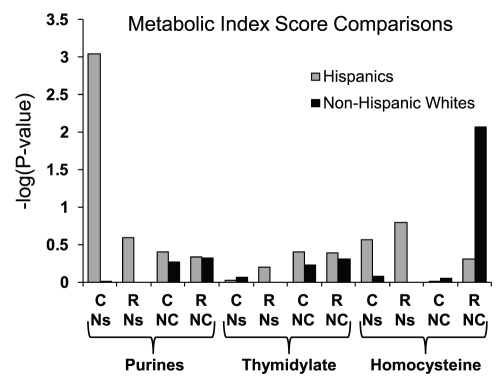
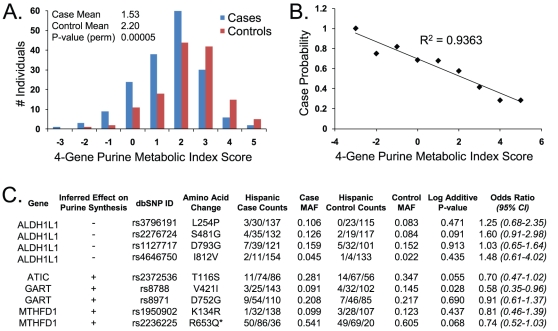
Despite compelling epidemiological evidence that folic acid supplements reduce the frequency of neural tube defects (NTDs) in newborns, common variant association studies with folate metabolism genes have failed to explain the majority of NTD risk. The contribution of rare alleles as well as genetic interactions within the folate pathway have not been extensively studied in the context of NTDs. Thus, we sequenced the exons in 31 folate-related genes in a 480-member NTD case-control population to identify the full spectrum of allelic variation and determine whether rare alleles or obvious genetic interactions within this pathway affect NTD risk. We constructed a pathway model, predetermined independent of the data, which grouped genes into coherent sets reflecting the distinct metabolic compartments in the folate/one-carbon pathway (purine synthesis, pyrimidine synthesis, and homocysteine recycling to methionine). By integrating multiple variants based on these groupings, we uncovered two provocative, complex genetic risk signatures. Interestingly, these signatures differed by race/ethnicity: a Hispanic risk profile pointed to alterations in purine biosynthesis, whereas that in non-Hispanic whites implicated homocysteine metabolism. In contrast, parallel analyses that focused on individual alleles, or individual genes, as the units by which to assign risk revealed no compelling associations. These results suggest that the ability to layer pathway relationships onto clinical variant data can be uniquely informative for identifying genetic risk as well as for generating mechanistic hypotheses. Furthermore, the identification of ethnic-specific risk signatures for spina bifida resonated with epidemiological data suggesting that the underlying pathogenesis may differ between Hispanic and non-Hispanic groups.
尽管有强有力的流行病学证据表明叶酸补充剂可降低新生儿神经管缺陷 (NTD) 的发生频率,但叶酸代谢基因的常见变异关联研究未能解释大多数 NTD 风险。在 NTD 背景下,尚未广泛研究稀有等位基因以及叶酸途径内的遗传相互作用的贡献。因此,我们对 480 名 NTD 病例对照人群中的 31 个叶酸相关基因的外显子进行了测序,以确定等位基因变异的全貌,并确定该途径内的稀有等位基因或明显遗传相互作用是否会影响 NTD 风险。我们构建了一个途径模型,该模型是在独立于数据的情况下预先确定的,它将基因分为反映叶酸/一碳途径中不同代谢区室的连贯组(嘌呤合成、嘧啶合成以及同型半胱氨酸循环回甲硫氨酸)。通过基于这些分组整合多个变体,我们发现了两个引人注目的复杂遗传风险特征。有趣的是,这些特征因种族/民族而异:西班牙裔的风险特征指向嘌呤生物合成的改变,而非西班牙裔白人的风险特征则暗示同型半胱氨酸代谢异常。相比之下,以个体等位基因或单个基因为单位来分配风险的平行分析并未揭示出强烈的关联。这些结果表明,将途径关系分层到临床变异数据中可以为识别遗传风险以及生成机制假设提供独特的信息。此外,对脊柱裂的种族特异性风险特征的识别与表明潜在发病机制可能在西班牙裔和非西班牙裔人群之间存在差异的流行病学数据相呼应。