Kim Young-Seung, Brechbiel Martin W
Radioimmune & Inorganic Chemistry Section, Radiation Oncology Branch, NCI, NIH, 10 Center Drive, Building 10, Rm B3B69, Bethesda, MD 20892-1002, USA.
Tumour Biol. 2012 Jun;33(3):573-90. doi: 10.1007/s13277-011-0286-y. Epub 2011 Dec 6.
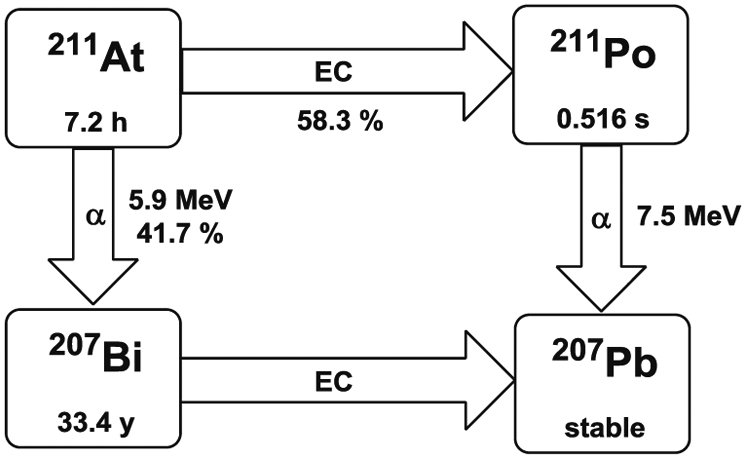
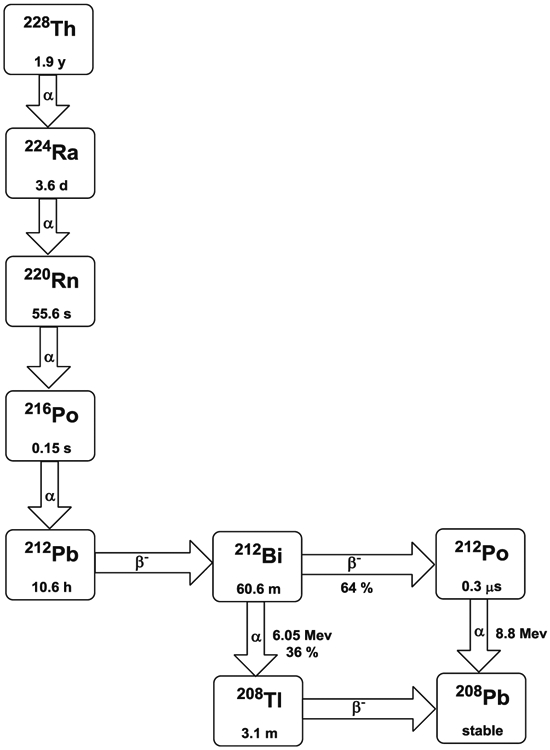
The effectiveness of targeted α-therapy (TAT) can be explained by the properties of α-particles. Alpha particles are helium nuclei and are ~8,000 times larger than β(-)-particles (electrons). When emitted from radionuclides that decay via an α-decay pathway, they release enormous amounts of energy over a very short distance. Typically, the range of α-particles in tissue is 50-100 μm and they have high linear energy transfer (LET) with a mean energy deposition of 100 keV/μm, providing a more specific tumor cell killing ability without damage to the surrounding normal tissues than β(-)-emitters. Due to these properties, the majority of pre-clinical and clinical trials have demonstrated that α-emitters such as (225)Ac, (211)At, (212)Bi, (213)Bi, (212)Pb, (223)Ra, and (227)Th are ideal for the treatment of smaller tumor burdens, micrometastatic disease, and disseminated disease. Even though these α-emitters have favorable properties, the development of TAT has been limited by high costs, unresolved chemistry, and limited availability of the radionuclides. To overcome these limitations, more potent isotopes, additional sources, and more efficient isotope production methods should be addressed. Furthermore, better chelation and labeling methods with the improvements of isotope delivery, targeting vehicles, molecular targets, and identification of appropriate clinical applications are still required.
靶向α治疗(TAT)的有效性可以通过α粒子的特性来解释。α粒子是氦原子核,比β(-)粒子(电子)大约8000倍。当从通过α衰变途径衰变的放射性核素中发射时,它们在非常短的距离内释放大量能量。通常,α粒子在组织中的射程为50-100μm,它们具有高线性能量传递(LET),平均能量沉积为100keV/μm,与β(-)发射体相比,具有更特异的肿瘤细胞杀伤能力,而不会损伤周围正常组织。由于这些特性,大多数临床前和临床试验表明,诸如(225)Ac、(211)At、(212)Bi、(213)Bi、(212)Pb、(223)Ra和(227)Th等α发射体对于治疗较小的肿瘤负荷、微转移疾病和播散性疾病是理想的。尽管这些α发射体具有良好的特性,但TAT的发展受到高成本、未解决的化学问题以及放射性核素可用性有限的限制。为了克服这些限制,应研究更有效的同位素、更多的来源和更有效的同位素生产方法。此外,仍然需要更好的螯合和标记方法,以及改进同位素递送、靶向载体、分子靶点和确定合适的临床应用。