School of Medicine, Boston University, Boston, MA, USA.
J Clin Periodontol. 2012 Feb;39(2):107-14. doi: 10.1111/j.1600-051X.2011.01824.x. Epub 2011 Dec 12.
To examine whether overweight and obesity indicators - body mass index (BMI), waist circumference (WC), and WC-to-height ratio - predict progression of periodontal disease in men.
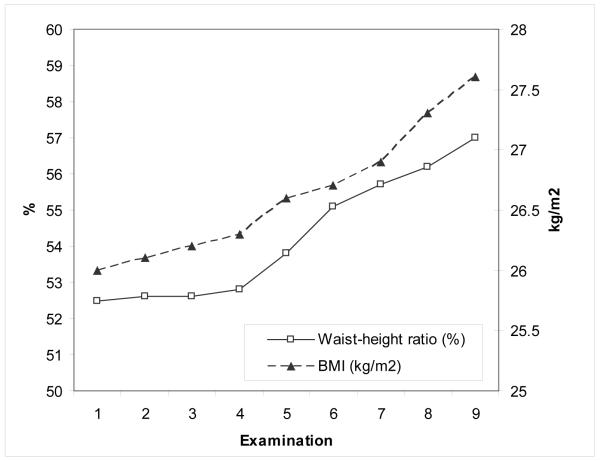
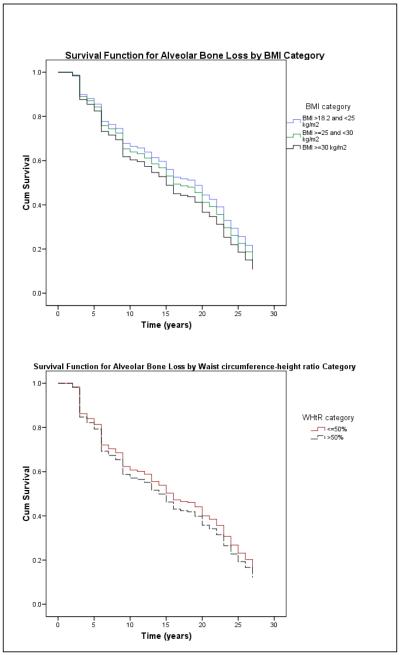
Participants were 1038 medically healthy, non-Hispanic, white males in the VA Dental Longitudinal Study who were monitored with triennial oral and medical examinations between 1969 and 1996. Periodontal disease progression in an individual was defined as having two or more teeth advance to levels of alveolar bone loss ≥40%, probing pocket depth ≥5 mm, or clinical attachment loss ≥5 mm after baseline. Extended Cox regression analyses estimated hazards of experiencing periodontal disease progression events due to overweight/obesity status, controlling for age, smoking, education, diabetes, recent periodontal treatment, recent prophylaxis, and number of filled/decayed surfaces.
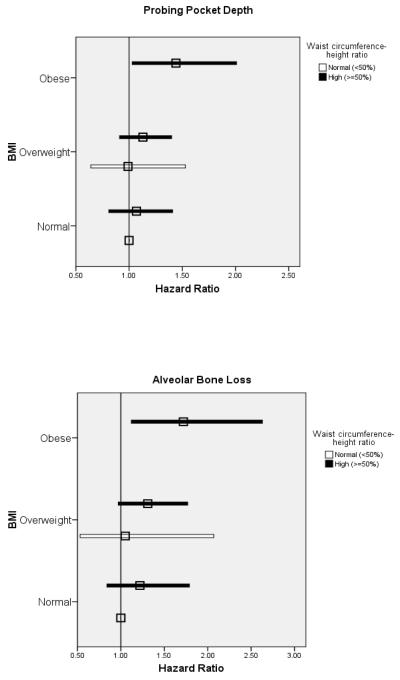
Body mass index and WC-to-height ratio were significantly associated with hazards of experiencing periodontal disease progression events regardless of periodontal disease indicator. Adjusted hazard ratios for periodontal disease progression were 41-72% higher in obese men (BMI ≥30 kg/m(2)) relative to men with both normal weight and WC-to-height ratio (≤50%).
Both overall obesity and central adiposity are associated with an increased hazards of periodontal disease progression events in men.
研究超重和肥胖指标(体重指数(BMI)、腰围(WC)和 WC 与身高比)是否可预测男性牙周病的进展。
参与者为 1969 年至 1996 年间接受了三年一次的口腔和医学检查的 VA 牙科纵向研究中的 1038 名医学上健康、非西班牙裔、白人男性。个体的牙周病进展定义为基线后有两颗或两颗以上牙齿进展至牙槽骨丧失≥40%、探诊袋深度≥5mm 或临床附着丧失≥5mm 的水平。扩展 Cox 回归分析估计了超重/肥胖状态导致牙周病进展事件的风险,控制了年龄、吸烟、教育、糖尿病、近期牙周治疗、近期预防以及填充/龋齿表面的数量。
无论牙周病指标如何,体重指数和 WC 与身高比与经历牙周病进展事件的风险显著相关。与 BMI 和 WC 与身高比均正常的男性(BMI≥30kg/m²)相比,肥胖男性(BMI≥30kg/m²)的牙周病进展调整后风险比为 41-72%。
总体肥胖和中心性肥胖与男性牙周病进展事件的风险增加相关。