Vogt Julia, Nguyen Rosa, Kluwe Lan, Schuhmann Martin, Roehl Angelika C, Mußotter Tanja, Cooper David N, Mautner Victor-Felix, Kehrer-Sawatzki Hildegard
Institute of Human Genetics, University of Ulm, Ulm, Germany.
J Med Case Rep. 2011 Dec 12;5:577. doi: 10.1186/1752-1947-5-577.
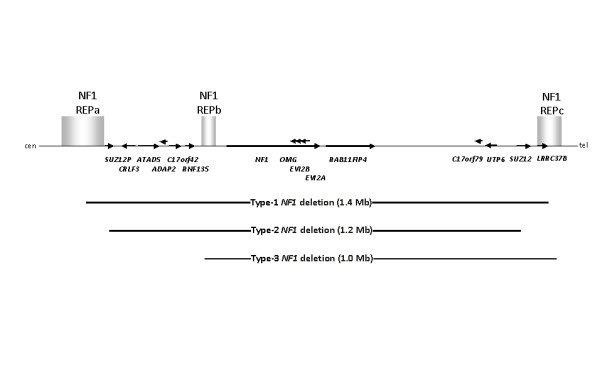
Large deletions of the NF1 gene and its flanking regions are frequently associated with a severe clinical manifestation. Different types of gross NF1 deletion have been identified that are distinguishable both by their size and the number of genes included within the deleted regions. Type-1 NF1 deletions encompass 1.4 Mb and include 14 genes, whereas the much less common type-2 NF1 deletions span 1.2 Mb and contain 13 genes. Genotype-phenotype correlations in patients with large NF1 deletions are likely to be influenced by the nature and number of the genes deleted in addition to the NF1 gene. Whereas the clinical phenotype associated with type-1 NF1 deletions has been well documented, the detailed clinical characterization of patients with non-mosaic type-2 NF1 deletions has not so far been reported.
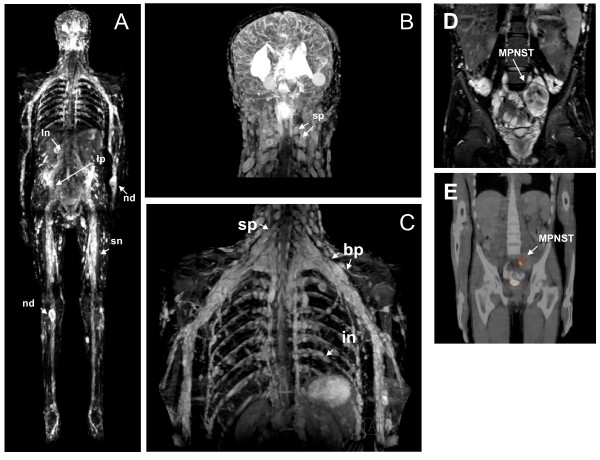
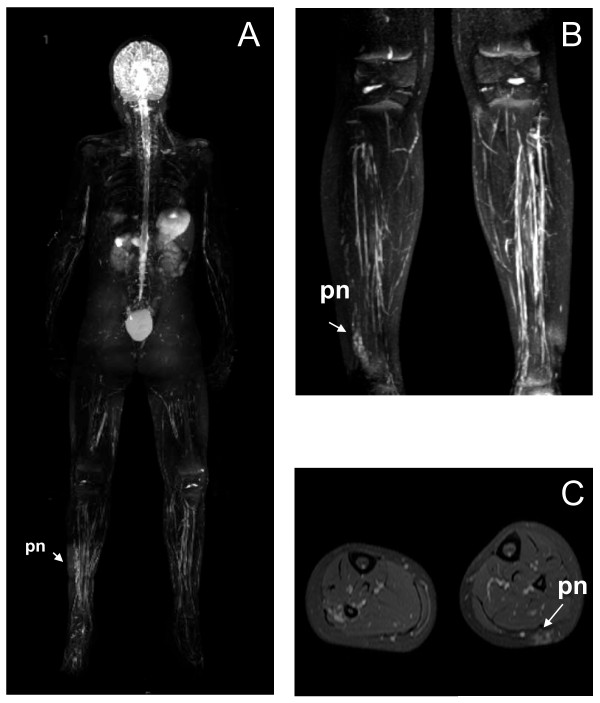
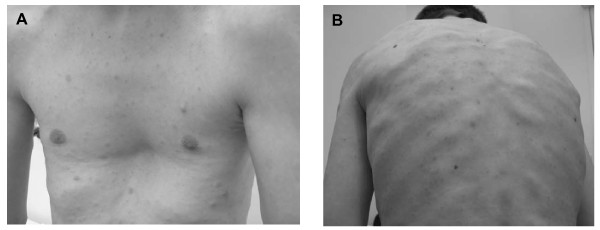
In the present report we characterized two Caucasian European patients with non-mosaic (germline) type-2 NF1 deletions. Our first patient was a 13-year-old girl with dysmorphic facial features, mild developmental delay, large hands and feet, hyperflexibility of the joints, macrocephaly and T2 hyperintensities in the brain. A whole-body magnetic resonance imaging scan indicated two internal plexiform neurofibromas. Our second patient was an 18-year-old man who exhibited dysmorphic facial features, developmental delay, learning disability, large hands and feet, hyperflexibility of the joints, macrocephaly and a very high subcutaneous and internal tumor load as measured volumetrically on whole-body magnetic resonance imaging scans. At the age of 18 years, he developed a malignant peripheral nerve sheath tumor and died from secondary complications. Both our patients exhibited cardiovascular malformations.
Our two patients with non-mosaic type-2 NF1 deletions exhibited clinical features that have been reported in individuals with germline type-1 NF1 deletions. Therefore, a severe disease manifestation is not confined to only patients with type-1 NF1 deletions but may also occur in individuals with type-2 NF1 deletions. Our findings support the concept of an NF1 microdeletion syndrome with severe clinical manifestation that is caused by type-1 as well as type-2 NF1 deletions.
NF1基因及其侧翼区域的大片段缺失常与严重的临床表现相关。已鉴定出不同类型的NF1大片段缺失,可根据其大小和缺失区域内包含的基因数量加以区分。1型NF1缺失涵盖1.4 Mb,包含14个基因,而罕见得多的2型NF1缺失跨度为1.2 Mb,包含13个基因。除NF1基因外,大片段NF1缺失患者的基因型-表型相关性可能还受缺失基因的性质和数量影响。虽然与1型NF1缺失相关的临床表型已有充分记录,但非嵌合型2型NF1缺失患者的详细临床特征迄今尚未见报道。
在本报告中,我们描述了两名患有非嵌合型(种系)2型NF1缺失的欧洲白种人患者。我们的首例患者是一名13岁女孩,面部特征异常、轻度发育迟缓、手足较大、关节过度灵活、巨头畸形且脑部T2高信号。全身磁共振成像扫描显示有两个内部丛状神经纤维瘤。我们的第二例患者是一名18岁男性,表现为面部特征异常、发育迟缓、学习障碍、手足较大、关节过度灵活、巨头畸形,全身磁共振成像扫描测量显示皮下和内部肿瘤负荷极高。18岁时,他患上了恶性外周神经鞘瘤并死于继发并发症。我们的两名患者均有心血管畸形。
我们的两名非嵌合型2型NF1缺失患者表现出的临床特征与种系1型NF1缺失个体中所报道的特征相同。因此,严重的疾病表现并不局限于1型NF1缺失患者,也可能发生在2型NF1缺失个体中。我们的研究结果支持由1型和2型NF1缺失引起的具有严重临床表现的NF1微缺失综合征这一概念。