Center for Neuroregeneration Research, McLean Hospital/Harvard Medical School, Harvard University, MRC130, Belmont, MA 02478, USA.
Mol Cell Neurosci. 2012 Feb;49(2):230-9. doi: 10.1016/j.mcn.2011.11.006. Epub 2011 Dec 6.
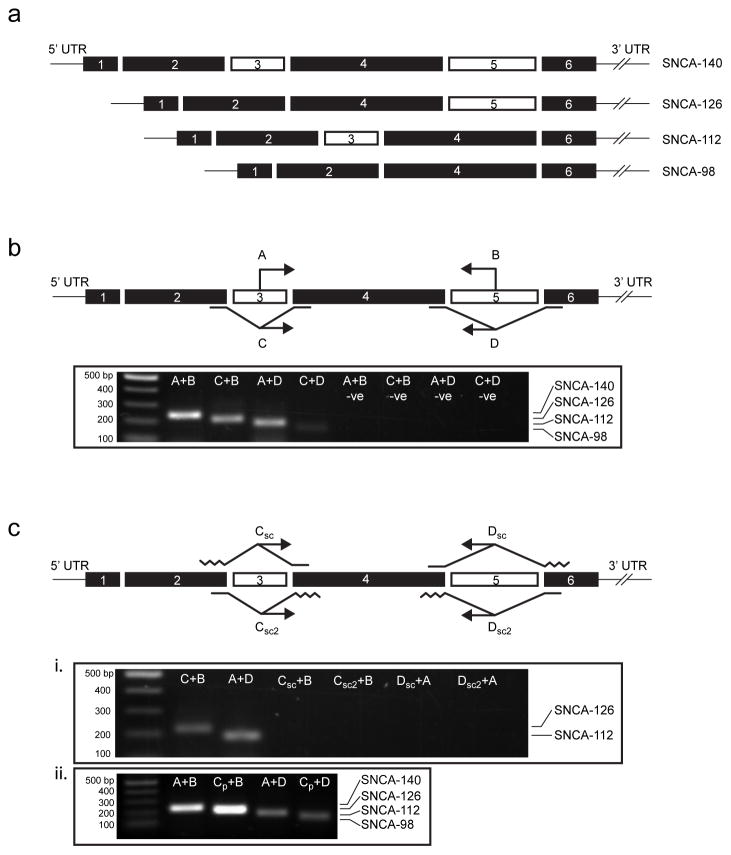
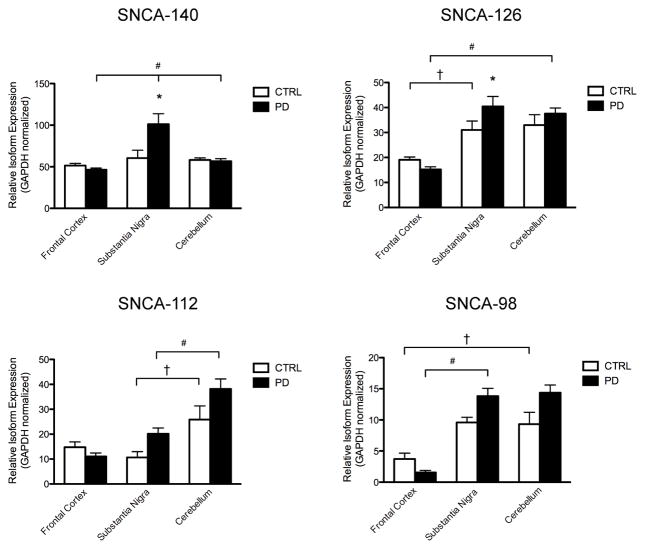
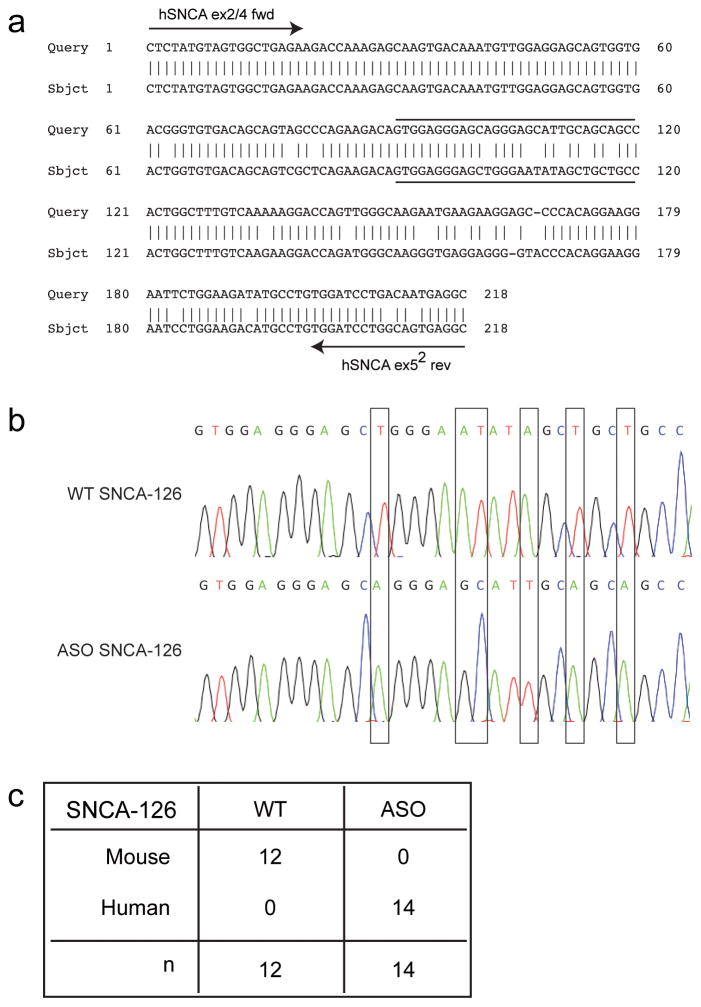
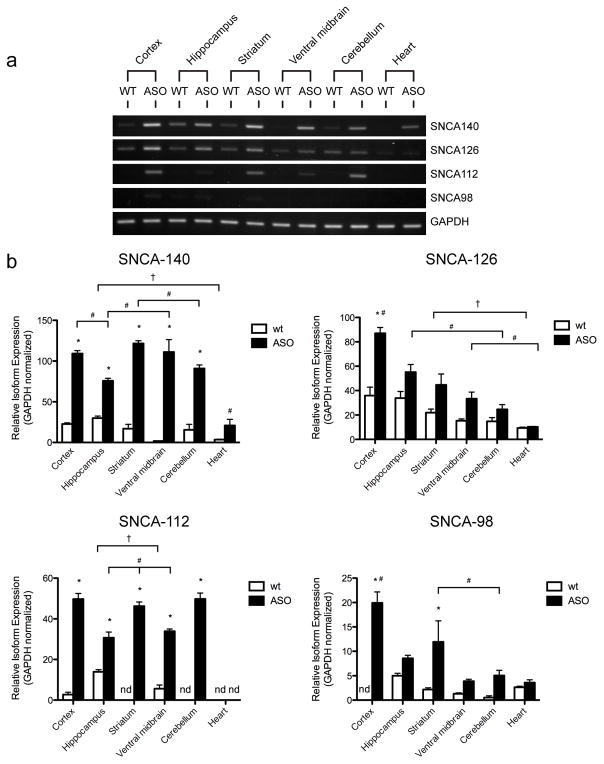
Alternative splicing is a complex post-transcriptional process that can be regulated by cis-acting elements located within genomic non-coding regions. Recent studies have identified that polymorphic variations in non-coding regions of the α-synuclein gene (SNCA) locus are associated with an increased risk for developing Parkinson's disease (PD). The underlying mechanism(s) for this susceptibility may involve changes in α-synuclein mRNA expression and alternative splicing. As a first step towards understanding the biology of α-synuclein splice variants in PD, we characterized the levels of the full-length SNCA-140 mRNA transcript and SNCA-126, -112, and -98 alternatively spliced variants in different neuronal regions from PD patients or transgenic mice overexpressing human α-synuclein (ASO). In human post-mortem tissue, α-synuclein spliced transcripts were expressed in a region-specific manner in the cortex, substantia nigra, and cerebellum. We observed increased nigral SNCA-140 and SNCA-126 transcript levels in PD patients when compared to neurologically unaffected cases. Human α-synuclein splicing changes were also found to occur in a region-specific manner in ASO mice. Here, SNCA-126, -112, and -98 transcript levels did not increase proportionally with SNCA-140 levels, or parallel the region-specific mouse transcript ratios seen in wild-type (WT) littermates. While most transcripts were elevated in ASO mice when compared to WT mice, the most prominent increase was found in the ventral midbrain of 15-month-old ASO mice. These results demonstrate region-specific human α-synuclein transcript level abnormalities in PD patients and in a transgenic mouse model of α-synucleinopathy. This study is relevant to understanding the normal, adaptive, or pathological role(s) of α-synuclein splice variants.
选择性剪接是一种复杂的转录后过程,可以通过位于基因组非编码区域内的顺式作用元件进行调节。最近的研究表明,α-突触核蛋白基因 (SNCA) 位点的非编码区域中的多态性变异与帕金森病 (PD) 的发病风险增加有关。这种易感性的潜在机制可能涉及α-突触核蛋白 mRNA 表达和选择性剪接的变化。作为了解 PD 中α-突触核蛋白剪接变体生物学的第一步,我们对来自 PD 患者或过表达人α-突触核蛋白 (ASO) 的转基因小鼠的不同神经元区域中的全长 SNCA-140 mRNA 转录本和 SNCA-126、-112 和 -98 选择性剪接变体的水平进行了表征。在人死后组织中,α-突触核蛋白剪接转录物在皮质、黑质和小脑以区域特异性方式表达。与神经正常的病例相比,我们观察到 PD 患者的黑质 SNCA-140 和 SNCA-126 转录本水平升高。还发现 ASO 小鼠中的人类α-突触核蛋白剪接变化也以区域特异性方式发生。在这里,SNCA-126、-112 和 -98 转录本水平没有与 SNCA-140 水平成比例增加,也没有与 WT 同窝仔鼠中看到的区域特异性小鼠转录本比值平行。虽然与 WT 小鼠相比,ASO 小鼠中的大多数转录本升高,但在 15 个月大的 ASO 小鼠的腹侧中脑发现了最显著的增加。这些结果表明 PD 患者和α-突触核蛋白病转基因小鼠模型中存在区域特异性人类α-突触核蛋白转录本水平异常。这项研究对于理解α-突触核蛋白剪接变体的正常、适应性或病理性作用具有重要意义。