Department of Health Sciences, Interdisciplinary Graduate School of Medicine and Engineering, University of Yamanashi, Japan.
J Epidemiol. 2012;22(1):2-6. doi: 10.2188/jea.je20110116. Epub 2011 Dec 10.
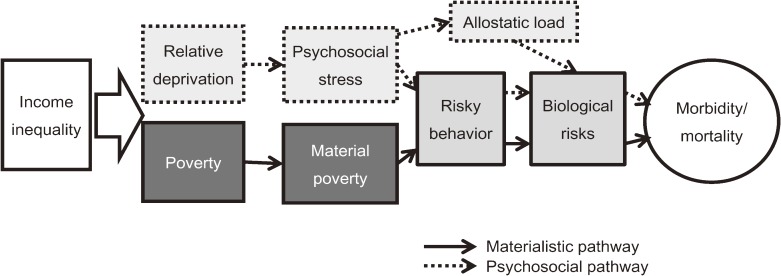
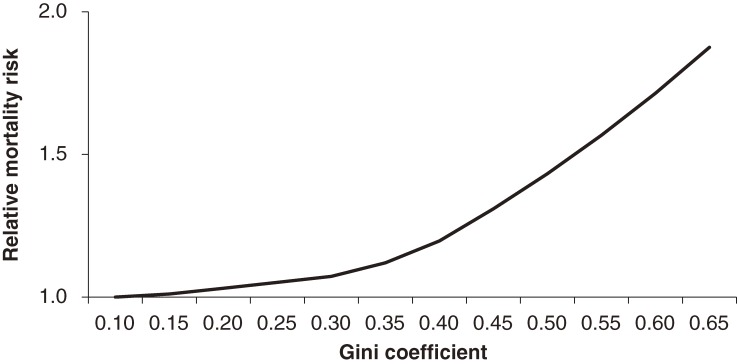
Growing socioeconomic disparity is a global concern, as it could affect population health. The author and colleagues have investigated the health impacts of socioeconomic disparities as well as the pathways that underlie those disparities. Our meta-analysis found that a large population has risks of mortality and poor self-rated health that are attributable to income inequality. The study results also suggested the existence of threshold effects (ie, a threshold of income inequality over which the adverse impacts on health increase), period effects (ie, the potential for larger impacts in later years, specifically after the 1990s), and lag effects between income inequality and health outcomes. Our other studies using Japanese national representative survey data and a large-scale cohort study of Japanese older adults (AGES cohort) support the relative deprivation hypothesis, namely, that invidious social comparisons arising from relative deprivation in an unequal society adversely affect health. A study with a natural experiment design found that the socioeconomic gradient in self-rated health might actually have become shallower after the 1997-98 economic crisis in Japan, due to smaller health improvements among middle-class white-collar workers and middle/upper-income workers. In conclusion, income inequality might have adverse impacts on individual health, and psychosocial stress due to relative deprivation may partially explain those impacts. Any study of the effects of macroeconomic fluctuations on health disparities should also consider multiple potential pathways, including expanding income inequality, changes in the labor market, and erosion of social capital. Further studies are needed to attain a better understanding of the social determinants of health in a rapidly changing society.
不断扩大的社会经济差距是一个全球性问题,因为它可能会影响到人口健康。作者及其同事研究了社会经济差距对健康的影响,以及导致这些差距的途径。我们的荟萃分析发现,很大一部分人群的死亡率和自我健康评估较差与收入不平等有关。研究结果还表明存在阈值效应(即,收入不平等对健康的不利影响随着不平等程度的增加而增加)、时期效应(即,在后期,特别是在 20 世纪 90 年代之后,可能会产生更大的影响)以及收入不平等与健康结果之间的滞后效应。我们使用日本全国代表性调查数据和一项针对日本老年人的大规模队列研究(AGES 队列)进行的其他研究支持相对剥夺假说,即不平等社会中因相对剥夺而产生的有害社会比较会对健康产生不利影响。一项具有自然实验设计的研究发现,由于中产阶级白领工人和中/高收入工人的健康改善较小,日本在 1997-98 年经济危机后,自我健康评估的社会经济梯度实际上可能变得更平缓。总之,收入不平等可能对个人健康产生不利影响,而相对剥夺引起的心理社会压力可能部分解释了这些影响。任何对宏观经济波动对健康差距影响的研究都应考虑多种潜在途径,包括扩大收入不平等、劳动力市场变化和社会资本侵蚀。需要进一步研究,以更好地理解快速变化社会中的健康决定因素。