School of Biological Sciences, University of Aberdeen, Aberdeen, United Kingdom.
PLoS One. 2011;6(12):e28028. doi: 10.1371/journal.pone.0028028. Epub 2011 Dec 5.
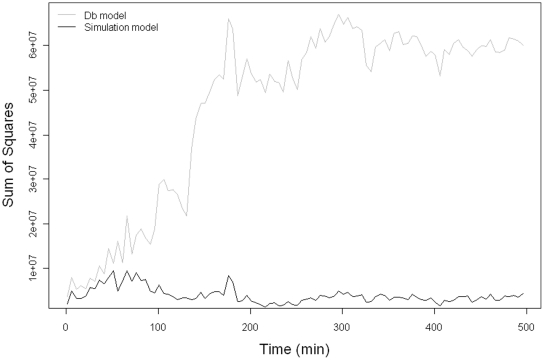
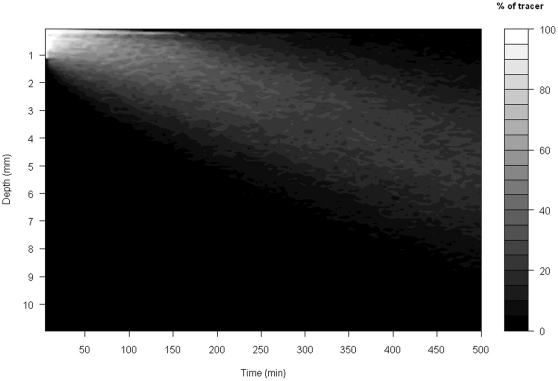
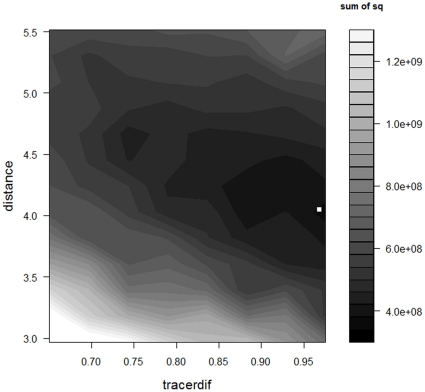
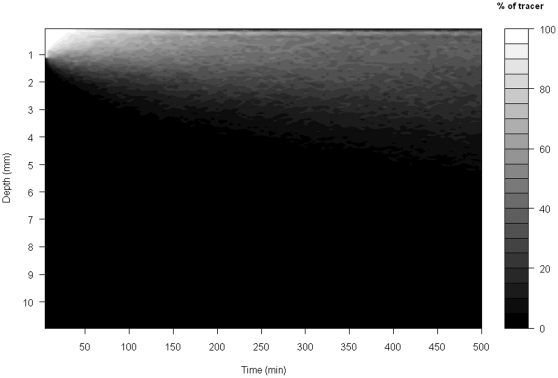
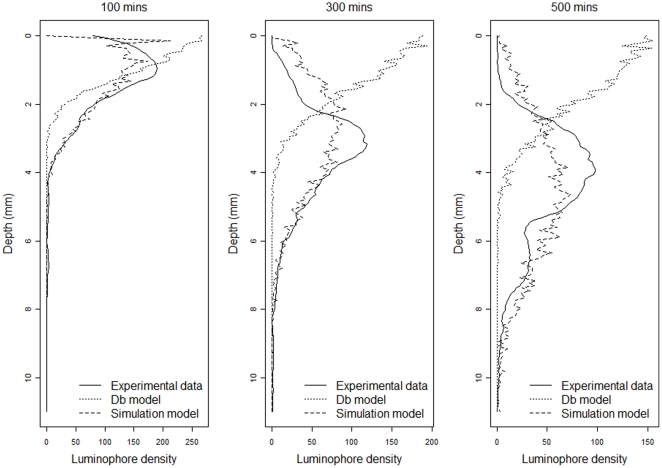
Bioturbation is one of the most widespread forms of ecological engineering and has significant implications for the structure and functioning of ecosystems, yet our understanding of the processes involved in biotic mixing remains incomplete. One reason is that, despite their value and utility, most mathematical models currently applied to bioturbation data tend to neglect aspects of the natural complexity of bioturbation in favour of mathematical simplicity. At the same time, the abstract nature of these approaches limits the application of such models to a limited range of users. Here, we contend that a movement towards process-based modelling can improve both the representation of the mechanistic basis of bioturbation and the intuitiveness of modelling approaches. In support of this initiative, we present an open source modelling framework that explicitly simulates particle displacement and a worked example to facilitate application and further development. The framework combines the advantages of rule-based lattice models with the application of parameterisable probability density functions to generate mixing on the lattice. Model parameters can be fitted by experimental data and describe particle displacement at the spatial and temporal scales at which bioturbation data is routinely collected. By using the same model structure across species, but generating species-specific parameters, a generic understanding of species-specific bioturbation behaviour can be achieved. An application to a case study and comparison with a commonly used model attest the predictive power of the approach.
生物扰动是最广泛的生态工程形式之一,对生态系统的结构和功能有重大影响,但我们对生物混合过程的理解仍然不完整。原因之一是,尽管数学模型具有价值和实用性,但目前应用于生物扰动数据的大多数模型往往忽视了生物扰动自然复杂性的某些方面,而偏向于数学的简洁性。同时,这些方法的抽象性质限制了这些模型在有限范围内的用户应用。在这里,我们认为,向基于过程的建模方法转变可以提高生物扰动的机械基础的表示和建模方法的直观性。为了支持这一倡议,我们提出了一个开源的建模框架,该框架明确地模拟了颗粒的位移,并提供了一个实例来促进应用和进一步的开发。该框架结合了基于规则的晶格模型的优点,以及应用参数化概率密度函数来在晶格上生成混合。模型参数可以通过实验数据拟合,并描述生物扰动数据通常采集的空间和时间尺度上的颗粒位移。通过在不同物种中使用相同的模型结构,但生成特定于物种的参数,可以实现对特定于物种的生物扰动行为的一般理解。对一个案例研究的应用和与一个常用模型的比较证明了该方法的预测能力。