Zoological Research Museum Alexander Koenig, Bonn, Germany.
PLoS One. 2011;6(12):e28035. doi: 10.1371/journal.pone.0028035. Epub 2011 Dec 6.
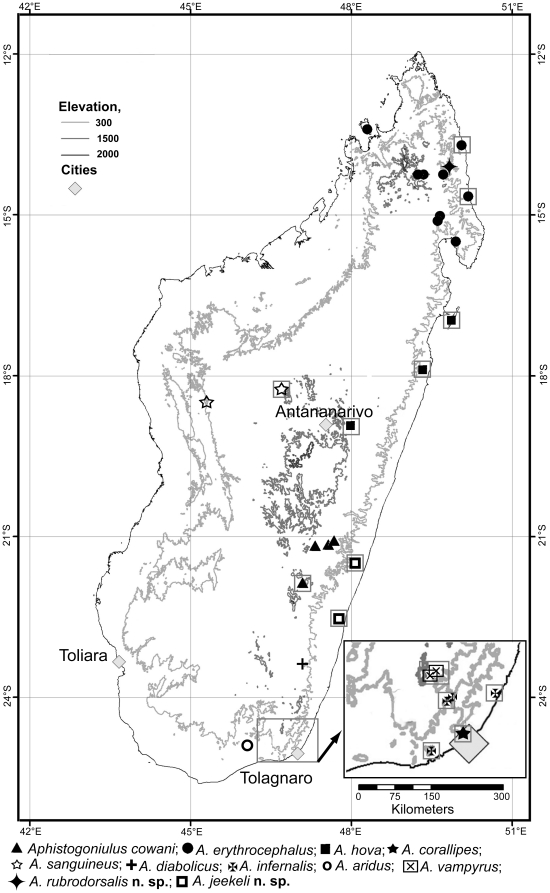
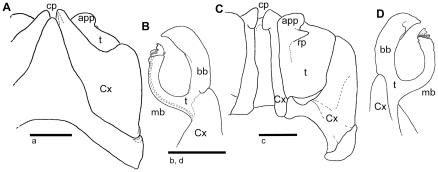
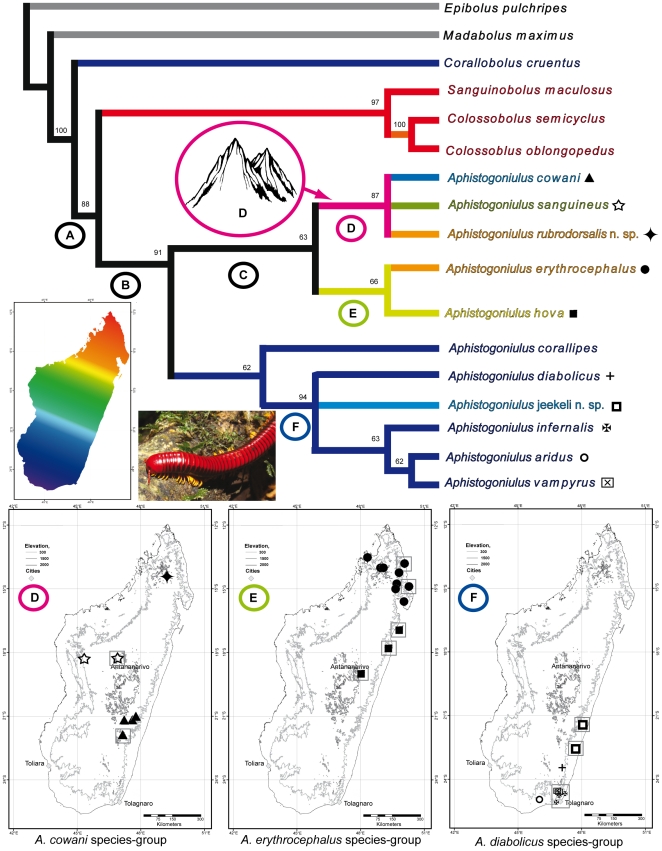
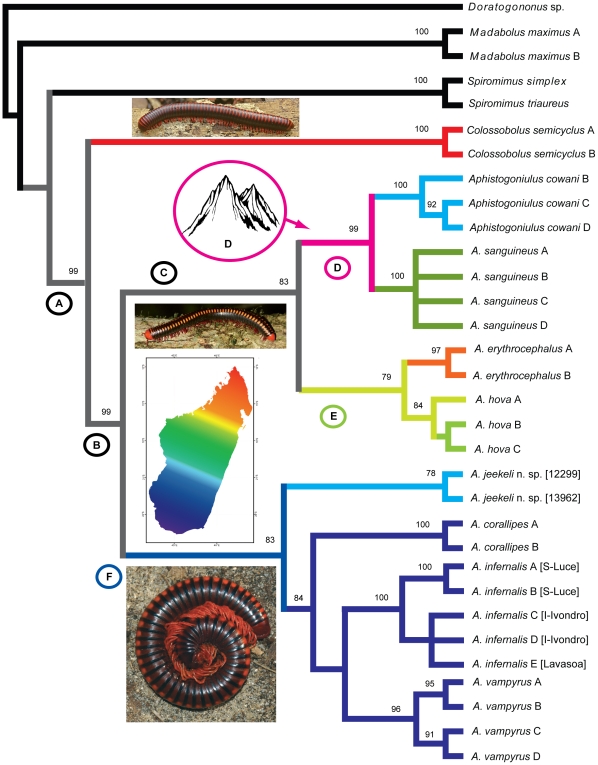
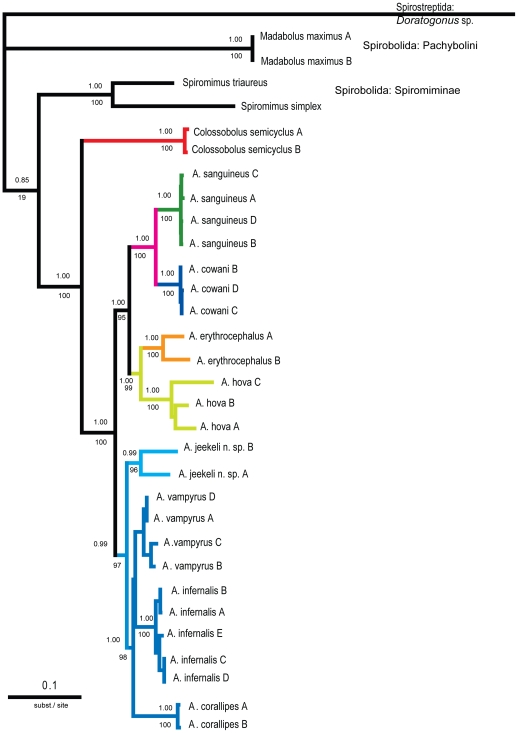
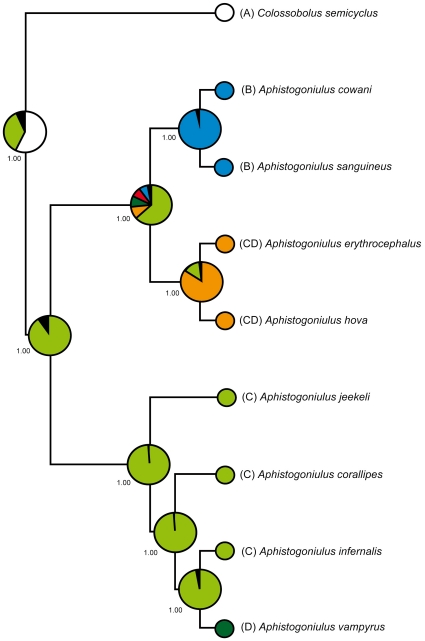
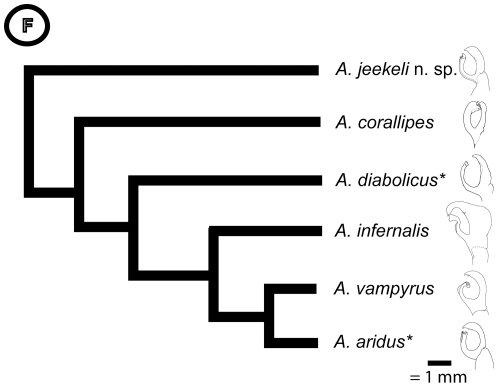
To elucidate the speciation mechanisms prevalent within hotspots of biodiversity, and the evolutionary processes behind the rise of their species-rich and endemic biota, we investigated the phylogeny of the giant fire-millipede genus Aphistogoniulus Silvestri, 1897, a Malagasy endemic. This study is the first comprehensive (molecular and morphological) phylogenetic study focusing on millipede (class Diplopoda) speciation on Madagascar. The morphological analysis is based on 35 morphological characters and incorporates ten described as well as two newly described species (A. rubrodorsalisn. sp. and A. jeekelin. sp.) of Aphistogoniulus. The molecular analysis is based on both mitochondrial (COI and 16S), and nuclear genes (complete 18S rDNA), together comprised of 3031 base pairs, which were successfully sequenced for 31 individual specimens and eight species of Aphistogoniulus. In addition to the null-model (speciation by distance), two diversification models, mountain refugia and ecotone shift, were discovered to play a role in the speciation of soil arthropods on Madagascar. Mountain refugia were important in the speciation of the A. cowani clade, with three species occurring in the Andringitra and Ranomafana Mountains in the southeast (A. cowani), the Ambohijanahary and Ambohitantely Mountains in the mid-west (A. sanguineus), and the Marojejy Mountain in the northeast (A. rubrodorsalisn. sp.). An ecotone shift from the eastern rainforest to the unique subarid spiny forest of Mahavelo was discovered in the A. vampyrus-A. aridus species-pair. In the monophyletic A. diabolicus clade, evidence for divergent evolution of sexual morphology was detected: species with greatly enlarged gonopods are sister-taxa to species with normal sized gonopods. Among the large-bodied Spirobolida genera of Madagascar, Colossobolus and Sanguinobolus were found to be close sister-genera to Aphistogoniulus. Forest destruction has caused forest corridors between populations to disappear, which might limit the possible resolution of biogeographic analyses on Madagascar.
为了阐明生物多样性热点地区普遍存在的物种形成机制,以及这些物种丰富且特有生物区系兴起的进化过程,我们研究了巨型火蜈蚣属 Aphistogoniulus Silvestri, 1897 的系统发育,这是马达加斯加的特有种。本研究是首次针对蜈蚣(纲 Diplopoda)在马达加斯加的物种形成进行的全面(分子和形态)系统发育研究。形态分析基于 35 个形态特征,包含十个已描述和两个新描述的物种(A. rubrodorsalisn. sp. 和 A. jeekelin. sp.)的 Aphistogoniulus。分子分析基于线粒体(COI 和 16S)和核基因(完整的 18S rDNA),共包含 3031 个碱基对,成功地对 31 个个体标本和 Aphistogoniulus 的 8 个物种进行了测序。除了零模型(由距离引起的物种形成)外,还发现了山地避难所和生态交错带转移两种多样化模型在马达加斯加土壤节肢动物的物种形成中发挥了作用。山地避难所在 A. cowani 进化枝的物种形成中非常重要,三个物种出现在东南部的安德里安齐特拉和拉诺马法纳山脉(A. cowani)、中西部的安布胡扬贾哈里和安博坦特利山脉(A. sanguineus)以及东北部的马罗杰杰山(A. rubrodorsalisn. sp.)。在 A. vampyrus-A. aridus 种对中发现了从东部雨林到独特的亚干旱刺灌丛 Mahavelo 的生态交错带转移。在单系的 A. diabolicus 进化枝中,检测到性形态分化进化的证据:具有巨大增大的生殖肢的物种是具有正常大小生殖肢的物种的姐妹群。在马达加斯加的大型 Spirobolida 属中,Colossobolus 和 Sanguinobolus 被发现与 Aphistogoniulus 密切相关。森林破坏导致种群之间的森林走廊消失,这可能限制了对马达加斯加生物地理分析的可能分辨率。