Department of Zoology, Karl-Franzens-University, Graz, Styria, Austria.
PLoS One. 2011;6(12):e28593. doi: 10.1371/journal.pone.0028593. Epub 2011 Dec 6.
Insects often communicate by sound in mixed species choruses; like humans and many vertebrates in crowded social environments they thus have to solve cocktail-party-like problems in order to ensure successful communication with conspecifics. This is even more a problem in species-rich environments like tropical rainforests, where background noise levels of up to 60 dB SPL have been measured.
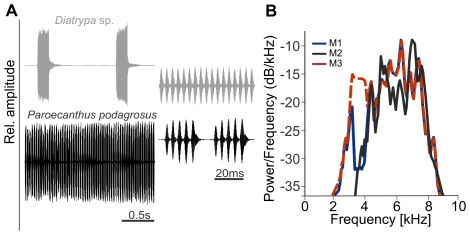
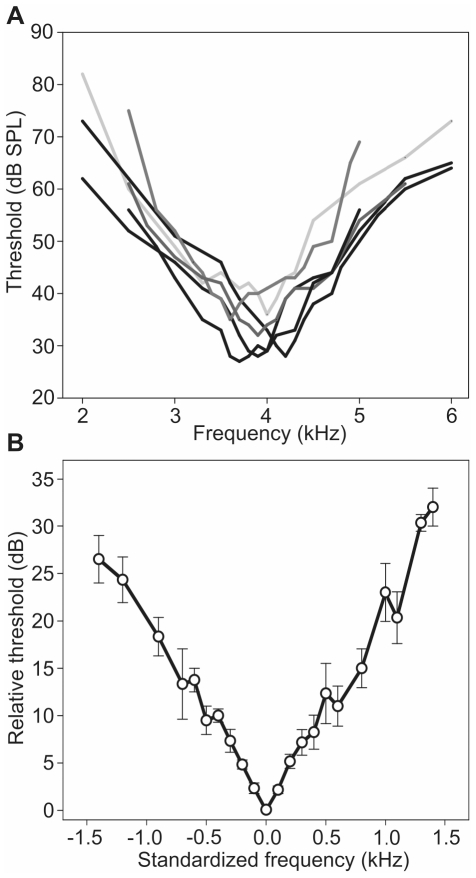
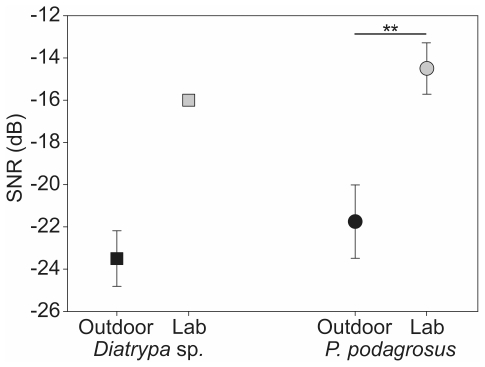
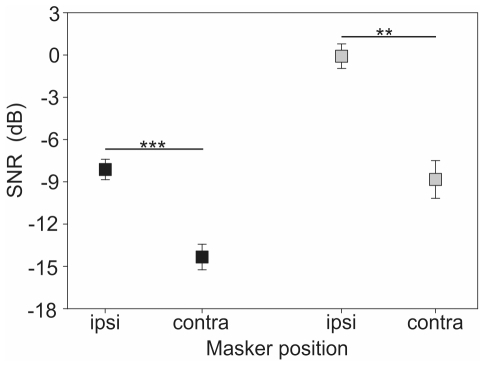
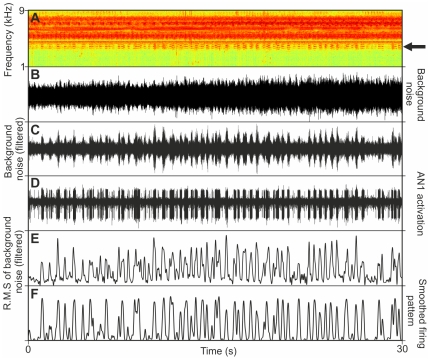
Using neurophysiological methods we investigated the effect of natural background noise (masker) on signal detection thresholds in two tropical cricket species Paroecanthus podagrosus and Diatrypa sp., both in the laboratory and outdoors. We identified three 'bottom-up' mechanisms which contribute to an excellent neuronal representation of conspecific signals despite the masking background. First, the sharply tuned frequency selectivity of the receiver reduces the amount of masking energy around the species-specific calling song frequency. Laboratory experiments yielded an average signal-to-noise ratio (SNR) of -8 dB, when masker and signal were broadcast from the same side. Secondly, displacing the masker by 180° from the signal improved SNRs by further 6 to 9 dB, a phenomenon known as spatial release from masking. Surprisingly, experiments carried out directly in the nocturnal rainforest yielded SNRs of about -23 dB compared with those in the laboratory with the same masker, where SNRs reached only -14.5 and -16 dB in both species. Finally, a neuronal gain control mechanism enhances the contrast between the responses to signals and the masker, by inhibition of neuronal activity in interstimulus intervals.
Thus, conventional speaker playbacks in the lab apparently do not properly reconstruct the masking noise situation in a spatially realistic manner, since under real world conditions multiple sound sources are spatially distributed in space. Our results also indicate that without knowledge of the receiver properties and the spatial release mechanisms the detrimental effect of noise may be strongly overestimated.
昆虫在混合物种的合唱中经常通过声音进行交流;就像人类和许多脊椎动物在拥挤的社会环境中一样,它们为了确保与同种个体的成功交流,必须解决类似鸡尾酒会的问题。在热带雨林等物种丰富的环境中,背景噪音水平高达 60 dB SPL,这甚至是一个更大的问题。
使用神经生理学方法,我们在实验室和户外研究了自然背景噪声(掩蔽声)对两种热带蟋蟀物种 Paroecanthus podagrosus 和 Diatrypa sp. 的信号检测阈值的影响。我们确定了三个“自下而上”的机制,这些机制有助于在存在掩蔽背景的情况下,对同种个体信号进行极好的神经元表示。首先,接收者的尖锐调谐频率选择性减少了物种特异性鸣叫频率周围的掩蔽能量。当掩蔽声和信号从同一侧广播时,实验室实验产生了平均信噪比 (SNR) 为-8 dB。其次,将掩蔽声从信号处移开 180°,可使 SNR 进一步提高 6 至 9 dB,这种现象称为空间掩蔽释放。令人惊讶的是,直接在夜间雨林中进行的实验与实验室相比,SNR 约为-23 dB,而在实验室中,相同的掩蔽声下,两种物种的 SNR 仅为-14.5 和-16 dB。最后,神经元增益控制机制通过在刺激间间隔抑制神经元活动,增强了对信号和掩蔽声的响应对比度。
因此,在实验室中使用传统的扬声器播放显然不能以空间上真实的方式正确重建掩蔽噪声情况,因为在现实世界中,多个声源在空间中是空间分布的。我们的结果还表明,如果不了解接收者的特性和空间释放机制,噪声的有害影响可能会被严重高估。