Department of Electrotechnics, University of Mascara, Mascara 29000, Algeria.
Sensors (Basel). 2010;10(9):8553-71. doi: 10.3390/s100908553. Epub 2010 Sep 14.
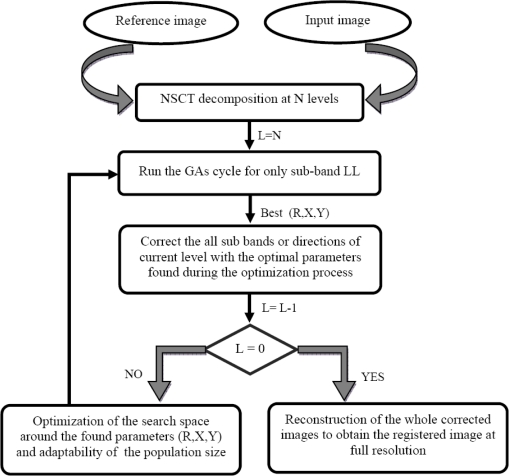
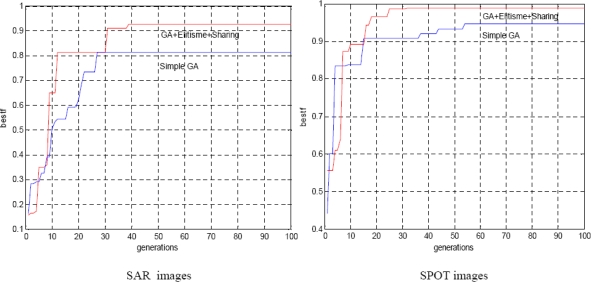
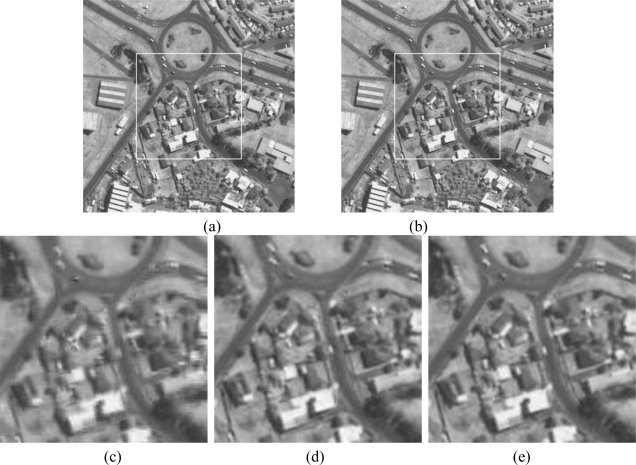
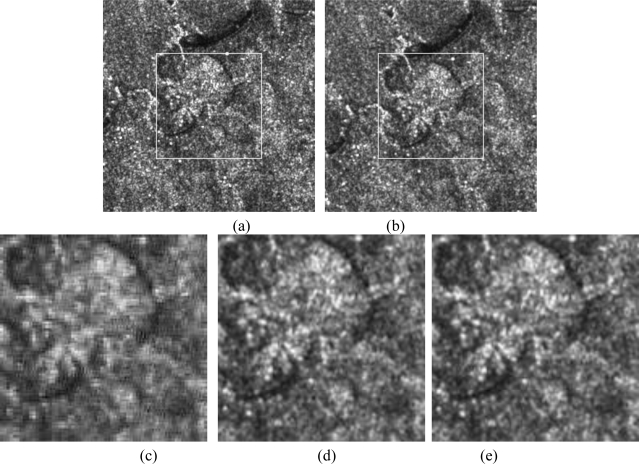
Image registration is a fundamental task used in image processing to match two or more images taken at different times, from different sensors or from different viewpoints. The objective is to find in a huge search space of geometric transformations, an acceptable accurate solution in a reasonable time to provide better registered images. Exhaustive search is computationally expensive and the computational cost increases exponentially with the number of transformation parameters and the size of the data set. In this work, we present an efficient image registration algorithm that uses genetic algorithms within a multi-resolution framework based on the Non-Subsampled Contourlet Transform (NSCT). An adaptable genetic algorithm for registration is adopted in order to minimize the search space. This approach is used within a hybrid scheme applying the two techniques fitness sharing and elitism. Two NSCT based methods are proposed for registration. A comparative study is established between these methods and a wavelet based one. Because the NSCT is a shift-invariant multidirectional transform, the second method is adopted for its search speeding up property. Simulation results clearly show that both proposed techniques are really promising methods for image registration compared to the wavelet approach, while the second technique has led to the best performance results of all. Moreover, to demonstrate the effectiveness of these methods, these registration techniques have been successfully applied to register SPOT, IKONOS and Synthetic Aperture Radar (SAR) images. The algorithm has been shown to work perfectly well for multi-temporal satellite images as well, even in the presence of noise.
图像配准是图像处理中的一项基本任务,用于匹配在不同时间、从不同传感器或从不同视角拍摄的两幅或多幅图像。其目标是在庞大的几何变换搜索空间中找到一个可接受的准确解决方案,在合理的时间内提供更好的配准图像。穷举搜索计算成本很高,并且计算成本随着变换参数的数量和数据集的大小呈指数级增长。在这项工作中,我们提出了一种有效的图像配准算法,该算法在基于非下采样轮廓变换(NSCT)的多分辨率框架内使用遗传算法。采用了一种自适应的注册遗传算法来最小化搜索空间。该方法应用于混合方案中,应用了两种技术,即适应度共享和精英策略。提出了两种基于 NSCT 的配准方法。在这些方法和基于小波的方法之间建立了比较研究。由于 NSCT 是一种平移不变的多方向变换,因此采用第二种方法来提高搜索速度。仿真结果清楚地表明,与小波方法相比,这两种提出的技术都是用于图像配准的很有前途的方法,而第二种技术的性能结果最佳。此外,为了证明这些方法的有效性,这些配准技术已成功应用于配准 SPOT、IKONOS 和合成孔径雷达(SAR)图像。该算法已被证明对多时相卫星图像也非常有效,即使存在噪声。