Barcelona Centre for International Health Research CRESIB, Hospital Clínic, Universitat de Barcelona, Barcelona, Spain.
PLoS One. 2011;6(12):e28744. doi: 10.1371/journal.pone.0028744. Epub 2011 Dec 12.
Low Birth Weight (LBW) is prevalent in low-income countries. Even though the economic evaluation of interventions to reduce this burden is essential to guide health policies, data on costs associated with LBW are scarce. This study aims to estimate the costs to the health system and to the household and the Disability Adjusted Life Years (DALYs) arising from infant deaths associated with LBW in Southern Mozambique.
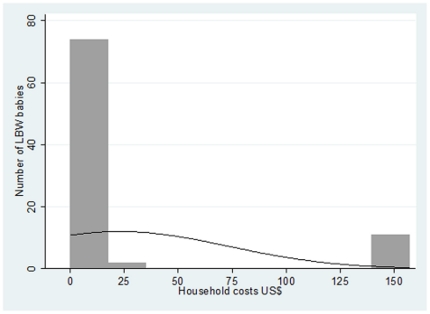
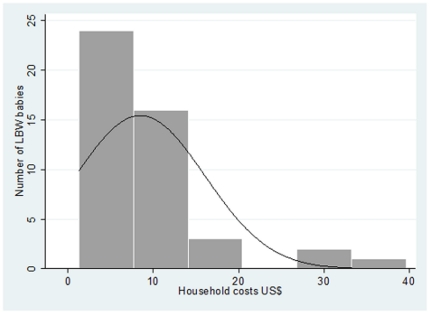
Costs incurred by the households were collected through exit surveys. Health system costs were gathered from data obtained onsite and from published information. DALYs due to death of LBW babies were based on local estimates of prevalence of LBW (12%), very low birth weight (VLBW) (1%) and of case fatality rates compared to non-LBW weight babies [for LBW (12%) and VLBW (80%)]. Costs associated with LBW excess morbidity were calculated on the incremental number of hospital admissions in LBW babies compared to non-LBW weight babies. Direct and indirect household costs for routine health care were 24.12 US$ (CI 95% 21.51; 26.26). An increase in birth weight of 100 grams would lead to a 53% decrease in these costs. Direct and indirect household costs for hospital admissions were 8.50 US$ (CI 95% 6.33; 10.72). Of the 3,322 live births that occurred in one year in the study area, health system costs associated to LBW (routine health care and excess morbidity) and DALYs were 169,957.61 US$ (CI 95% 144,900.00; 195,500.00) and 2,746.06, respectively.
This first cost evaluation of LBW in a low-income country shows that reducing the prevalence of LBW would translate into important cost savings to the health system and the household. These results are of relevance for similar settings and should serve to promote interventions aimed at improving maternal care.
低出生体重(LBW)在低收入国家很普遍。尽管评估减少这一负担的干预措施的经济价值对于指导卫生政策至关重要,但与 LBW 相关的成本数据却很少。本研究旨在评估莫桑比克南部与 LBW 相关的婴儿死亡给卫生系统和家庭带来的成本,以及由此导致的残疾调整生命年(DALYs)。
通过退出调查收集家庭的成本数据。卫生系统成本则通过现场获取的数据和已发表的信息收集。LBW 婴儿死亡导致的 DALYs 是基于当地对 LBW(12%)、极低出生体重(VLBW)(1%)和与非 LBW 体重婴儿相比的病死率的估计[对于 LBW(12%)和 VLBW(80%)]。通过 LBW 婴儿与非 LBW 体重婴儿相比的额外住院人数来计算 LBW 过度发病率相关的成本。常规保健的直接和间接家庭成本为 24.12 美元(95%CI 21.51;26.26)。体重增加 100 克将使这些成本降低 53%。住院的直接和间接家庭成本为 8.50 美元(95%CI 6.33;10.72)。在研究地区的一年中,3322 例活产中,与 LBW(常规保健和过度发病率)和 DALYs 相关的卫生系统成本为 169957.61 美元(95%CI 144900.00;195500.00)和 2746.06,分别。
这是对低收入国家 LBW 的首次成本评估,表明降低 LBW 的发生率将为卫生系统和家庭带来重要的成本节约。这些结果对于类似的情况具有相关性,应该有助于促进旨在改善产妇保健的干预措施。