EAWAG, Department of Aquatic Ecology, and ETH-Zurich, Institute of Integrative Biology, Duebendorf, Switzerland.
BMC Evol Biol. 2011 Dec 19;11:366. doi: 10.1186/1471-2148-11-366.
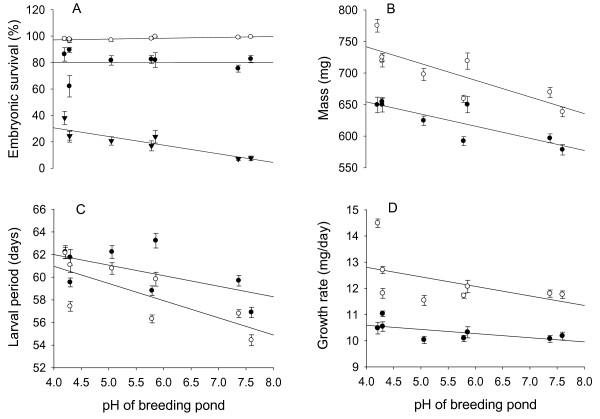
Environmental stress can result in strong ecological and evolutionary effects on natural populations, but to what extent it drives adaptive divergence of natural populations is little explored. We used common garden experiments to study adaptive divergence in embryonic and larval fitness traits (embryonic survival, larval growth, and age and size at metamorphosis) in eight moor frog, Rana arvalis, populations inhabiting an acidification gradient (breeding pond pH 4.0 to 7.5) in southwestern Sweden. Embryos were raised until hatching at three (pH 4.0, 4.3 and 7.5) and larvae until metamorphosis at two (pH 4.3 and 7.5) pH treatments. To get insight into the putative selective agents along this environmental gradient, we measured relevant abiotic and biotic environmental variables from each breeding pond, and used linear models to test for phenotype-environment correlations.
We found that acid origin populations had higher embryonic and larval acid tolerance (survival and larval period were less negatively affected by low pH), higher larval growth but slower larval development rates, and metamorphosed at a larger size. The phenotype-environment correlations revealed that divergence in embryonic acid tolerance and metamorphic size correlated most strongly with breeding pond pH, whereas divergence in larval period and larval growth correlated most strongly with latitude and predator density, respectively.
Our results suggest that R. arvalis has diverged in response to pH mediated selection along this acidification gradient. However, as latitude and pH were closely spatially correlated in this study, further studies are needed to disentangle the specific agents of natural selection along acidification gradients. Our study highlights the need to consider the multiple interacting selective forces that drive adaptive divergence of natural populations along environmental stress gradients.
环境压力会对自然种群产生强烈的生态和进化影响,但它在多大程度上驱动自然种群的适应性分化还很少被探索。我们使用了田间实验来研究栖息在瑞典西南部酸化梯度(繁殖池塘 pH 值 4.0 至 7.5)中的 8 个沼蛙种群的胚胎和幼体适应性分化(胚胎存活率、幼体生长和变态时的年龄和大小)。将胚胎在三个 pH 值(4.0、4.3 和 7.5)条件下培养至孵化,将幼虫在两个 pH 值(4.3 和 7.5)条件下培养至变态。为了深入了解沿这个环境梯度的潜在选择因子,我们从每个繁殖池塘测量了相关的非生物和生物环境变量,并使用线性模型来检验表型与环境的相关性。
我们发现,酸性起源的种群具有更高的胚胎和幼体耐酸能力(低 pH 对生存和幼体期的负面影响较小)、更高的幼体生长速度但较慢的幼体发育速度,以及更大的变态体型。表型与环境的相关性表明,胚胎耐酸能力和变态体型的分化与繁殖池塘 pH 值的相关性最强,而幼体期和幼体生长的分化与纬度和捕食者密度的相关性最强。
我们的研究结果表明,由于 pH 值介导的选择,R. arvalis 在这条酸化梯度上已经发生了分化。然而,由于在本研究中纬度和 pH 值在空间上密切相关,因此需要进一步的研究来厘清沿酸化梯度的自然选择的具体因子。我们的研究强调了需要考虑沿环境压力梯度驱动自然种群适应性分化的多种相互作用的选择压力。