Department of Radiation Oncology, Cancer Institute and Hospital, Chinese Academy of Medical Sciences, Peking Union Medical College, Beijing 100021, China.
Radiat Oncol. 2011 Dec 19;6:175. doi: 10.1186/1748-717X-6-175.
To explore the risk factors of distant brain failure (DBF) for patients with brain metastasis (BM) who were treated with stereotactic radiotherapy alone and to group the patients on the basis of their risk levels.
We retrospectively analyzed 132 newly diagnosed BM patients who were treated with stereotactic radiotherapy alone from May 2000 to April 2010. Kaplan-Meier and Cox proportional hazards regression analyses were performed for univariate and multivariate analyses.
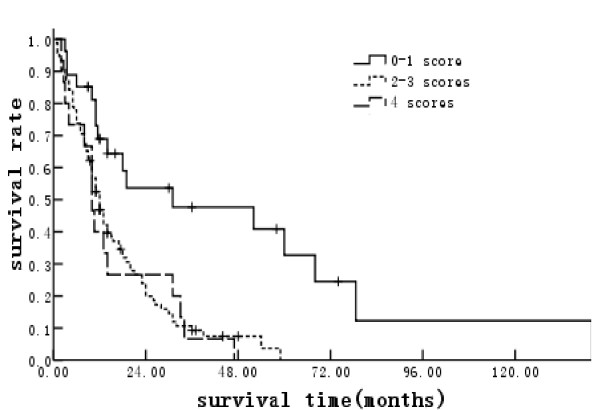
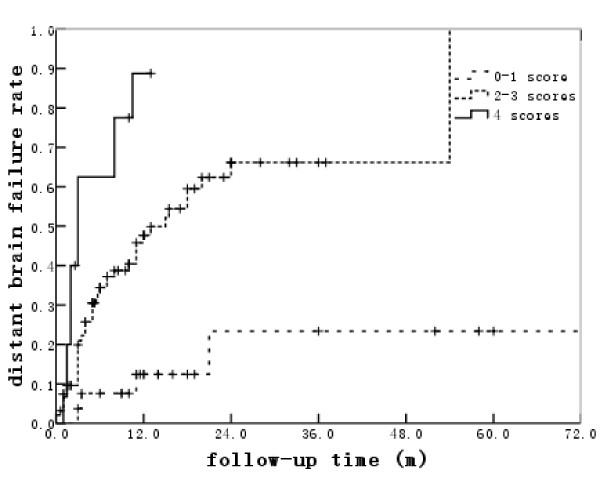
The 1-year incidence rate of DBF was 44.7%, and the median DBF time (MDBFT) was 18 months. In multivariate analysis, the risk factors of DBF were the number of BMs greater than 1 (p = 0.041), uncontrolled extracranial disease (p = 0.005), interval time (IT) of less than 60 months between the diagnosis of primary tumor and BM (p = 0.024), and total volume of BM was greater than 6 cc (p = 0.049). Each risk factor was assigned 1 score. The median survival times for the patients with scores of 0-1, 2-3, and 4 were 31, 12, and 10 months, respectively, and the corresponding MDBFTs were not reached, 13, and 3 months, respectively, (p < 0.001). The crude DBF incidence rates in patients with scores of 0-1, 2-3, and 4 were 14.8%, 50.0%, and 76.9%, respectively, (p < 0.001).
The patients with scores of 0-1 had a lower risk of DBF than the patients with higher scores did, and it may be reasonable to treat these patients with SRS alone and resort to whole-brain radiation therapy only for salvage. The patients with a score of 4 had the highest risk of developing DBF after stereotactic radiotherapy alone, these patients may be candidates for initial whole-brain radiation therapy or clinical trials. The patients with a score of 2-3 had a moderate risk of developing DBF, SRT alone combined with close clinical monitoring would be the optimal treatment regimen for such patients, and for those patients with difficulties in receiving close clinical mornitoring, SRT combined with WBRT will be more suitable.
探讨单纯立体定向放疗(SRT)治疗脑转移瘤(BM)患者发生远隔脑失败(DBF)的危险因素,并对患者进行风险分层。
我们回顾性分析了 2000 年 5 月至 2010 年 4 月期间 132 例单纯 SRT 治疗的初诊 BM 患者。采用 Kaplan-Meier 法和 Cox 比例风险回归分析进行单因素和多因素分析。
1 年 DBF 发生率为 44.7%,中位 DBF 时间(MDBFT)为 18 个月。多因素分析显示,BM 数目>1(p=0.041)、颅外疾病未控制(p=0.005)、原发灶诊断与 BM 间隔时间(IT)<60 个月(p=0.024)和 BM 总体积>6cc(p=0.049)是 DBF 的危险因素。每个危险因素赋值 1 分。0-1 分、2-3 分和 4 分患者的中位生存时间分别为 31、12 和 10 个月,相应的 MDBFT 分别为未达到、13 和 3 个月(p<0.001)。0-1 分、2-3 分和 4 分患者的粗 DBF 发生率分别为 14.8%、50.0%和 76.9%(p<0.001)。
0-1 分患者的 DBF 风险低于高分患者,单独 SRS 治疗可能更为合理,仅对这些患者进行挽救性全脑放疗。单独 SRT 后发生 DBF 的风险最高的是 4 分患者,这些患者可能是初始全脑放疗或临床试验的候选者。2-3 分患者发生 DBF 的风险处于中等水平,单独 SRT 联合密切临床监测可能是这类患者的最佳治疗方案,而对于难以接受密切临床监测的患者,SRT 联合 WBRT 可能更为合适。