Department of Neurology, Kaohsiung Chang Gung Memorial Hospital and Chang Gung University College of Medicine, Kaohsiung, Taiwan.
BMC Med Imaging. 2011 Dec 21;11:22. doi: 10.1186/1471-2342-11-22.
Incremental palmar stimulation of the median nerve sensory conduction at the wrist, the "inching test", provides an assessment with reference to segments proximal and distal to the entrapment. This study used high-resolution ultrasonography (US) to measure the median nerve's cross-section areas (CSAs) like the "inching test" and to correlate with the nerve conduction study (NCS) severity and duration of carpal tunnel syndrome (CTS).
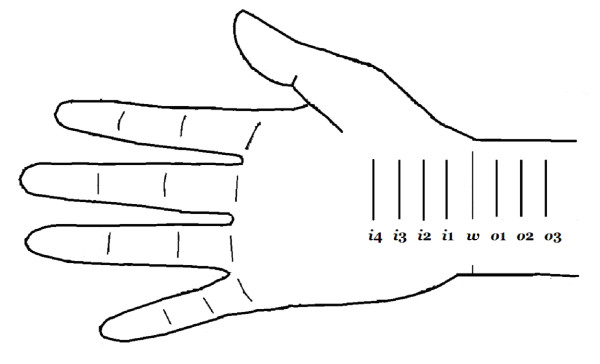
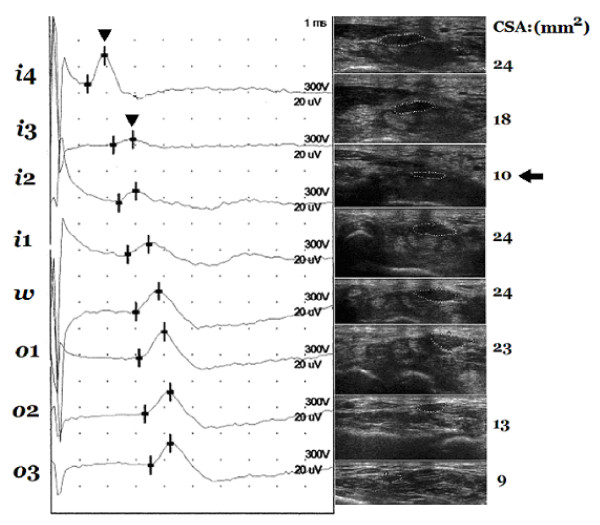
Two hundred and twelve (212) "CTS-hands" from 135 CTS patients and 50 asymptomatic hands ("A-hands") from 25 control individuals were enrolled. The median nerve CSAs were measured at the 8-point marked as i4, i3, i2, i1, w, o1, o2, and 03 in inching test. The NCS severities were classified into six groups based on motor and sensory responses (i.e., negative, minimal, mild, moderate, severe, and extreme). Results of US studies were compared in terms of NCS severity and duration of clinical CTS symptoms.
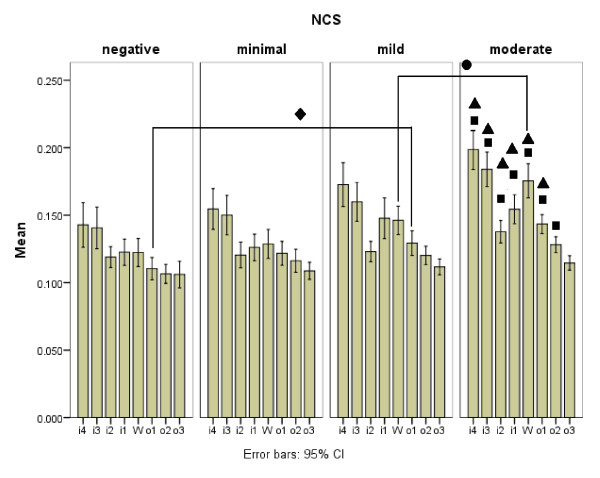
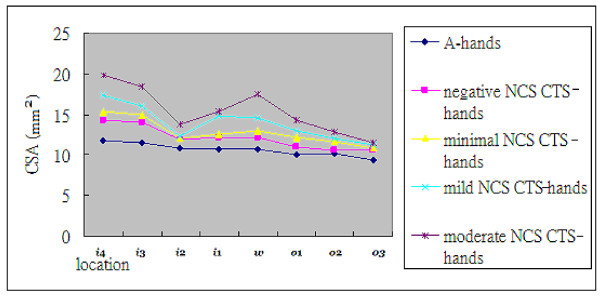
There was significantly larger CSA of the NCS negative group of "CTS-hands" than of "A-hands". The cut-off values of the CSAs of the NCS negative CTS group were 12.5 mm2, 11.5 mm2 and 10.1 mm2 at the inlet, wrist crease, and outlet, respectively. Of the 212 "CTS-hands", 32 were NCS negative while 40 had minimal, 43 mild, 85 moderate, 10 severe, and two extreme NCS severities. The CSAs of "CTS-hands" positively correlated with different NCS severities and with the duration of CTS symptoms. By duration of clinical symptoms, 12 of the 212 "CTS-hands" were in the 1 month group; 82 in >1 month and ≤ 12 months group, and 118 in >12 months group. In "inching test", segments i4-i3 and i3-i2 were the most common "positive-site". The corresponding CSAs measured at i4 and i3, but not at i2, were significantly larger than those measured at points that were not "positive-site".
Using the 8-point measurement of the median nerve CSA from inlet to outlet similar to the "inching test" has positive correlations with NCS severity and duration of CTS clinical symptoms, and can provide more information on anatomic changes. Combined NCS and US studies using the 8-point measurement may have a higher positive rate than NCS alone for diagnosing CTS.
在腕部对正中神经感觉传导进行渐进性手掌刺激,即“逐渐递增测试”,可以提供一种与卡压部位近端和远端相关的评估。本研究使用高分辨率超声(US)测量正中神经的横截面积(CSA),类似于“逐渐递增测试”,并将其与神经传导研究(NCS)严重程度和腕管综合征(CTS)的持续时间相关联。
共纳入 135 例 CTS 患者的 212 只“CTS 手”和 25 名对照个体的 50 只无症状手(“A 手”)。在逐渐递增测试中,在 i4、i3、i2、i1、w、o1、o2 和 03 8 个标记点测量正中神经 CSA。根据运动和感觉反应,将 NCS 严重程度分为 6 组(即阴性、轻微、轻度、中度、重度和极度)。比较 US 研究结果在 NCS 严重程度和 CTS 临床症状持续时间方面的差异。
“CTS 手”中 NCS 阴性组的 CSA 明显大于“A 手”。NCS 阴性 CTS 组 CSA 的截断值分别为 12.5mm2、11.5mm2 和 10.1mm2,位于入口处、腕部褶皱和出口处。在 212 只“CTS 手”中,32 只 NCS 阴性,40 只 NCS 轻微,43 只 NCS 轻度,85 只 NCS 中度,10 只 NCS 重度,2 只 NCS 极度。“CTS 手”的 CSA 与不同的 NCS 严重程度和 CTS 症状持续时间呈正相关。根据临床症状持续时间,212 只“CTS 手”中,12 只为 1 个月组;82 只为>1 个月且≤12 个月组,118 只为>12 个月组。在“逐渐递增测试”中,i4-i3 和 i3-i2 段是最常见的“阳性部位”。在 i4 和 i3 处测量到的 CSA 明显大于在 i2 处测量到的 CSA,而在 i2 处测量到的 CSA 明显大于不在“阳性部位”处测量到的 CSA。
使用类似于“逐渐递增测试”的从中部到出口的正中神经 CSA 的 8 点测量与 NCS 严重程度和 CTS 临床症状持续时间呈正相关,并能提供有关解剖结构变化的更多信息。与单独使用 NCS 相比,使用 8 点测量进行 NCS 和 US 联合研究可能具有更高的阳性率,用于诊断 CTS。