Institute of Biotechnology and Biochemical Engineering, Graz University of Technology, A-8010 Graz, Austria.
J Biol Chem. 2012 Feb 24;287(9):6655-67. doi: 10.1074/jbc.M111.289223. Epub 2011 Dec 22.
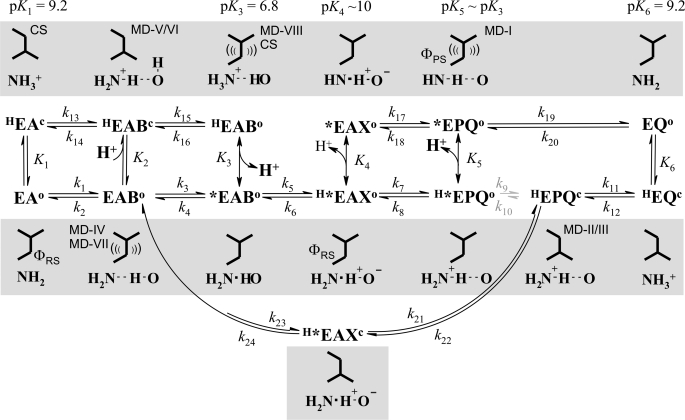
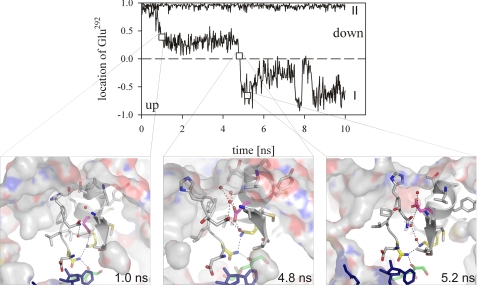
The active site of mannitol 2-dehydrogenase from Pseudomonas fluorescens (PfM2DH) is connected with bulk solvent through a narrow protein channel that shows structural resemblance to proton channels utilized by redox-driven proton pumps. A key element of the PfM2DH channel is the "mobile" Glu(292), which was seen crystallographically to adopt distinct positions up and down the channel. It was suggested that the "down → up" conformational change of Glu(292) could play a proton relay function in enzymatic catalysis, through direct proton shuttling by the Glu or because the channel is opened for water molecules forming a chain along which the protons flow. We report evidence from site-directed mutagenesis (Glu(292) → Ala) substantiated by data from molecular dynamics simulations that support a role for Glu(292) as a gate in a water chain (von Grotthuss-type) mechanism of proton translocation. Occupancy of the up and down position of Glu(292) is influenced by the bonding and charge state of the catalytic acid base Lys(295), suggesting that channel opening/closing motions of the Glu are synchronized to the reaction progress. Removal of gatekeeper control in the E292A mutant resulted in a selective, up to 120-fold slowing down of microscopic steps immediately preceding catalytic oxidation of mannitol, consistent with the notion that formation of the productive enzyme-NAD(+)-mannitol complex is promoted by a corresponding position change of Glu(292), which at physiological pH is associated with obligatory deprotonation of Lys(295) to solvent. These results underscore the important role of conformational dynamics in the proton transfer steps of alcohol dehydrogenase catalysis.
荧光假单胞菌甘露醇 2-脱氢酶(PfM2DH)的活性部位通过一条狭窄的蛋白质通道与体相溶剂相连,该通道的结构与氧化还原驱动质子泵所使用的质子通道相似。PfM2DH 通道的一个关键元件是“可移动”Glu(292),其在晶体结构中被观察到在通道中上下采取明显的位置。有人提出,Glu(292)的“向下→向上”构象变化可能在酶催化中发挥质子传递功能,通过 Glu 的直接质子转移,或者因为通道打开,水分子形成一条链,质子在其中流动。我们通过定点突变(Glu(292)→Ala)报告了证据,并通过分子动力学模拟的数据进行了证实,支持了 Glu(292)作为质子转移水链(von Grotthuss 型)机制中的门的作用。Glu(292)占据上下位置的情况受催化酸碱 Lys(295)的键合和电荷状态的影响,这表明通道的打开/关闭运动与反应进展同步。E292A 突变体中门控控制的缺失导致微观步骤选择性地减缓多达 120 倍,这些微观步骤立即发生在甘露醇的催化氧化之前,这与以下观点一致,即形成有生产力的酶-NAD(+)-甘露醇复合物是由 Glu(292)的相应位置变化促进的,在生理 pH 下,该位置变化与 Lys(295)的必需去质子化到溶剂相关联。这些结果强调了构象动力学在醇脱氢酶催化的质子转移步骤中的重要作用。