Laboratory of Transplantation Immunobiology, Department of Immunology, Institute of Biomedical Sciences IV, University of São Paulo, São Paulo, Brazil.
PLoS One. 2011;6(12):e29004. doi: 10.1371/journal.pone.0029004. Epub 2011 Dec 14.
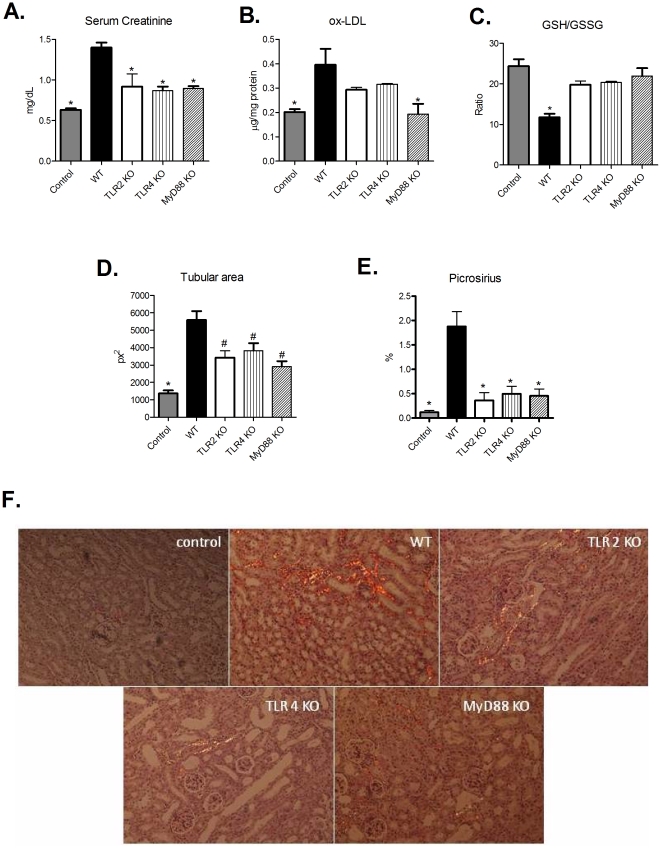
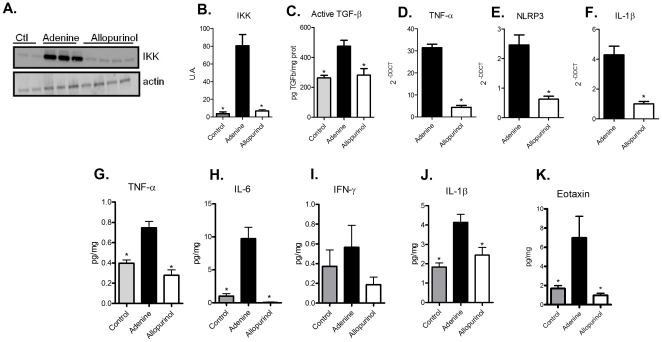
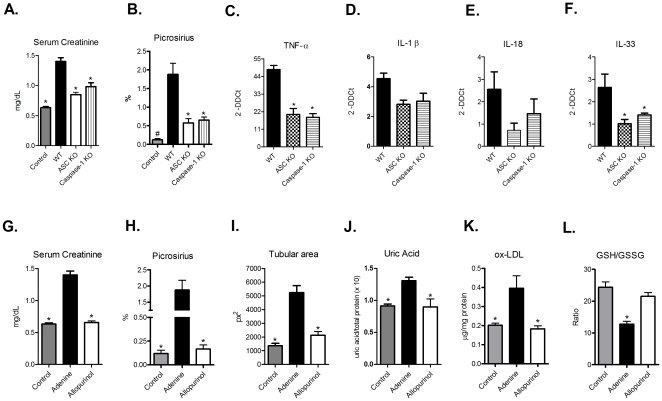
Tubule-interstitial nephritis (TIN) results in decreased renal function and interstitial inflammation, which ultimately leads to fibrosis. Excessive adenine intake can cause TIN because xanthine dehydrogenase (XDH) can convert this purine into an insoluble compound, which precipitates in the tubuli. Innate immune sensors, such as Toll-like receptors (TLR) and inflammasome complex, play a crucial role in the initiation of inflammation. The aim of this study was to evaluate the roles of TLR-2 and -4, Myd88 and inflammasome complex in an experimental model of TIN. Here, we show that wild-type (WT) mice fed adenine-enriched food exhibited significant renal dysfunction and enhanced cellular infiltration accompanied by collagen deposition. They also presented higher gene and protein expression of pro-inflammatory cytokines. In contrast, TLR-2, -4, MyD88, ASC and Caspase-1 KO mice showed renoprotection associated with expression of inflammatory molecules at levels comparable to controls. Furthermore, treatment of WT animals with allopurinol, an XDH inhibitor, led to reduced levels of uric acid, oxidative stress, collagen deposition and a downregulation of the NF-kB signaling pathway. We concluded that MyD88 signaling and inflammasome participate in the development of TIN. Furthermore, inhibition of XDH seems to be a promising way to therapeutically target the developing inflammatory process.
肾小管间质性肾炎(TIN)可导致肾功能下降和间质炎症,最终导致纤维化。过量腺嘌呤的摄入可导致 TIN,因为黄嘌呤脱氢酶(XDH)可将这种嘌呤转化为不溶性化合物,从而在肾小管中沉淀。先天免疫传感器,如 Toll 样受体(TLR)和炎性小体复合物,在炎症的启动中起着至关重要的作用。本研究旨在评估 TLR-2 和 -4、Myd88 和炎性小体复合物在 TIN 实验模型中的作用。在这里,我们表明,富含腺嘌呤的食物喂养的野生型(WT)小鼠表现出明显的肾功能障碍和增强的细胞浸润,伴有胶原沉积。它们还表现出更高的促炎细胞因子的基因和蛋白表达。相比之下,TLR-2、-4、MyD88、ASC 和 Caspase-1 KO 小鼠表现出肾保护作用,与炎症分子的表达水平与对照组相当。此外,用 XDH 抑制剂别嘌呤醇治疗 WT 动物可降低尿酸水平、氧化应激、胶原沉积和 NF-kB 信号通路的下调。我们得出结论,MyD88 信号和炎性小体参与了 TIN 的发展。此外,抑制 XDH 似乎是一种有前途的治疗方法,可以针对正在发展的炎症过程。