Weldon School of Biomedical Engineering, Purdue University, West Lafayette, Indiana, United States of America.
PLoS One. 2011;6(12):e29375. doi: 10.1371/journal.pone.0029375. Epub 2011 Dec 16.
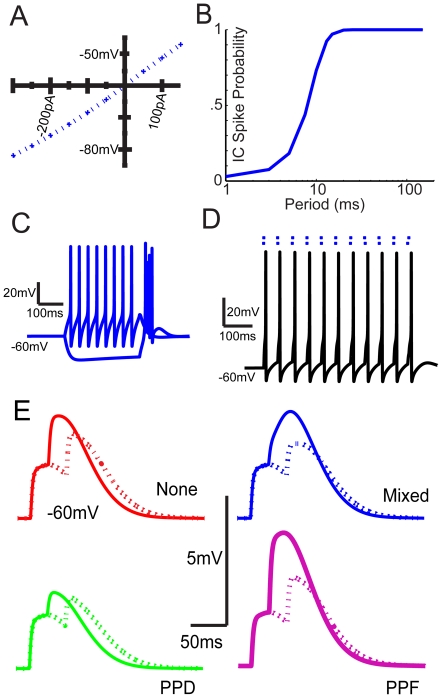
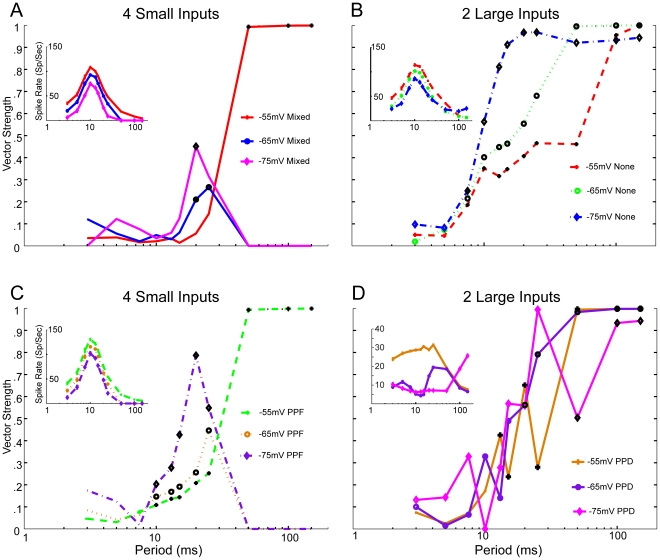
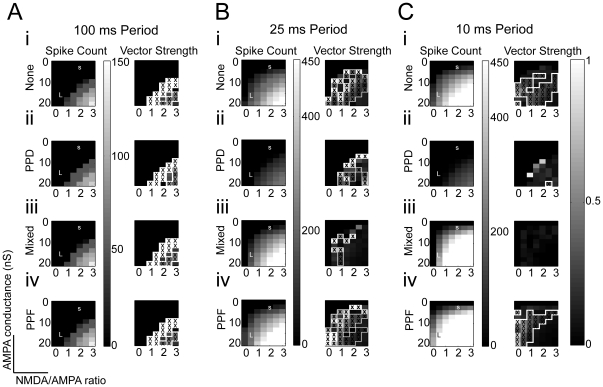
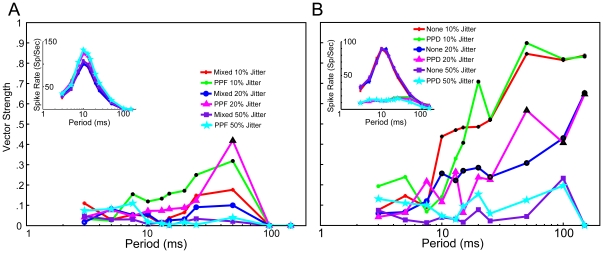
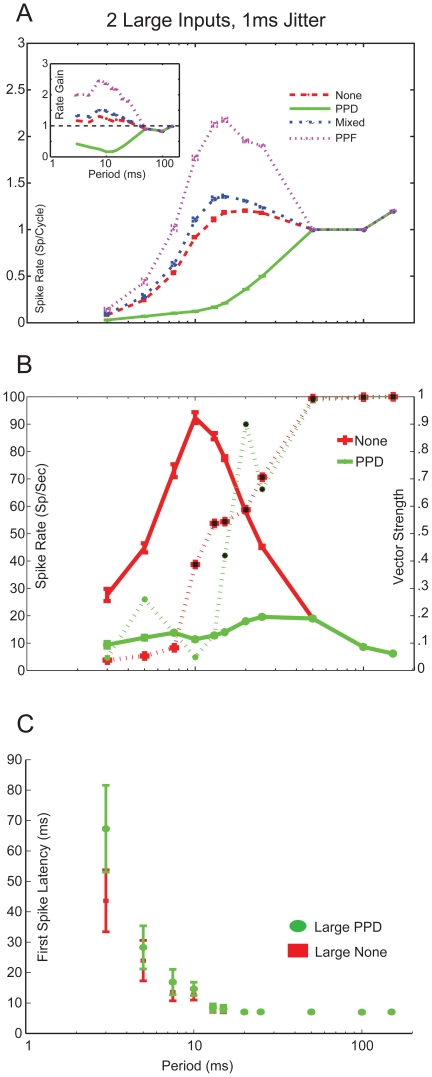
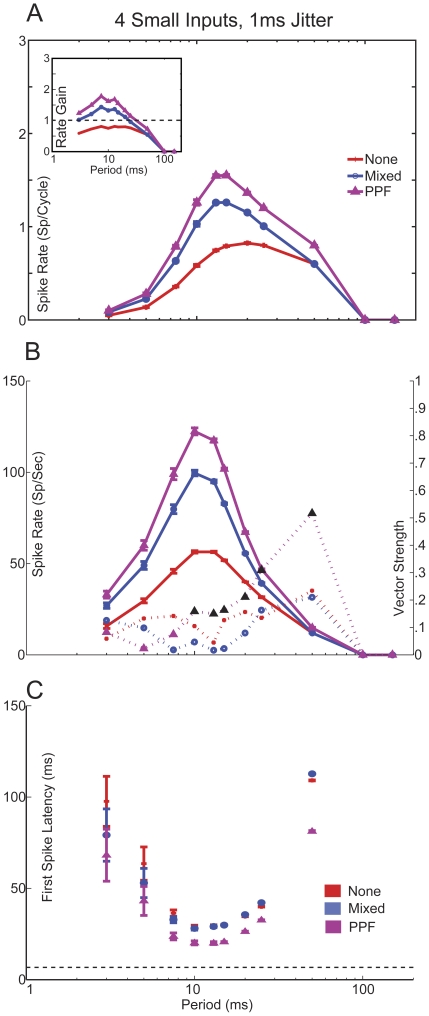
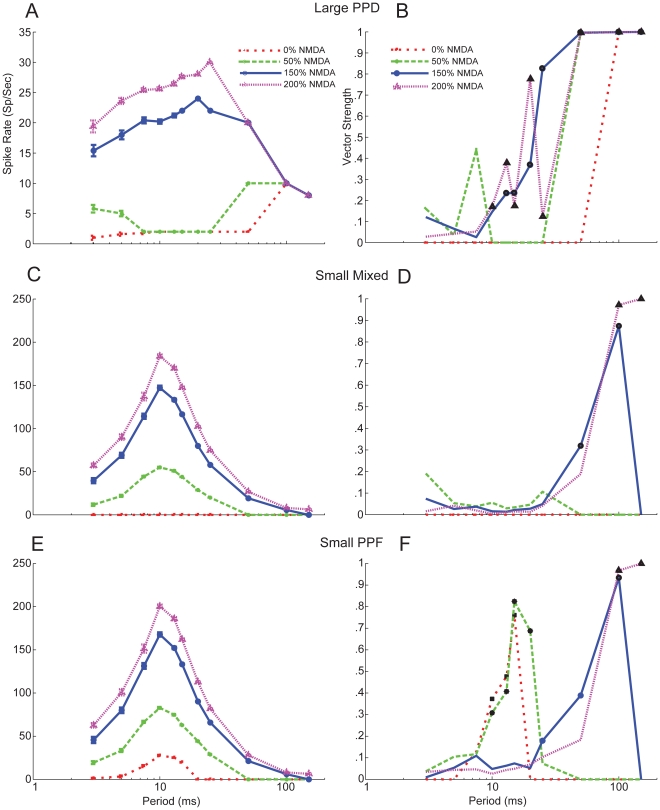
Acoustic stimuli are often represented in the early auditory pathway as patterns of neural activity synchronized to time-varying features. This phase-locking predominates until the level of the medial geniculate body (MGB), where previous studies have identified two main, largely segregated response types: Stimulus-synchronized responses faithfully preserve the temporal coding from its afferent inputs, and Non-synchronized responses, which are not phase locked to the inputs, represent changes in temporal modulation by a rate code. The cellular mechanisms underlying this transformation from phase-locked to rate code are not well understood. We use a computational model of a MGB thalamocortical neuron to test the hypothesis that these response classes arise from inferior colliculus (IC) excitatory afferents with divergent properties similar to those observed in brain slice studies. Large-conductance inputs exhibiting synaptic depression preserved input synchrony as short as 12.5 ms interclick intervals, while maintaining low firing rates and low-pass filtering responses. By contrast, small-conductance inputs with Mixed plasticity (depression of AMPA-receptor component and facilitation of NMDA-receptor component) desynchronized afferent inputs, generated a click-rate dependent increase in firing rate, and high-pass filtered the inputs. Synaptic inputs with facilitation often permitted band-pass synchrony along with band-pass rate tuning. These responses could be tuned by changes in membrane potential, strength of the NMDA component, and characteristics of synaptic plasticity. These results demonstrate how the same synchronized input spike trains from the inferior colliculus can be transformed into different representations of temporal modulation by divergent synaptic properties.
声刺激通常在早期听觉通路中表现为与时变特征同步的神经活动模式。这种锁相主要存在于内侧膝状体(MGB)水平,先前的研究已经确定了两种主要的、基本分离的反应类型:刺激同步反应忠实地保留了来自传入输入的时间编码,而非同步反应则不受输入的相位锁定,以率码表示时间调制的变化。从锁相到率码的这种转换的细胞机制尚不清楚。我们使用 MGB 丘脑皮层神经元的计算模型来检验以下假设:这些反应类型源自具有不同特性的下丘兴奋性传入,类似于在脑片研究中观察到的特性。表现出突触抑制的大电导输入保留了 12.5 毫秒的短间隔内的输入同步性,同时保持低发放率和低通滤波反应。相比之下,具有混合可塑性(AMPA 受体成分的抑制和 NMDA 受体成分的易化)的小电导输入去同步传入输入,产生了与发放率相关的增加,并对输入进行高通滤波。易化的突触输入通常允许与带通同步以及带通率调谐。这些反应可以通过膜电位变化、NMDA 成分的强度和突触可塑性的特征来调节。这些结果表明,来自下丘的相同同步输入尖峰序列如何通过不同的突触特性转化为时间调制的不同表示。