Kapela Adam, Nagaraja Sridevi, Parikh Jaimit, Tsoukias Nikolaos M
Department of Biomedical Engineering, Florida International University, Miami, FL, USA.
Crit Rev Biomed Eng. 2011;39(5):435-60. doi: 10.1615/critrevbiomedeng.v39.i5.50.
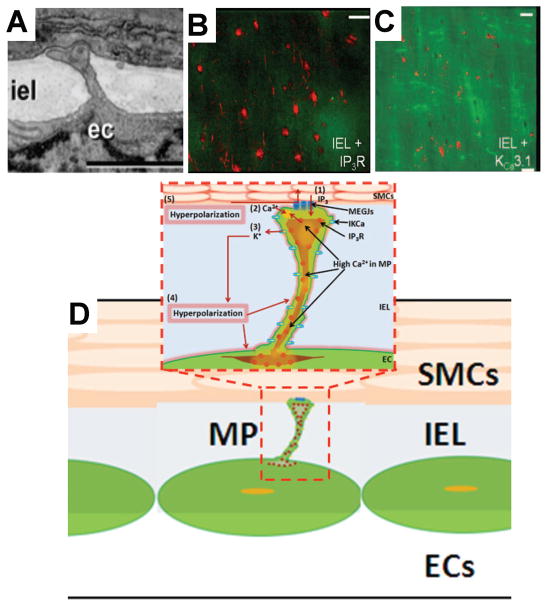
A network of intracellular signaling pathways and complex intercellular interactions regulate calcium mobilization in vascular cells, arteriolar tone, and blood flow. Different endothelium-derived vasoreactive factors have been identified and the importance of myoendothelial communication in vasoreactivity is now well appreciated. The ability of many vascular networks to conduct signals upstream also is established. This phenomenon is critical for both short-term changes in blood perfusion as well as long-term adaptations of a vascular network. In addition, in a phenomenon termed vasomotion, arterioles often exhibit spontaneous oscillations in diameter. This is thought to improve tissue oxygenation and enhance blood flow. Experimentation has begun to reveal important aspects of the regulatory machinery and the significance of these phenomena for the regulation of local perfusion and oxygenation. Mathematical modeling can assist in elucidating the complex signaling mechanisms that participate in these phenomena. This review highlights some of the important experimental studies and relevant mathematical models that provide the current understanding of these mechanisms in vasoreactivity.
细胞内信号通路网络和复杂的细胞间相互作用调节血管细胞中的钙动员、小动脉张力和血流。不同的内皮衍生血管反应性因子已被确定,并且肌内皮通讯在血管反应性中的重要性现在已得到充分认识。许多血管网络向上游传导信号的能力也已得到证实。这种现象对于血液灌注的短期变化以及血管网络的长期适应性都至关重要。此外,在一种称为血管运动的现象中,小动脉的直径经常会出现自发振荡。人们认为这有助于改善组织氧合并增强血流。实验已开始揭示调节机制的重要方面以及这些现象对局部灌注和氧合调节的意义。数学建模有助于阐明参与这些现象的复杂信号机制。本综述重点介绍了一些重要的实验研究和相关数学模型,这些研究和模型为目前对血管反应性中这些机制的理解提供了依据。