Department of Biochemistry, University of Cambridge, 80 Tennis Court Road, Cambridge CB2 1GA, UK. (
Trends Biochem Sci. 2012 Mar;37(3):92-8. doi: 10.1016/j.tibs.2011.11.003. Epub 2011 Dec 22.
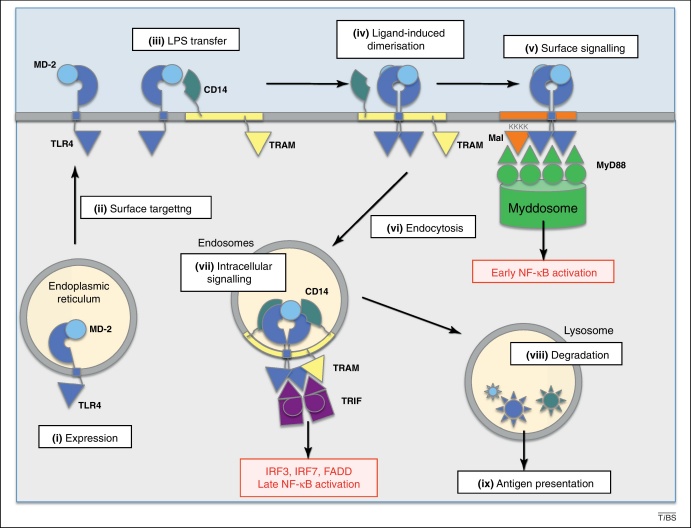
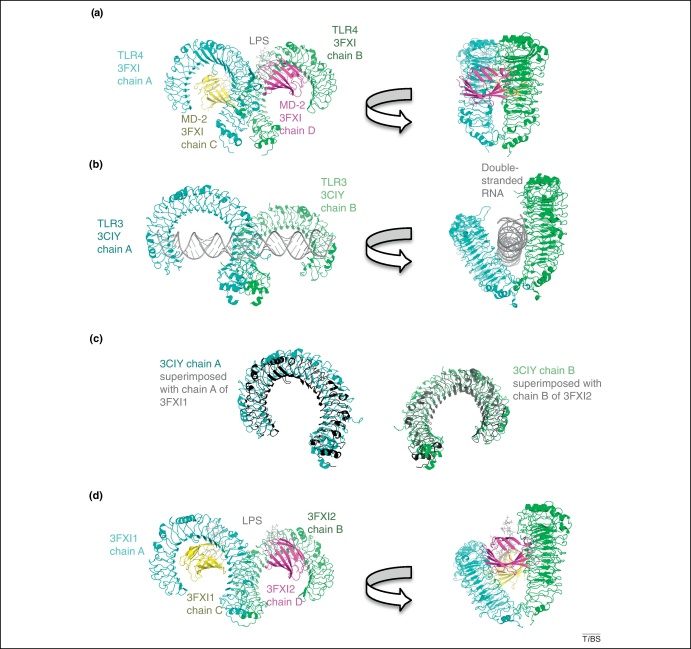
TLR4 is unique among pathogen-recognition receptors in that it initiates different pathways in different cellular locations. Binding of a bridging factor, Mal, allows recruitment of an adapter protein, MyD88, at the plasma membrane, which leads to the production of proinflammatory cytokines. Upon internalization, TLR4 uses a different bridging factor, TRAM, to activate a MyD88-independent pathway that results in type I interferon expression. Interestingly, both Mal and TRAM are localised initially at the plasma membrane. In this Opinion, I suggest a possible mechanism by which endosomal acidification triggers the differential adaptor usage of TLR4. I discuss the evidence of the pH sensitivity of TLR4 and propose a new dimerisation mode for TLR4 based on the crystal structure of the related receptor TLR3 bound to its ligand, double-stranded RNA.
TLR4 在病原体识别受体中是独一无二的,因为它在不同的细胞位置启动不同的途径。桥接因子 Mal 的结合允许衔接蛋白 MyD88 在质膜上募集,从而导致促炎细胞因子的产生。内吞后,TLR4 使用不同的桥接因子 TRAM 激活 MyD88 非依赖性途径,导致 I 型干扰素的表达。有趣的是,Mal 和 TRAM 最初都定位在质膜上。在本观点中,我提出了一种可能的机制,即内体酸化触发 TLR4 不同衔接子的使用。我讨论了 TLR4 的 pH 敏感性的证据,并基于与其配体双链 RNA 结合的相关受体 TLR3 的晶体结构,提出了 TLR4 的一种新二聚化模式。