Multidisciplinary Cardiovascular Research Centre and Leeds Institute of Genetics, Health and Therapeutics, University of Leeds, Leeds, UK.
Lancet. 2012 Feb 4;379(9814):453-60. doi: 10.1016/S0140-6736(11)61335-4. Epub 2011 Dec 22.
In patients with suspected coronary heart disease, single-photon emission computed tomography (SPECT) is the most widely used test for the assessment of myocardial ischaemia, but its diagnostic accuracy is reported to be variable and it exposes patients to ionising radiation. The aim of this study was to establish the diagnostic accuracy of a multiparametric cardiovascular magnetic resonance (CMR) protocol with x-ray coronary angiography as the reference standard, and to compare CMR with SPECT, in patients with suspected coronary heart disease.
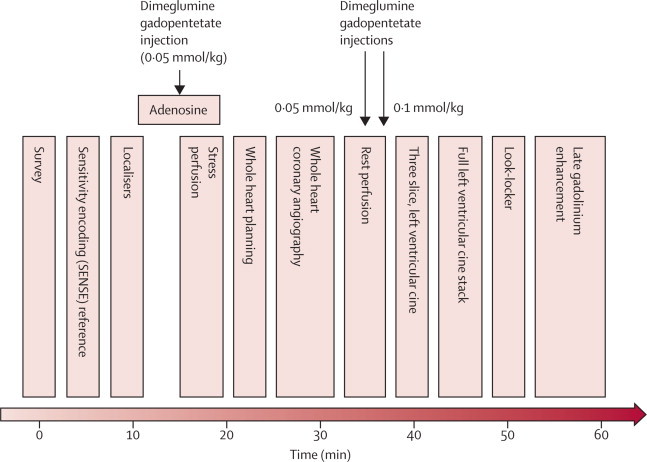
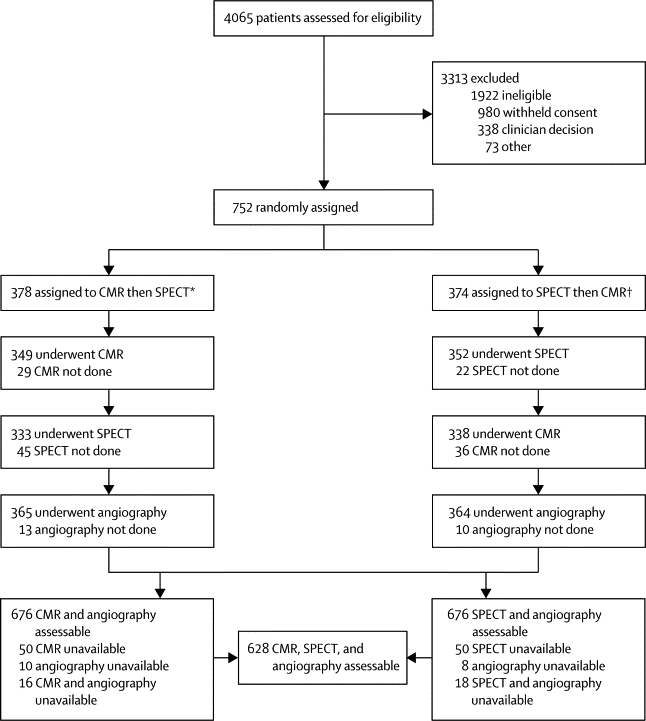
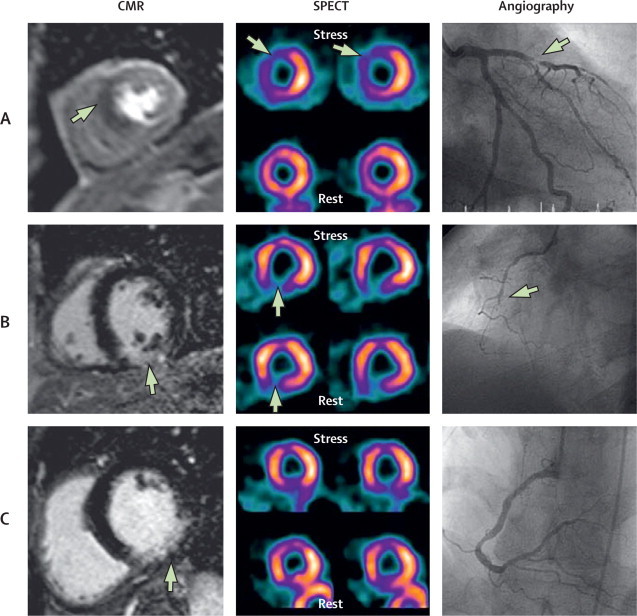
In this prospective trial patients with suspected angina pectoris and at least one cardiovascular risk factor were scheduled for CMR, SPECT, and invasive x-ray coronary angiography. CMR consisted of rest and adenosine stress perfusion, cine imaging, late gadolinium enhancement, and MR coronary angiography. Gated adenosine stress and rest SPECT used (99m)Tc tetrofosmin. The primary outcome was diagnostic accuracy of CMR. This trial is registered at controlled-trials.com, number ISRCTN77246133.
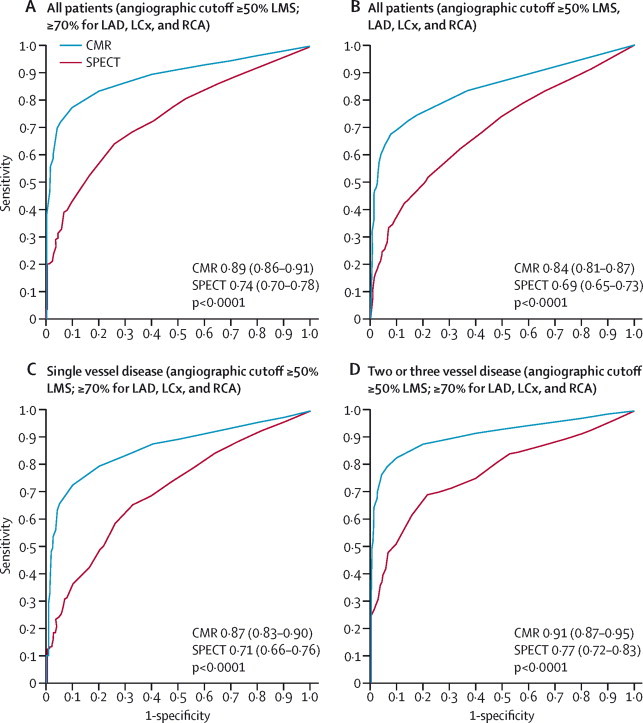
In the 752 recruited patients, 39% had significant CHD as identified by x-ray angiography. For multiparametric CMR the sensitivity was 86·5% (95% CI 81·8-90·1), specificity 83·4% (79·5-86·7), positive predictive value 77·2%, (72·1-81·6) and negative predictive value 90·5% (87·1-93·0). The sensitivity of SPECT was 66·5% (95% CI 60·4-72·1), specificity 82·6% (78·5-86·1), positive predictive value 71·4% (65·3-76·9), and negative predictive value 79·1% (74·8-82·8). The sensitivity and negative predictive value of CMR and SPECT differed significantly (p<0·0001 for both) but specificity and positive predictive value did not (p=0·916 and p=0·061, respectively).
CE-MARC is the largest, prospective, real world evaluation of CMR and has established CMR's high diagnostic accuracy in coronary heart disease and CMR's superiority over SPECT. It should be adopted more widely than at present for the investigation of coronary heart disease.
British Heart Foundation.
在疑似冠心病患者中,单光子发射计算机断层扫描(SPECT)是评估心肌缺血最广泛使用的检查,但据报道其诊断准确性存在差异,并且会使患者暴露在电离辐射下。本研究的目的是建立以 X 射线冠状动脉造影为参考标准的多参数心血管磁共振(CMR)方案的诊断准确性,并比较 CMR 与 SPECT 在疑似冠心病患者中的应用。
在这项前瞻性试验中,患有疑似心绞痛和至少一种心血管危险因素的患者被安排进行 CMR、SPECT 和有创 X 射线冠状动脉造影检查。CMR 包括静息和腺苷负荷灌注、电影成像、晚期钆增强和 MR 冠状动脉造影。门控腺苷负荷和静息 SPECT 使用(99m)Tc 四氮茂。主要结局是 CMR 的诊断准确性。本试验在 controlled-trials.com 注册,编号为 ISRCTN77246133。
在招募的 752 名患者中,39%的患者经 X 射线血管造影确定存在明显的冠心病。对于多参数 CMR,其敏感性为 86.5%(95%CI81.8-90.1),特异性为 83.4%(79.5-86.7),阳性预测值为 77.2%(72.1-81.6),阴性预测值为 90.5%(87.1-93.0)。SPECT 的敏感性为 66.5%(95%CI60.4-72.1),特异性为 82.6%(78.5-86.1),阳性预测值为 71.4%(65.3-76.9),阴性预测值为 79.1%(74.8-82.8)。CMR 和 SPECT 的敏感性和阴性预测值差异有统计学意义(均<0.0001),但特异性和阳性预测值差异无统计学意义(p=0.916 和 p=0.061)。
CE-MARC 是迄今为止最大的前瞻性真实世界 CMR 评估,已确定 CMR 在冠心病中的高诊断准确性,以及 CMR 优于 SPECT。它应该比目前更广泛地用于冠心病的检查。
英国心脏基金会。