Department of Neurobiology, Northwestern University, Evanston, Illinois 60208, USA.
Nature. 2011 Dec 25;481(7382):502-5. doi: 10.1038/nature10732.
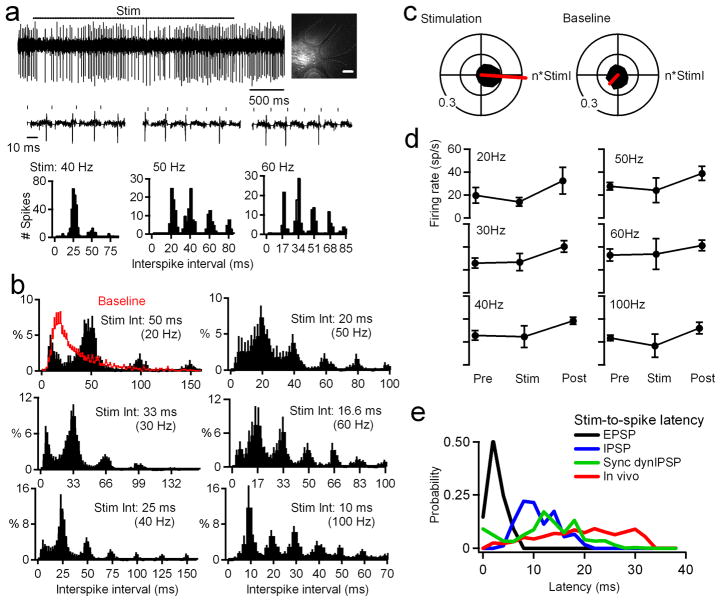
An unusual feature of the cerebellar cortex is that its output neurons, Purkinje cells, release GABA (γ-aminobutyric acid). Their high intrinsic firing rates (50 Hz) and extensive convergence predict that their target neurons in the cerebellar nuclei would be largely inhibited unless Purkinje cells pause their spiking, yet Purkinje and nuclear neuron firing rates do not always vary inversely. One indication of how these synapses transmit information is that populations of Purkinje neurons synchronize their spikes during cerebellar behaviours. If nuclear neurons respond to Purkinje synchrony, they may encode signals from subsets of inhibitory inputs. Here we show in weanling and adult mice that nuclear neurons transmit the timing of synchronous Purkinje afferent spikes, owing to modest Purkinje-to-nuclear convergence ratios (∼40:1), fast inhibitory postsynaptic current kinetics (τ(decay) = 2.5 ms) and high intrinsic firing rates (∼90 Hz). In vitro, dynamically clamped asynchronous inhibitory postsynaptic potentials mimicking Purkinje afferents suppress nuclear cell spiking, whereas synchronous inhibitory postsynaptic potentials entrain nuclear cell spiking. With partial synchrony, nuclear neurons time-lock their spikes to the synchronous subpopulation of inputs, even when only 2 out of 40 afferents synchronize. In vivo, nuclear neurons reliably phase-lock to regular trains of molecular layer stimulation. Thus, cerebellar nuclear neurons can preferentially relay the spike timing of synchronized Purkinje cells to downstream premotor areas.
小脑皮层的一个不寻常特征是其输出神经元浦肯野细胞释放 GABA(γ-氨基丁酸)。它们的固有放电率高(50Hz)且广泛汇聚,表明其小脑核中的目标神经元将被广泛抑制,除非浦肯野细胞暂停其放电,但浦肯野细胞和核神经元的放电率并不总是成反比变化。这些突触传递信息的一个迹象是浦肯野神经元群体在小脑行为期间同步其尖峰。如果核神经元对浦肯野同步做出反应,它们可能会对抑制性输入的子集进行编码。在这里,我们在幼鼠和成年小鼠中表明,核神经元传递同步浦肯野传入尖峰的时间,这归因于适度的浦肯野到核汇聚比(∼40:1)、快速抑制性突触后电流动力学(τ(decay)= 2.5ms)和高固有放电率(∼90Hz)。在体外,模拟浦肯野传入的动态钳制异步抑制性突触后电位抑制核细胞放电,而同步抑制性突触后电位使核细胞放电同步。在部分同步的情况下,核神经元会将其尖峰与输入的同步亚群时间锁定,即使只有 40 个传入神经元中的 2 个同步。在体内,核神经元可靠地与分子层刺激的规则列车相位锁定。因此,小脑核神经元可以优先将同步浦肯野细胞的尖峰时间传递到下游的运动前区。