Pharmaceutical Outcomes Research and Policy Program, University of Washington, Seattle, WA, USA.
BMC Med Res Methodol. 2011 Dec 28;11:175. doi: 10.1186/1471-2288-11-175.
Many previous studies estimating the relationship between body mass index (BMI) and mortality impose assumptions regarding the functional form for BMI and result in conflicting findings. This study investigated a flexible data driven modelling approach to determine the nonlinear and asymmetric functional form for BMI used to examine the relationship between mortality and obesity. This approach was then compared against other commonly used regression models.
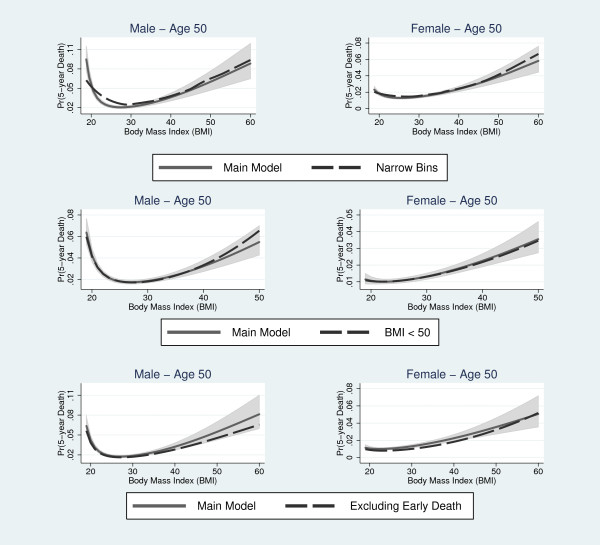
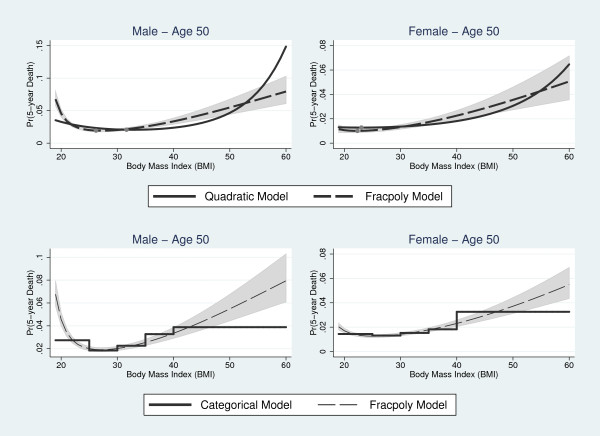
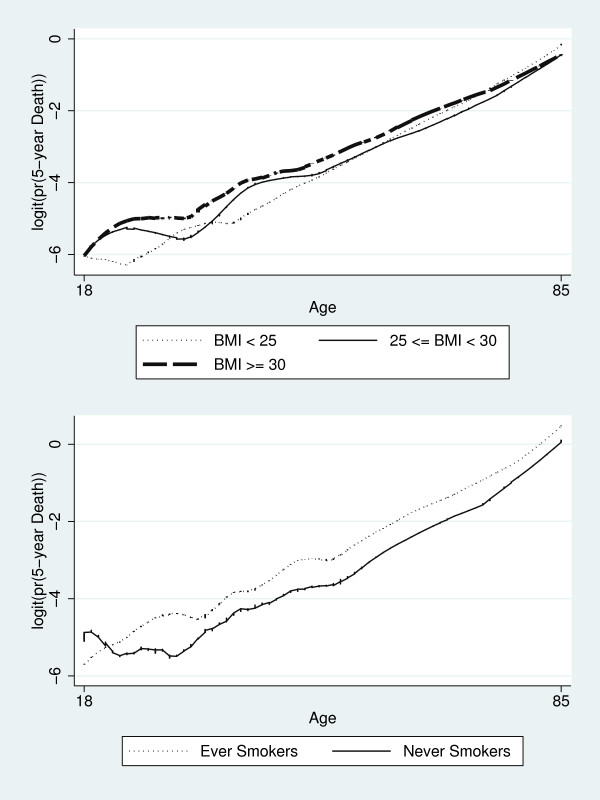
This study used data from the National Health Interview Survey, between 1997 and 2000. Respondents were linked to the National Death Index with mortality follow-up through 2005. We estimated 5-year all-cause mortality for adults over age 18 using the logistic regression model adjusting for BMI, age and smoking status. All analyses were stratified by sex. The multivariable fractional polynomials (MFP) procedure was employed to determine the best fitting functional form for BMI and evaluated against the model that includes linear and quadratic terms for BMI and the model that groups BMI into standard weight status categories using a deviance difference test. Estimated BMI-mortality curves across models were then compared graphically.
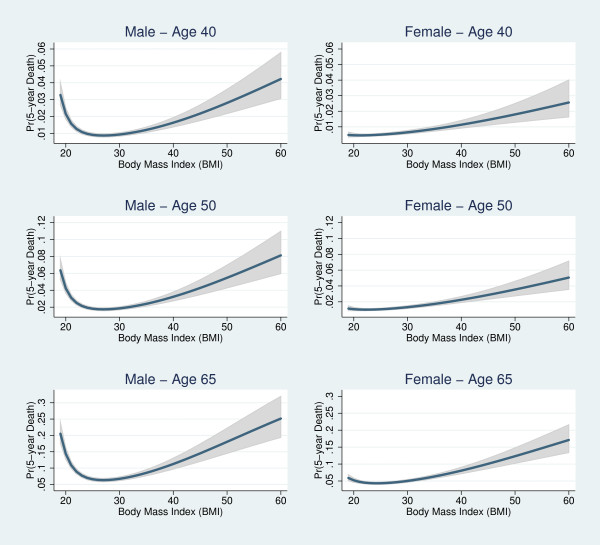
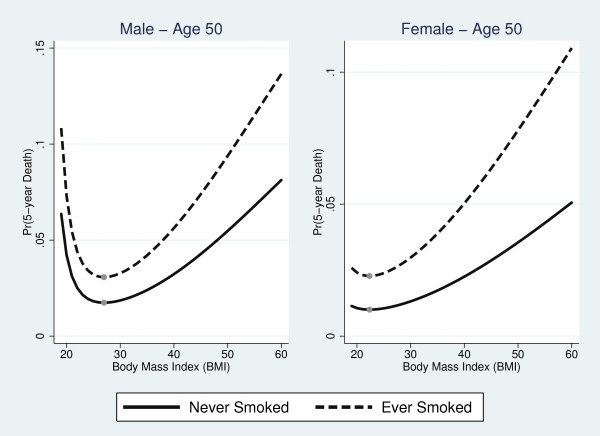
The best fitting adjustment model contained the powers -1 and -2 for BMI. The relationship between 5-year mortality and BMI when estimated using the MFP approach exhibited a J-shaped pattern for women and a U-shaped pattern for men. A deviance difference test showed a statistically significant improvement in model fit compared to other BMI functions. We found important differences between the MFP model and other commonly used models with regard to the shape and nadir of the BMI-mortality curve and mortality estimates.
The MFP approach provides a robust alternative to categorization or conventional linear-quadratic models for BMI, which limit the number of curve shapes. The approach is potentially useful in estimating the relationship between the full spectrum of BMI values and other health outcomes, or costs.
许多先前研究估计体重指数(BMI)与死亡率之间的关系,对 BMI 的函数形式做出假设,导致研究结果相互矛盾。本研究采用灵活的数据驱动建模方法,确定 BMI 用于检查肥胖与死亡率之间关系的非线性和非对称函数形式。然后,将这种方法与其他常用回归模型进行比较。
本研究使用了 1997 年至 2000 年期间国家健康访谈调查的数据。通过国家死亡指数,将受访者与死亡率随访联系起来,直到 2005 年。我们使用逻辑回归模型,根据 BMI、年龄和吸烟状况,估计 18 岁以上成年人 5 年全因死亡率。所有分析均按性别分层。多元分数多项式(MFP)程序用于确定 BMI 的最佳拟合函数形式,并通过与包含 BMI 线性和二次项的模型以及使用偏差差异检验将 BMI 分组为标准体重状况类别的模型进行评估。然后比较了不同模型的估计 BMI-死亡率曲线。
最佳拟合调整模型包含 BMI 的幂-1 和幂-2。使用 MFP 方法估计的 5 年死亡率与 BMI 之间的关系,女性呈 J 形,男性呈 U 形。偏差差异检验表明,与其他 BMI 函数相比,模型拟合有显著改善。我们发现 MFP 模型与其他常用模型在 BMI-死亡率曲线的形状和最低点以及死亡率估计方面存在重要差异。
MFP 方法为 BMI 的分类或传统线性-二次模型提供了一个强大的替代方法,限制了曲线形状的数量。该方法在估计 BMI 值与其他健康结果或成本之间的关系方面具有潜在的用途。