Center for Vectorborne Diseases, School of Veterinary Medicine, University of California Davis, Davis, California, United States of America.
PLoS Negl Trop Dis. 2011 Dec;5(12):e1452. doi: 10.1371/journal.pntd.0001452. Epub 2011 Dec 20.
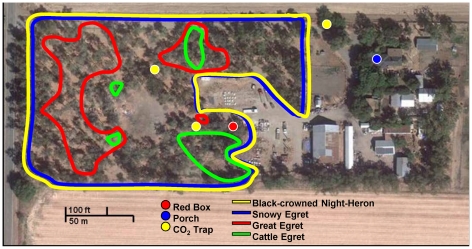
Host selection by vector mosquitoes is a critical component of virus proliferation, particularly for viruses such as West Nile (WNV) that are transmitted enzootically to a variety of avian hosts, and tangentially to dead-end hosts such as humans. Culex tarsalis is a principal vector of WNV in rural areas of western North America. Based on previous work, Cx. tarsalis utilizes a variety of avian and mammalian hosts and tends to feed more frequently on mammals in the late summer than during the rest of the year. To further explore this and other temporal changes in host selection, bloodfed females were collected at a rural farmstead and heron nesting site in Northern California from May 2008 through May 2009, and bloodmeal hosts identified using either a microsphere-based array or by sequencing of the mitochondrial cytochrome c oxidase I (COI) gene. Host composition during summer was dominated by four species of nesting Ardeidae. In addition, the site was populated with various passerine species as well as domestic farm animals and humans. When present, Cx. tarsalis fed predominantly (>80%) upon the ardeids, with Black-crowned Night-Herons, a highly competent WNV host, the most prevalent summer host. As the ardeids fledged and left the area and mosquito abundance increased in late summer, Cx. tarsalis feeding shifted to include more mammals, primarily cattle, and a high diversity of avian species. In the winter, Yellow-billed Magpies and House Sparrows were the predominant hosts, and Yellow-billed Magpies and American Robins were fed upon more frequently than expected given their relative abundance. These data demonstrated that host selection was likely based both on host availability and differences in utilization, that the shift of bloodfeeding to include more mammalian hosts was likely the result of both host availability and increased mosquito abundance, and that WNV-competent hosts were fed upon by Cx. tarsalis throughout the year.
媒介蚊虫对宿主的选择是病毒增殖的一个关键组成部分,特别是对于西尼罗河病毒(WNV)等通过动物媒介在各种禽类宿主中传播的病毒,以及偶尔传播给人类等终端宿主。库蚊是西尼罗河病毒在北美西部农村地区的主要传播媒介。基于之前的研究,库蚊利用多种禽类和哺乳动物宿主,并且在夏末比一年中的其他时间更频繁地以哺乳动物为食。为了进一步探索这种以及其他时间上对宿主选择的变化,从 2008 年 5 月到 2009 年 5 月,在加利福尼亚北部的一个农村农场和苍鹭筑巢点收集了吸食血液的雌性蚊虫,并使用基于微球的阵列或线粒体细胞色素 c 氧化酶 I(COI)基因测序来鉴定血餐宿主。夏季的宿主组成主要由四种筑巢的鹳形目鸟类组成。此外,该地点还居住着各种雀形目鸟类以及家畜和人类。当库蚊存在时,主要(>80%)以鹳形目鸟类为食,黑冠夜鹭是一种高度适应的 WNV 宿主,是最常见的夏季宿主。随着鹳形目鸟类离巢离开该地区以及夏末蚊子数量增加,库蚊的取食转而包括更多的哺乳动物,主要是牛,以及更多种类的鸟类。在冬季,黄嘴喜鹊和家麻雀是主要的宿主,并且黄嘴喜鹊和美洲知更鸟比它们的相对丰度更频繁地被取食。这些数据表明,宿主选择可能既基于宿主的可利用性,又基于利用的差异,将吸血转向包括更多的哺乳动物宿主可能是宿主的可利用性和蚊子数量增加的共同结果,并且具有适应WNV 的宿主全年都被库蚊取食。